
A Final Hand Played with Grace, Where Life’s Hard Lessons Are Carried in Every Note
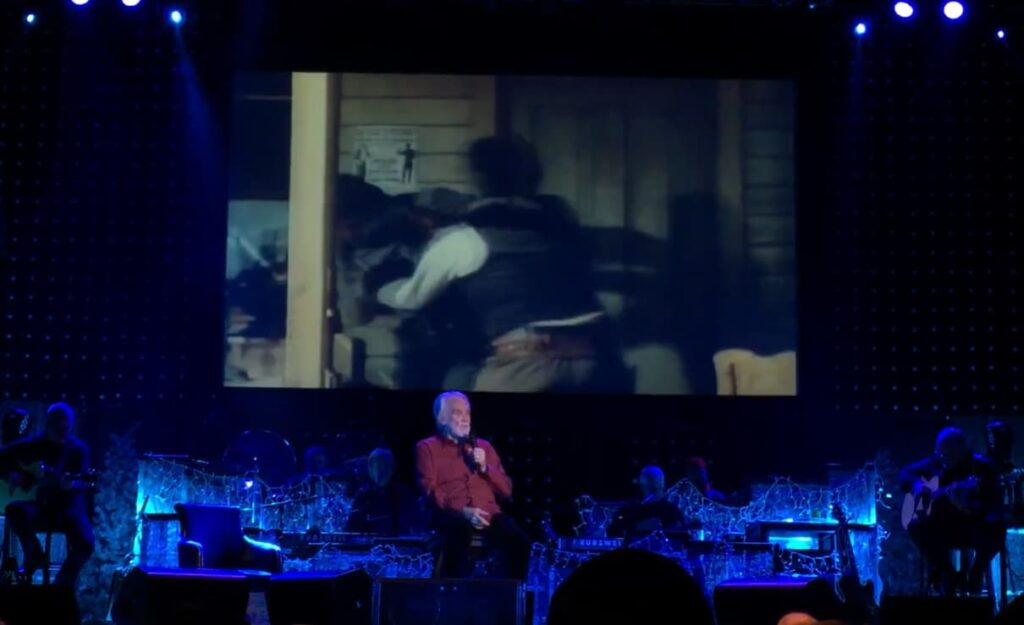
When Kenny Rogers stood under the lights in Nashville in 2017 for his farewell concert, “All In For The Gambler,” there was a quiet understanding in the room that this was more than a performance. It was a closing chapter. At the center of that evening stood “The Gambler,” the song that had come to define not only his career, but an entire philosophy of living—simple on the surface, yet layered with hard-earned truth.
Originally released in 1978 as the title track of the album “The Gambler,” the song quickly rose to No. 1 on the Billboard Hot Country Singles chart. It also crossed over to the Billboard Hot 100, peaking at No. 16, and reached No. 18 on the Adult Contemporary chart. Written by Don Schlitz, who was only in his early twenties at the time, the song earned widespread recognition, winning the Grammy Award for Best Country Song in 1979. But numbers and accolades only tell part of the story. What made “The Gambler” endure was not its chart success—it was its quiet wisdom.
By the time of that 2017 farewell concert, Kenny Rogers had been carrying this song for nearly four decades. And yet, it never felt worn. If anything, it had deepened. The story of a late-night encounter on a train, where a seasoned gambler offers life advice in exchange for a drink of whiskey, had taken on new meaning. What once sounded like clever storytelling now felt like reflection—almost autobiographical in its tone.
There is something unmistakably different in the way Kenny Rogers delivers the song in this final performance. The voice, weathered by time, no longer reaches for the same smooth clarity of earlier years. But in its place, there is something far more compelling: authenticity. Each line feels lived in, as though the distance between the singer and the story has quietly disappeared.
The meaning of “The Gambler” has always rested in its now-famous lines—“You’ve got to know when to hold ’em, know when to fold ’em…” Yet in 2017, those words carry a different weight. They no longer sound like advice being given. They sound like truths that have already been tested, perhaps even paid for. The song becomes less about the gambler in the story and more about the man singing it.
The concert itself, held in Nashville—a city so closely tied to Rogers’ legacy—was filled with collaborations and tributes. Artists from across generations gathered to honor a career that had bridged country, pop, and storytelling in a way few others managed. But when “The Gambler” begins, everything else seems to fall away. The stage quiets. The audience listens, not out of excitement, but out of recognition.
There is a subtle stillness in that moment. No grand reinvention, no attempt to modernize or reinterpret. The arrangement remains faithful, almost restrained. And that restraint allows the song’s essence to come forward more clearly than ever before.
The story behind the song’s creation adds another layer to its significance. Don Schlitz reportedly wrote “The Gambler” in a single burst of inspiration, drawing from fragments of imagery and experience. At the time, it was just another song—one of many. But in the hands of Kenny Rogers, it became something larger. It became a narrative that listeners could carry with them, applying its lessons in ways that felt personal and immediate.
Over the years, “The Gambler” evolved beyond music. It inspired a series of television films starring Rogers himself, further embedding the character into popular culture. But even without those adaptations, the song alone was enough. Its power lay in its simplicity, in its ability to say something meaningful without ever raising its voice.
In that final performance, there is a sense of completion—not in a dramatic or definitive way, but in something quieter. As the song reaches its closing lines, there is no attempt to hold onto the moment longer than necessary. It simply ends, as it always has, with the gambler slipping away into the night.
And perhaps that is the most fitting conclusion. Because “The Gambler” was never about permanence. It was about understanding when to let go, when to move on, when to accept that every story has its natural end.
As the applause rises in that Nashville hall, it is not just for the song, but for everything it has come to represent. A career, a voice, a way of seeing the world that values patience, humility, and quiet strength.
And as Kenny Rogers takes that final bow, there is a lingering feeling that the lessons of “The Gambler” remain—unchanged, unbroken, and still waiting to be heard, long after the last note has faded.