
A Quiet Man’s Breaking Point, Where Strength Is Measured Not in Fists but in Restraint
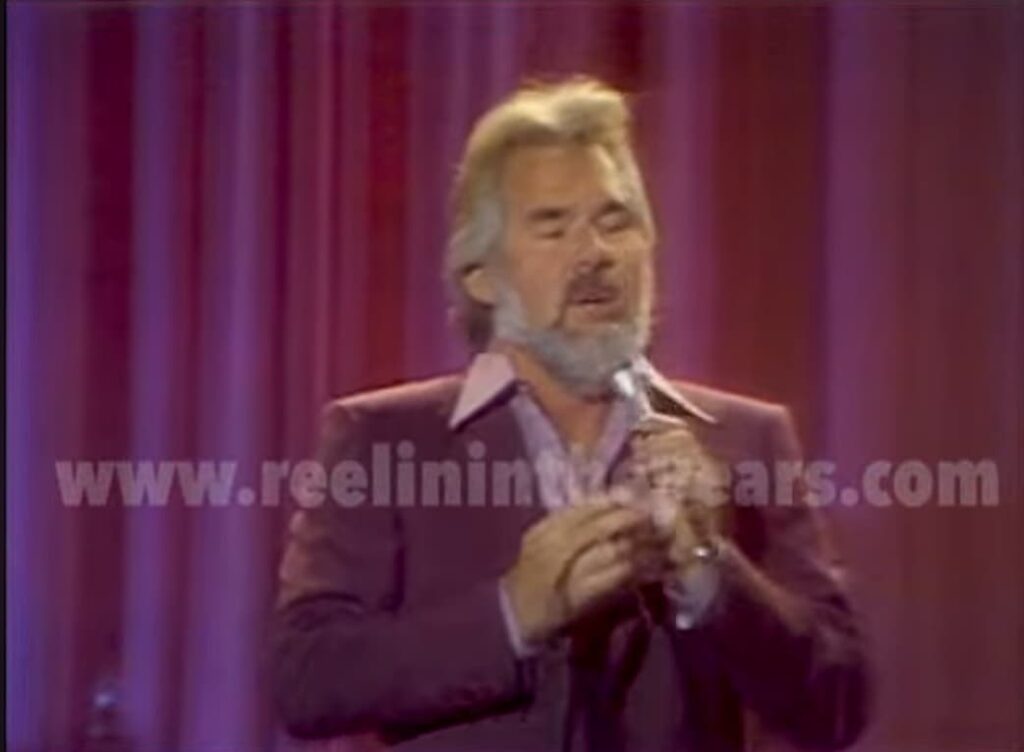
When Kenny Rogers brought “Coward of the County” to the stage in 1980—captured in the now-archived Reelin’ In The Years performance—he was standing at the height of a remarkable commercial and artistic peak. The song itself had been released in late 1979 as part of the album “Kenny,” and it quickly became one of the defining hits of his career, reaching No. 1 on the Billboard Hot Country Singles chart and climbing to No. 3 on the Billboard Hot 100 in early 1980. At a time when country music was steadily crossing into the mainstream, this song did not rely on novelty or spectacle—it relied on story, conviction, and a voice that knew how to carry both.
Written by Roger Bowling and Billy Edd Wheeler, “Coward of the County” is, on the surface, a simple narrative. But like many of the songs that defined Kenny Rogers, its power lies in what it chooses not to say outright. It tells the story of Tommy, a young man burdened by the reputation of his imprisoned father, who had once urged him to “walk away from trouble if you can.” In a world that equates restraint with weakness, Tommy is labeled a coward—not because he lacks strength, but because he chooses not to use it.
By the time of this 1980 live performance, audiences already knew the story well. Yet what makes this particular rendition compelling is not the familiarity—it is the way Kenny Rogers allows the narrative to breathe differently on stage. There is a measured calm in his delivery, a patience that suggests he understands the weight of each line. He does not rush toward the song’s turning point; instead, he lingers in its quiet moments, letting the listener sit with Tommy’s internal conflict.
The arrangement remains faithful to the original recording—gentle acoustic textures, understated instrumentation—but in a live setting, there is a subtle shift in atmosphere. The space between notes feels more pronounced, and the pauses carry their own meaning. It is within these pauses that the story finds its depth.
Then comes the moment that has defined the song for decades—the violation of Becky, and Tommy’s decision to finally act. In lesser hands, this could easily become melodrama. But Kenny Rogers approaches it with restraint, allowing the gravity of the situation to speak for itself. His voice does not rise in anger; it steadies, as if the emotion has already settled into something deeper than rage.
This is where the song’s true meaning reveals itself. “Coward of the County” is not about revenge. It is about the fragile line between principle and necessity. Tommy’s final act is not a rejection of his father’s advice, but a tragic reinterpretation of it. He has spent his life trying to honor a promise—to prove that strength can exist without violence. And yet, in the end, he is forced to confront a reality where that promise cannot fully protect what matters most.
In the 1980 performance, Kenny Rogers does not dramatize this contradiction. He presents it plainly, almost quietly. And in doing so, he trusts the listener to understand the complexity without being told how to feel. This is a hallmark of his style—an ability to deliver emotionally charged material with a kind of understated honesty.
Visually, the performance reflects the era’s simplicity. There are no elaborate effects, no attempt to overshadow the song itself. The focus remains where it should be: on the storytelling. Rogers stands composed, grounded, allowing his presence to anchor the narrative rather than dominate it.
It is worth remembering that during this period, Kenny Rogers was not just a country artist—he was a crossover figure, bringing narrative-driven songs into a broader cultural space. “Coward of the County” exemplifies this transition. It speaks in the language of country music, but its themes—honor, perception, the cost of restraint—are universal.
Looking back, this 1980 live rendition does more than preserve a hit song at its peak. It captures an artist who understood that storytelling in music is not about embellishment, but about clarity. About knowing when to step forward—and when to simply let the story stand.
And as the final lines settle, there is no sense of triumph. Only a quiet recognition that some battles, once fought, do not leave anyone unchanged.
That is where “Coward of the County” continues to endure—not in its resolution, but in its questions.