
A Story of Walking Away, Where Pride and Pain Collide in the Silence Left Behind
In 1977, Kenny Rogers released “Lucille”, a song that would not only redefine his career but also mark a turning point in the evolution of country music’s relationship with mainstream audiences. The single became an immediate success, reaching No. 1 on the Billboard Hot Country Singles chart and climbing to No. 5 on the Billboard Hot 100, a rare crossover achievement at the time. Internationally, it resonated just as strongly, reaching No. 1 on the UK Singles Chart. Featured on the album “Kenny Rogers” (1977), the song established Rogers as a storyteller of remarkable clarity, capable of bridging genres without losing emotional authenticity.
Written by Roger Bowling and Hal Bynum, “Lucille” is rooted in a narrative that feels both specific and universal. The story unfolds in a bar in Toledo, Ohio, where a chance encounter between two strangers becomes the stage for a confession. A woman named Lucille leaves her husband, abandoning both him and their children, choosing instead to walk away with another man. It is a premise that, in lesser hands, might have been reduced to simple judgment. But here, it is handled with restraint, allowing the complexity of human emotion to emerge without unnecessary commentary.
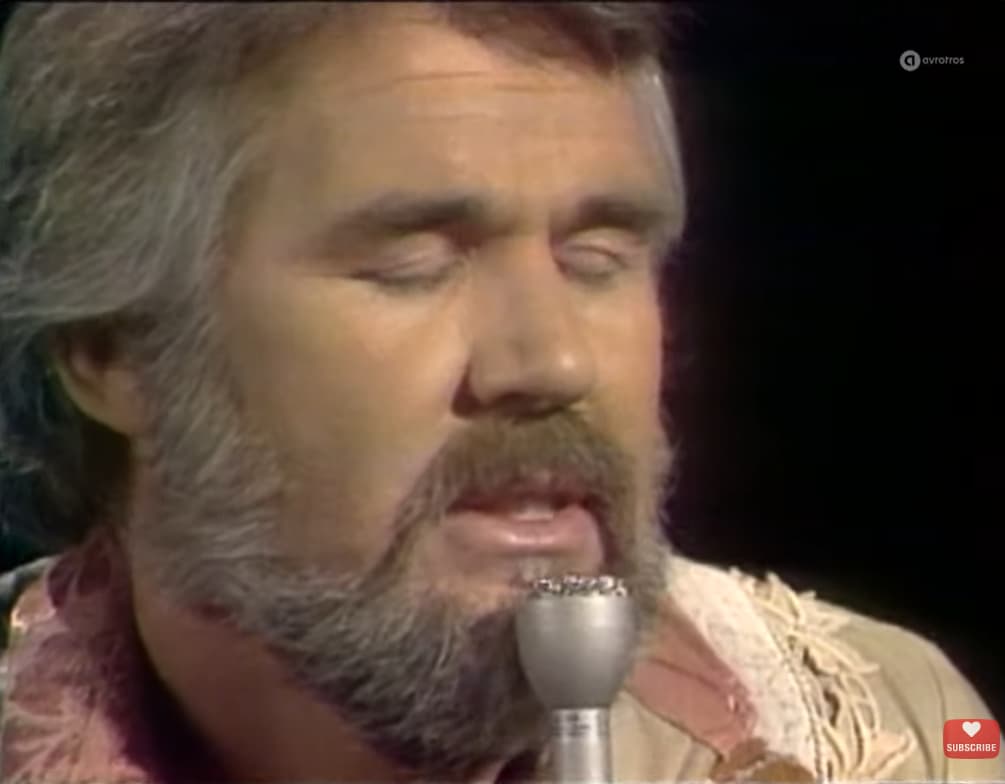
In the TopPop performance of 1977, Kenny Rogers presents the song with a calm authority that feels almost conversational. There is no dramatic emphasis, no attempt to exaggerate the story’s tension. Instead, he allows the narrative to unfold naturally, trusting the listener to understand its weight. His voice, slightly rough at the edges yet steady throughout, carries a sense of lived experience—a quality that cannot be imitated.
Musically, “Lucille” departs from traditional country instrumentation in subtle but significant ways. The absence of a prominent guitar solo, replaced instead by a restrained, almost minimalist arrangement, gives the song a sense of openness. This space allows the lyrics to take precedence, ensuring that the story remains at the center. The rhythm moves steadily, never rushing, as if mirroring the inevitability of the choices being described.
What makes the song particularly compelling is its perspective.
The narrator does not position himself as a moral authority. He listens. He observes. And in doing so, he becomes a mirror for the listener, reflecting the ambiguity of the situation. Lucille is neither fully condemned nor defended. She exists within the story as a person making a difficult, perhaps flawed decision—one that carries consequences but also reveals a deeper dissatisfaction.
The repeated line, “You picked a fine time to leave me, Lucille,” carries a quiet bitterness, but also something more subtle—a sense of disbelief. It is not shouted in anger. It is stated, almost resigned, as though the speaker has already begun to accept what cannot be changed. This restraint is what gives the song its emotional depth. It does not seek resolution. It simply presents the moment as it is.
For Kenny Rogers, this performance marked the beginning of a new chapter. Having transitioned from his earlier work with The First Edition, he embraced a style that leaned more heavily into narrative-driven songwriting. “Lucille” became the foundation upon which much of his later success was built, paving the way for songs like “The Gambler” and “Coward of the County”.
Looking back, the enduring power of “Lucille” lies not in its chart success, though that success was significant, but in its ability to capture a moment of human complexity without simplifying it. It speaks to the difficult choices people make, the quiet consequences that follow, and the understanding that not all stories have clear endings.
In the end, the song does not ask the listener to take sides.
It simply asks them to listen—and in that listening, to recognize something familiar.