
A Reluctant March Into Reality, Where Youthful Dreams Give Way to the Hard Lessons of War
When Status Quo released “In the Army Now” in 1986, it arrived not as a typical rock anthem, but as a stark and reflective piece that quietly challenged the romantic notions often associated with military life. The single became a major international success, reaching No. 2 on the UK Singles Chart and charting across Europe, including No. 1 in countries such as Austria, Germany, and Switzerland. It also entered the Billboard Hot 100 in the United States, marking one of the band’s notable chart appearances outside their established UK base. Featured on the album “In the Army Now” (1986), the song signaled a stylistic shift for the group—one that leaned more toward contemporary production while retaining their unmistakable identity.
Interestingly, “In the Army Now” was not originally written by Status Quo. The song was first recorded in 1981 by Dutch duo Bolland & Bolland, who composed it with a clear narrative structure and a strong anti-war undertone. When Status Quo chose to reinterpret it, they preserved the song’s core message but brought a broader reach to its story, allowing it to resonate with a wider audience during a time when global tensions still lingered in the background of everyday life.
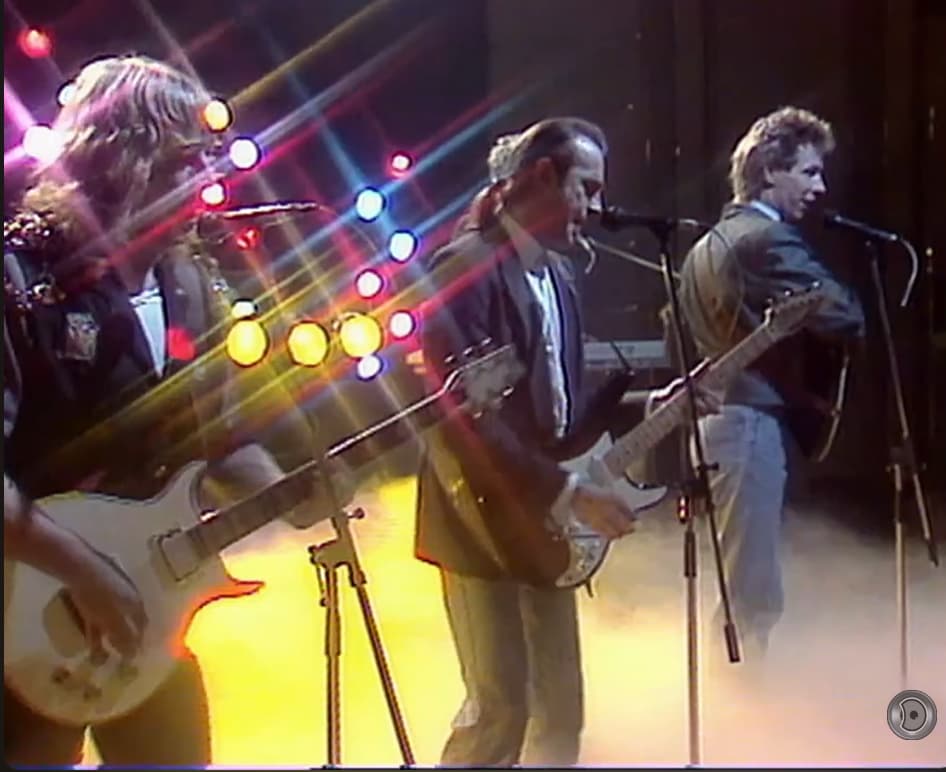
The television performance on March 25, 1987, captures the band at a moment where this message feels particularly immediate. There is a certain restraint in the way the song is presented—despite its driving rhythm and electronic accents, it never loses sight of the story it is telling. The production, characterized by its steady drum machine pulse and atmospheric synthesizers, creates a sense of inevitability. It feels like a march, but not one filled with pride. Instead, it carries a quiet tension, as though each step leads further into something uncertain.
Lyrically, “In the Army Now” tells the story of a young man who enlists, perhaps with a sense of duty or even naïve expectation, only to find himself confronted with the harsh realities of military life. The repetition of the line “You’re in the army now” becomes more than a simple statement—it evolves into a realization, almost a warning. With each refrain, the weight of the situation grows heavier, stripping away any illusion that might have existed at the beginning.
What makes the song particularly striking is its refusal to dramatize its message. There are no grand declarations, no overt condemnation. Instead, it relies on subtlety. The narrative unfolds in fragments—moments of fear, isolation, and disillusionment that feel all the more powerful because they are presented without embellishment. This approach allows the listener to fill in the gaps, to imagine the unspoken details that lie between the lines.
In the hands of Status Quo, a band known primarily for their straightforward rock sound, this shift toward a more reflective and narrative-driven piece reveals a different dimension of their artistry. Their delivery remains grounded, avoiding excessive emotion while still conveying the underlying tension. It is this balance that gives the song its lasting impact.
There is also something deeply reflective about revisiting “In the Army Now” from a later perspective. What might have once been heard simply as a catchy, rhythm-driven track reveals itself over time as something more layered. The themes of uncertainty, obligation, and the loss of innocence resonate differently when viewed through the lens of experience. The song does not change—but the listener does.
The 1987 television performance reinforces this idea. It captures a moment where the energy of the music contrasts with the gravity of its message, creating a sense of quiet contradiction. It is a reminder that not all songs reveal their full meaning at once. Some require time, patience, and a willingness to listen beyond the surface.
And in that sense, “In the Army Now” stands as more than just a successful single in Status Quo’s catalog.
It is a reflection on the distance between expectation and reality—a distance that can only truly be understood once it has been lived.