
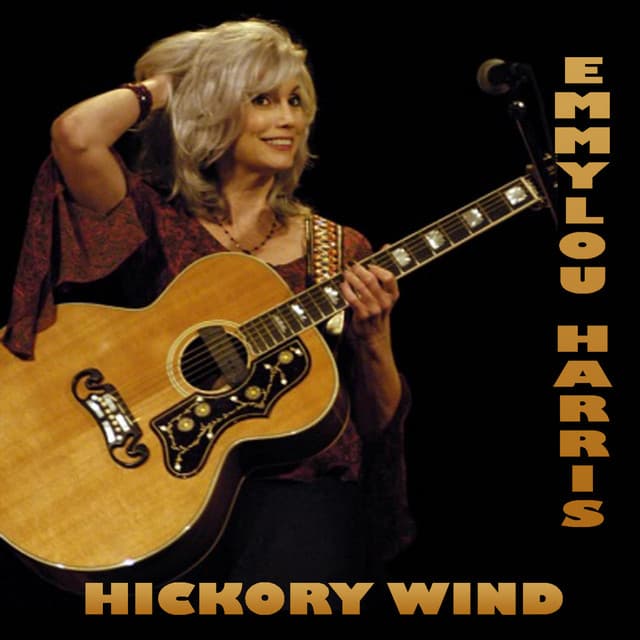
A song carried by memory, where the past feels closer than the road ahead and home lingers like a fading echo in the wind
Long before Emmylou Harris made “Hickory Wind” her own, the song had already carved out a sacred place in American music. Written by Gram Parsons and Bob Buchanan, it first appeared in 1968 on Sweetheart of the Rodeo by The Byrds, a record now regarded as one of the foundations of country rock. Yet it was in Harris’s hands—particularly through her live performances in the mid-1970s and later recordings—that the song seemed to find a deeper, more reflective voice, one that felt less like a declaration and more like a confession spoken quietly to oneself.
Unlike many of her charting singles, “Hickory Wind” was never a major commercial hit for Emmylou Harris, and it did not occupy a notable position on the Billboard charts under her name. But to measure this song by chart performance would miss its true significance. Within her repertoire, it stands as something more enduring—a spiritual inheritance from Gram Parsons, whose musical vision shaped Harris’s early career and, in many ways, her artistic identity.
By the time she began performing “Hickory Wind”, Harris had already stepped into the space Parsons left behind after his passing in 1973. Their partnership had been brief, but its influence was lasting. He had introduced her to a way of approaching country music that honored tradition while allowing room for vulnerability, for imperfection, for truth. And “Hickory Wind” carries all of that within it.
The song itself is deceptively simple.
It tells the story of a man who leaves home in search of something more—adventure, perhaps, or meaning—but finds only distance between who he was and who he has become. The “hickory wind” becomes a symbol, not just of place, but of memory—something that cannot be held, only felt in passing. It is the sound of a past that refuses to disappear, no matter how far one travels.
In Emmylou Harris’s voice, that sense of longing deepens.
Where Gram Parsons sang it with a kind of fragile honesty, Harris brings a clarity that feels almost luminous. Her tone is steady, but never detached. There is emotion in every line, yet it is held gently, never allowed to spill over into excess. She understands the weight of the song, and she carries it with care.
The arrangement, often sparse in her performances, allows the melody to breathe. Acoustic guitar, subtle harmonies, and the occasional swell of pedal steel create a landscape that feels wide and open, like the roads the song quietly evokes. There is space in the music, and within that space, the listener is left alone with the words.
What makes “Hickory Wind” endure is not just its theme of nostalgia, but its honesty about what that nostalgia means. This is not a romanticized return to the past. It is an acknowledgment that the past, once left behind, cannot be reclaimed in the same way. The wind may still carry its memory, but the moment itself is gone.
And yet, there is comfort in that realization.
For Emmylou Harris, performing this song has always felt like an act of remembrance—not only of the life it describes, but of Gram Parsons himself. Each rendition becomes a quiet conversation across time, a way of keeping his voice present without ever trying to replace it.
There is something profoundly human in that gesture.
Because “Hickory Wind” speaks to a feeling that never truly fades—the sense that somewhere behind us lies a version of life that felt simpler, clearer, more certain. Whether that memory is real or imagined almost no longer matters. What matters is the way it stays with us, carried on something as intangible as the wind.
And in the end, when Emmylou Harris sings those final lines, there is no resolution offered. No return home, no clear answer waiting at the end of the road.
Only the quiet understanding that some things are not meant to be held onto.
Only remembered.
And like the hickory wind itself, they pass through us—softly, briefly—before moving on.
 Oldies Songs