
A quiet meditation on emotional distance, where love lingers not in warmth but in the cold silence left behind
There are songs that arrive like a sudden storm, and then there are songs like “Cold On The Shoulder”—compositions that settle gently into the soul, revealing their depth only with time. Written and performed by the ever-reflective Gordon Lightfoot, this piece stands as one of the most introspective moments in his catalog. First released in 1975 as the title track of the album “Cold on the Shoulder,” the song did not storm the charts in the way his monumental hit “Sundown” had done just a year earlier, which reached No. 1 on the Billboard Hot 100. Instead, the album itself climbed respectably, reaching No. 10 on the Billboard 200, affirming Lightfoot’s enduring presence during a period when the musical landscape was rapidly evolving.
Yet, chart positions only tell part of the story. What truly defines “Cold On The Shoulder” is its emotional architecture—its ability to capture the quiet unraveling of a relationship not through confrontation, but through absence. The phrase itself, “cold on the shoulder,” evokes not anger, but indifference, that chilling space where affection once lived. It is a theme that Gordon Lightfoot approached with remarkable restraint, allowing the melody and sparse instrumentation to carry the weight of unspoken words.
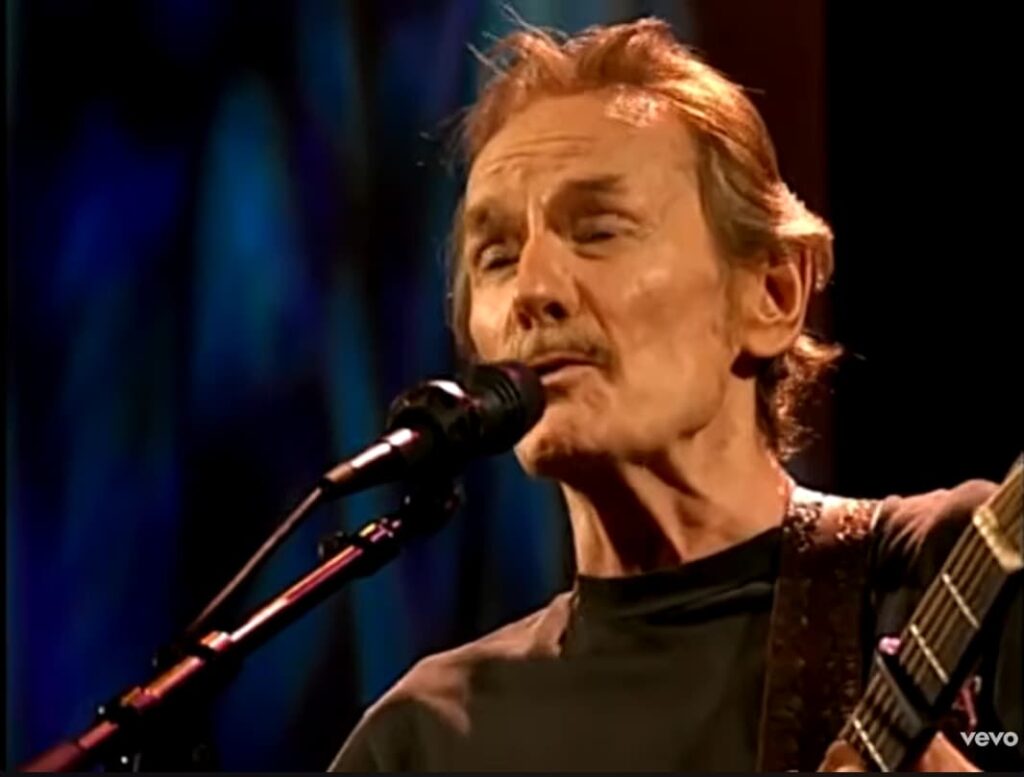
In the Live in Reno performance, this subtlety becomes even more pronounced. There is something deeply affecting about hearing Lightfoot deliver these lines in a live setting, where every pause, every slight shift in his voice feels magnified. His tone—never overly dramatic, never pleading—suggests a man who has already accepted the outcome, even as he continues to reflect on its meaning. The audience, though present, seems almost secondary; the performance feels intimate, as though one is listening to a private confession rather than a public recital.
By the mid-1970s, Gordon Lightfoot had already established himself as one of the most respected singer-songwriters of his generation. His work often bridged folk, country, and pop, creating a sound that was both accessible and deeply personal. Songs like “If You Could Read My Mind” and “Carefree Highway” had demonstrated his gift for storytelling—his ability to transform personal experience into universal reflection. “Cold On The Shoulder” fits seamlessly into this lineage, yet it carries a slightly different weight. It is less about narrative and more about atmosphere, less about events and more about emotional residue.
The story behind the song is often linked to the complexities of Lightfoot’s own life during that period—a time marked by personal transitions and the strains that come with balancing public success and private reality. While he rarely indulged in overt autobiography, there is an unmistakable authenticity in his writing. One senses that the emotions expressed in “Cold On The Shoulder” are not imagined, but lived—filtered through the lens of a songwriter who understood that the most powerful statements are often the quietest ones.
What gives this song its enduring resonance is its honesty. It does not attempt to resolve the tension it presents. There is no reconciliation, no dramatic climax—only the lingering awareness of distance. In a world that often celebrates grand gestures, Gordon Lightfoot chose instead to illuminate the spaces in between, the moments when something once vibrant begins to fade.
Listening to the Live in Reno version today, one cannot help but feel a sense of stillness, as though time itself has slowed to accommodate the song’s delicate pacing. It is a reminder that music does not always need to shout to be heard. Sometimes, it is the softest voices that leave the deepest impressions.
And so, “Cold On The Shoulder” remains not just a song, but a quiet companion—one that speaks to those unspoken chapters of life, where understanding comes not through answers, but through reflection. In that silence, Gordon Lightfoot found his voice, and in turn, offered listeners something far more lasting than a fleeting hit: a moment of truth, carried gently on melody.