
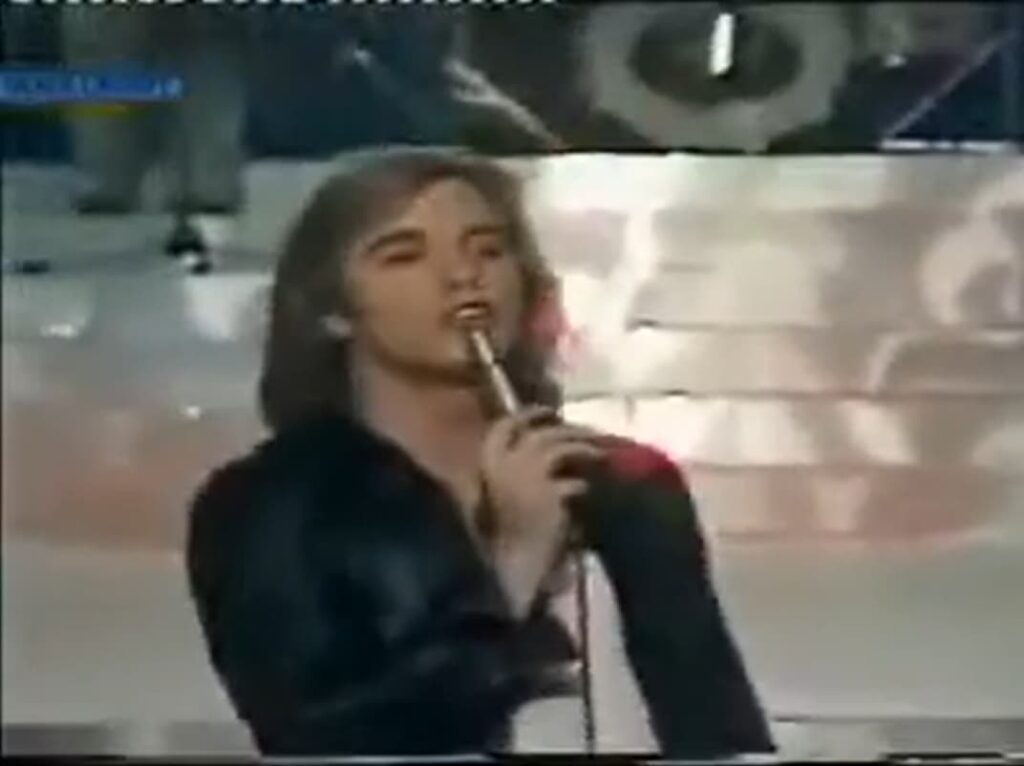
A tender revival of youthful longing, where past harmonies echo with renewed innocence and heartfelt devotion
There is something quietly enchanting about the way Shaun Cassidy approached his rendition of “Be My Baby”—a song already etched deeply into the golden fabric of popular music long before he ever stepped into the studio. Originally immortalized by The Ronettes in 1963 under the visionary production of Phil Spector, the song had reached No. 2 on the Billboard Hot 100 and became a cornerstone of the famed “Wall of Sound.” By the time Shaun Cassidy recorded his version for the 1980 album “Wasp”, the track was no longer simply a hit—it was a memory, a cultural artifact, a whisper from a different era.
Cassidy’s interpretation did not aim to outshine the original; instead, it felt like a gentle conversation across time. Released as part of an album that marked a transitional period in his career, “Be My Baby” was not issued as a major charting single in the same way his earlier hits like “Da Doo Ron Ron” or “Hey Deanie” had been—songs that had firmly established him as a teen idol in the late 1970s. Yet, that is precisely what gives this recording its quiet power. It exists not as a commercial statement, but as a personal one.
By 1979–1980, Shaun Cassidy was navigating the delicate shift from youthful stardom toward artistic maturity. His earlier success had been dazzling but tightly packaged, driven by the machinery of pop production and television fame. With “Wasp”, however, there was a subtle but unmistakable attempt to reshape his identity. Choosing to revisit “Be My Baby”—a song steeped in emotional vulnerability and timeless longing—was no coincidence. It allowed him to step away from the bright, almost frenetic energy of teen pop and lean into something more reflective, more sincere.
Listening closely, one can sense that Cassidy’s version softens the grandiosity of the original. Where Spector’s production soared with layered instrumentation and dramatic intensity, Cassidy’s take feels more intimate, almost as though the song has been pulled closer to the heart. The urgency is still there, but it is tempered by a kind of wistfulness—an awareness, perhaps, that love songs are not only about anticipation, but also about memory.
The meaning of “Be My Baby” has always been deceptively simple: a plea for love, a hopeful declaration wrapped in repetition and melody. Yet in Cassidy’s hands, it takes on an added dimension. It becomes a reflection on innocence itself—on the fleeting nature of those first, unguarded emotions. There is a sense that he is not just singing to someone, but also singing from a place that is already beginning to fade.
Behind this recording lies the broader story of an artist trying to be heard beyond the echo of his own image. The late 1970s had crowned Shaun Cassidy as a household name, fueled by television appearances and chart-topping singles. But fame of that kind often comes with limitations, expectations that can be difficult to escape. By revisiting a classic like “Be My Baby,” he subtly challenged those expectations, choosing reverence over reinvention, emotion over spectacle.
For listeners who encountered this version at the time, it may have felt like a quiet departure—less immediate, less commercially driven. But with the passage of time, it reveals its true character. It stands as a gentle bridge between eras, connecting the lush romanticism of the early 1960s with the introspective undercurrents of the late 1970s.
And perhaps that is the enduring beauty of Shaun Cassidy’s “Be My Baby.” It does not demand attention; it invites reflection. It reminds us that songs, much like memories, can be revisited and reshaped, carrying with them not only their original meaning but also the weight of everything that has come since. In that sense, Cassidy’s version is not just a cover—it is a quiet act of remembrance, a soft echo of a time when love songs felt like promises whispered into the night.