
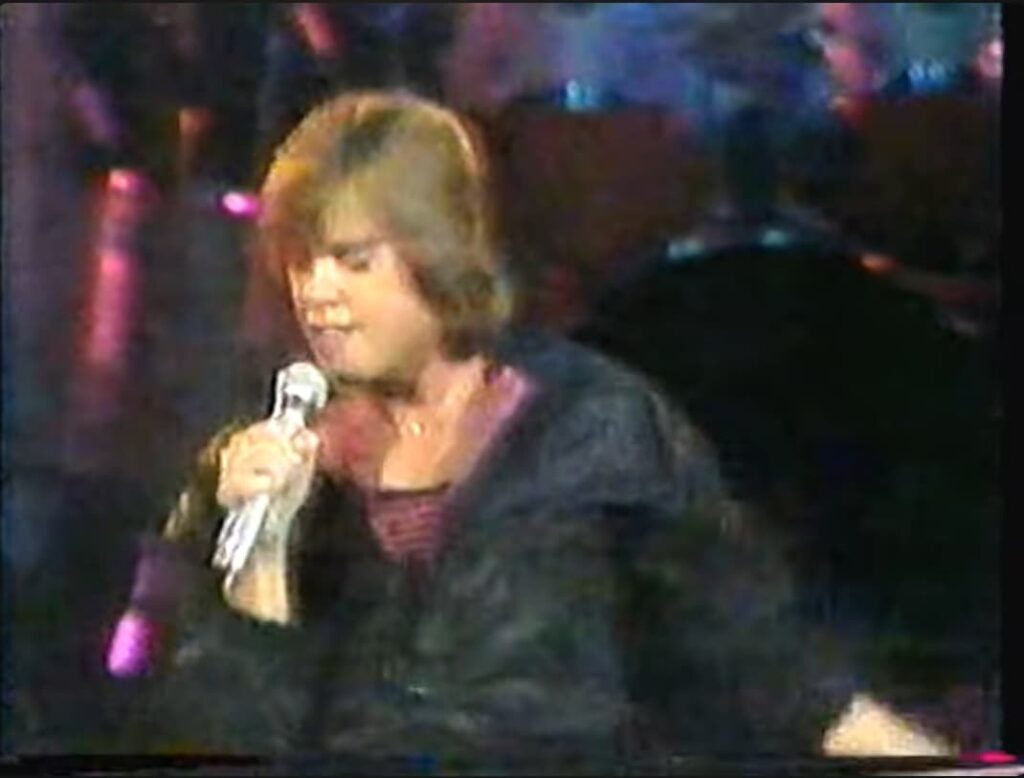
A Glimpse of Fading Stardom and Quiet Maturity—When Teen Idolatry Gave Way to Reflection
The 1979 TV Special of Shaun Cassidy stands as a fascinating and often overlooked moment in the arc of a career that once burned with extraordinary intensity. By the late 1970s, Cassidy was no longer merely the fresh-faced idol who had dominated the charts just a few years earlier—he was, instead, an artist standing at a crossroads, navigating the delicate transition from youthful sensation to something more grounded, more enduring.
To understand the weight of this television special, one must first recall the remarkable heights Cassidy had reached in a very short time. His 1977 breakout hit “Da Doo Ron Ron” soared to No. 1 on the Billboard Hot 100, while subsequent singles like “Hey Deanie” and “That’s Rock ’n’ Roll” secured strong Top 10 positions. Albums such as “Shaun Cassidy” (1977) and “Born Late” (1977) achieved multi-platinum success, placing him firmly among the defining pop figures of that era. Yet by 1979, the musical landscape had shifted. Trends were changing, audiences evolving, and the fervor that once surrounded teen idols had begun to soften.
It is within this context that the 1979 TV Special becomes so compelling. Rather than simply serving as a vehicle for performance, it feels like a quiet reckoning—a moment where image, expectation, and personal identity intersect. Cassidy, now a little older and more self-aware, carries himself differently. The bright exuberance remains, but it is tempered by something more reflective, almost introspective.
The performances within the special draw from his earlier successes, yet they are delivered with a subtle shift in tone. Songs that once felt like declarations of youthful energy now carry a trace of nostalgia, as though even in that moment, they were already becoming memories. There is a certain poignancy in this transformation. It reminds us how quickly time moves in the world of popular music, how swiftly the spotlight can change its focus.
Behind the scenes, Cassidy had begun to distance himself from the constraints of his early image. Like many artists who rise to fame at a young age, he faced the challenge of being defined by a persona that no longer fully reflected who he was becoming. The 1979 TV Special hints at this internal evolution. It does not openly reject the past, but neither does it cling to it. Instead, it exists in a space between—acknowledging what came before while quietly suggesting what might come next.
There is also something deeply evocative about the format itself. Television specials of that era held a unique place in cultural life. They were events—moments when audiences gathered, when music entered the home not as background noise, but as a shared experience. Watching Cassidy in this setting, one can almost sense the stillness of those evenings, the anticipation, the quiet connection between performer and viewer.
What makes this particular special endure is not its spectacle, but its sincerity. Cassidy does not attempt to reinvent himself dramatically. Instead, he allows small changes to speak: a more measured delivery, a quieter confidence, a willingness to let the music breathe. These are not the gestures of someone chasing attention, but of someone beginning to understand the value of authenticity.
In retrospect, the Shaun Cassidy 1979 TV Special can be seen as a transitional document—capturing an artist in the midst of change. It may not carry the chart-topping impact of his earlier hits, but it offers something arguably more meaningful: a glimpse into the process of growth, of letting go, of moving forward.
And perhaps that is why it continues to resonate. Not as a reminder of what once was, but as a reflection of what it means to evolve—quietly, gracefully, and with a sense of acceptance that only time can bring.