
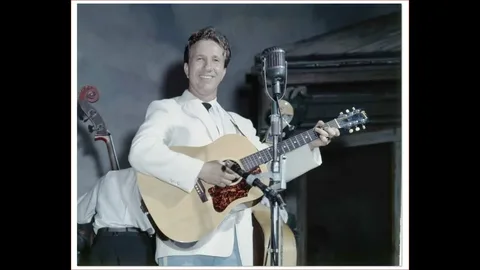
Marty Robbins –“Pretty Words”: A “High-Fidelity” Echo of Heartbreak from the Golden Age
In the sophisticated, gold-tinged landscape of 1954, Marty Robbins released a recording that would become a definitive “velvet” snapshot of his early Columbia Records era. When he unveiled “Pretty Words,” he wasn’t just delivering a country hit; he was crafting a “high-level” meditation on the fragility of promises. For those of us who remember the mid-fifties—the era of the analog warmth and the steady, rhythmic hum of the jukebox—this song was a visceral experience. It caught the “Gentle Giant” at a vocal peak where his crystalline tenor could navigate the delicate boundary between a man’s quiet dignity and the “velvet” ache of a broken trust.
The “story” behind “Pretty Words” is a masterclass in the “mini-movie” style of lyrical disillusionment. The narrative explores the heavy architecture of a relationship built on “high-level” declarations that ultimately ring hollow. Marty’s delivery is a study in vocal restraint; he uses his signature “velvet” phrasing to underscore the irony of the title, making the listener feel the weight of every “pretty” lie. It was an era where the “Nashville Sound” was beginning to find its footing, and Marty was its most versatile architect. He proved that a song about the heavy weight of disappointment didn’t need to be loud to be powerful; it simply needed to be phrased with the impeccable timing and “Truth” in a voice that were his trademarks.
For the sophisticated listener who has navigated the “twists and turns” of several decades, hearing Marty sing “Pretty Words” today is a deeply evocative experience. It brings back memories of wood-paneled dens and the realization that as we reach our silver years, the value of a word given is a profound form of resilience. The lyrics speak to a universal human experience of “saving face” while navigating the “ebbs and flows” of a life spent in reflection. For a “qualified” reader who has seen the world change from the steady principles of the fifties to the digital pace of today, this song is a profound mirror of our own history and the quiet dignity of a heart that knows the difference between a “pretty” word and a lasting truth.
The meaning of “Pretty Words” lies in its unapologetic honesty. Marty Robbins possessed the unique, almost magical gift of being a “vocal chameleon” who could inhabit the psyche of a wounded romantic with total, soulful sincerity. As we reflect on this 1954 masterpiece today, through the lens of our own decades of experience, we see it as more than just a track from the early charts; it is a testament to the enduring power of the narrative song to capture the subtleties of the human condition. The Master Storyteller may have eventually returned to the “El Paso” desert, but in the shimmering, rhythmic notes of this song, he remains the eternal witness to the heart’s most guarded lessons.
 Music Legend