
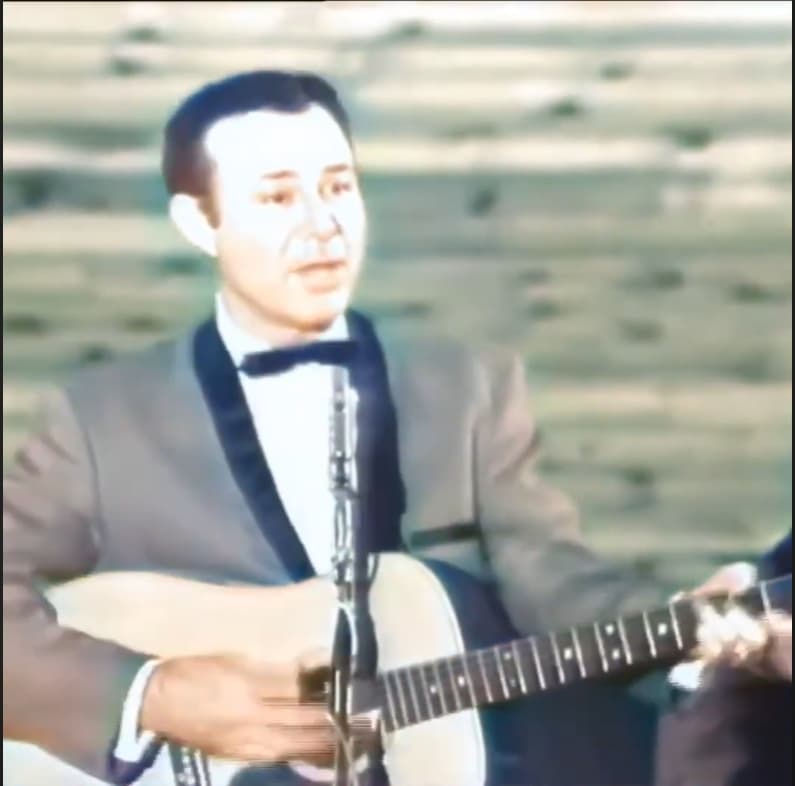
A voice carried across distance and time, where calm dignity and quiet emotion meet in a moment that feels untouched by passing years.
In 1964, when Jim Reeves performed in Oslo, Norway, it was more than a concert—it was the meeting of a voice and a world ready to receive it. By that time, Reeves had already established himself as one of the defining figures of the Nashville Sound, a style that softened the edges of traditional country music and brought it into a more refined, orchestral space. His recordings had crossed borders with remarkable ease, and nowhere was that more evident than in Europe, where his popularity often rivaled, and sometimes exceeded, his success in the United States.
Though this Oslo performance was not tied to a single charting release, it reflects the immense success Reeves had already achieved. Songs like “He’ll Have to Go” had reached No. 1 on the US Country Chart in 1960 and crossed over to No. 2 on the Billboard Hot 100, while “Welcome to My World” would soon top the country charts in 1964. These milestones formed the backdrop to his European appearances, where audiences were not simply discovering him—they were welcoming a familiar voice that had already found a place in their lives.
What made Jim Reeves so distinctive was not just the clarity of his baritone, but the restraint within it. He never seemed to push a song beyond its natural limits. Instead, he allowed each phrase to settle gently, as though the emotion did not need to be emphasized to be understood. In a live setting, this quality became even more apparent. There was no need for theatrical gestures or dramatic flourishes. The connection was established through tone, through timing, through a quiet confidence that drew listeners in rather than reaching outward.
The Oslo performance in 1964 carries an added layer of poignancy when viewed in retrospect. It took place only months before Reeves’ untimely death in a plane crash on July 31, 1964, an event that would mark the end of a career still very much in motion. Knowing this, the performance feels suspended in time—a moment preserved just before everything changed. There is no sense of finality in his delivery, no indication that this is anything other than another evening of music. And perhaps that is what makes it so affecting. It is not a farewell; it is simply a continuation that would, unexpectedly, become one of the last chapters.
The audience in Oslo responds with a kind of attentive warmth that reflects Reeves’ international appeal. There is a stillness in the room, a sense that the music is being received rather than consumed. This was always part of his strength. His songs did not demand attention—they earned it. Whether performing a ballad or a more rhythmic piece, he maintained a consistent tone, one that suggested stability, reassurance, and a certain timelessness.
In the broader context of country music, Jim Reeves represented a bridge between traditions. He honored the storytelling roots of the genre while embracing a smoother, more polished sound that allowed his music to travel beyond its origins. The Oslo performance embodies that balance. It is unmistakably country, yet it feels universal, accessible to listeners regardless of background or familiarity with the genre.
Listening now, there is a quiet realization that performances like this are rare. Not because of technical limitations or changes in style, but because of the particular quality Reeves brought to his music—a kind of emotional steadiness that resists exaggeration. It is a voice that does not age in the usual sense. Instead, it settles deeper, becoming more resonant with time.
In the end, Jim Reeves’ live performance in Oslo, Norway, 1964 stands as more than a historical recording. It is a moment of presence, of connection, of music delivered with a sincerity that does not seek to impress, but to endure. And in that enduring quality, it continues to find its way into the quiet spaces where songs are not just heard, but remembered.
 Oldies Songs