
A song born in a quiet London corner steps into the light, where skill speaks louder than spectacle and every note carries the weight of something patiently earned.
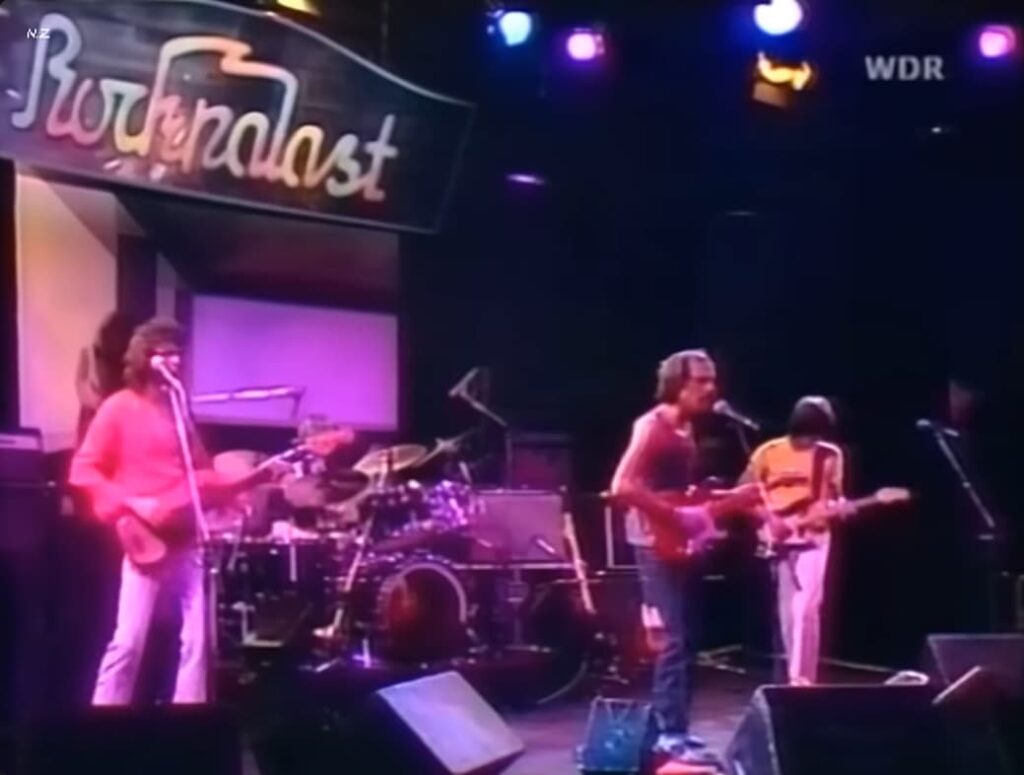
When Dire Straits performed “Sultans of Swing” live in 1979, it captured a band standing at a delicate but decisive moment—no longer unknown, yet not fully absorbed into the machinery of global fame. The song itself, released in late 1978 as part of their self-titled debut album “Dire Straits”, had already begun its quiet ascent, reaching No. 8 on the UK Singles Chart and climbing even higher to No. 4 on the Billboard Hot 100 in the United States. These were not just numbers; they marked the arrival of a sound that felt almost out of step with its era, and yet somehow exactly what listeners had been waiting for.
At the center of that sound was Mark Knopfler, whose guitar work refused to follow the prevailing trends of the late 1970s. While much of rock music was leaning toward aggression or theatricality, Knopfler chose restraint. His fingerstyle technique, clean and unhurried, gave “Sultans of Swing” a conversational quality—as if the song were being told rather than performed. In the 1979 live setting, this quality becomes even more pronounced. There is a sense that each note is placed with intention, never rushed, never overstated.
The performance itself reveals something essential about Dire Straits at that stage. They were still close to the spirit of the song’s origin—a small band observing the world rather than commanding it. The story behind “Sultans of Swing” is famously rooted in an ordinary moment: Mark Knopfler watching a little-known jazz group playing in a nearly empty pub in London, introduced with an almost ironic pride as “the Sultans of Swing.” That quiet, almost unnoticed scene became the foundation for a song that would travel far beyond its humble beginnings.
In this 1979 live video, that sense of observation remains intact. The arrangement stays faithful to the original recording, yet there is a subtle expansion in how the band interacts. The rhythm section holds steady, unintrusive, allowing space for the guitar to move freely. Knopfler’s solos, while not as extended as in later performances, already show the beginnings of what would become his signature live style—fluid, precise, and deeply expressive without ever feeling forced.
What makes this particular period so compelling is the balance between freshness and confidence. Dire Straits had not yet become an institution; they were still discovering how far their music could go. There is a certain tension in that discovery, a quiet awareness that something significant is happening, even if it is not fully understood in the moment. The audience, too, seems to sense it—not through overwhelming reaction, but through attentive listening, as though recognizing that this was not just another performance, but the early shape of something enduring.
Looking back now, the 1979 live version of “Sultans of Swing” feels almost intimate compared to the grander interpretations that would follow in later years. It has not yet stretched into the expansive, near-epic form heard in performances like Alchemy Live. Instead, it remains grounded, closer to the original intent—a song about musicians playing for the sake of playing, about the quiet dignity of craft in a world that often overlooks it.
And perhaps that is why this version continues to resonate. It captures a moment before transformation, before scale altered perception. The song is still itself, unembellished, carried by the steady hands of a band that understood something fundamental: that music does not need to announce its importance. It only needs to be played with honesty.
In the end, “Sultans of Swing” (1979 Live) is not just a performance—it is a glimpse into a beginning that already contained its future. A reminder that even the most enduring sounds often start in the quietest places, waiting patiently to be heard.