
A Voice in the Quiet Room, Where Loneliness Echoes Softer Than Words
Long before the polish of the Nashville Sound reached its full bloom, Jim Reeves gave the world “Four Walls,” a song that would quietly redefine the emotional vocabulary of country music. Released in 1957 as a single and later included on the album “Jim Reeves Sings”, the record rose to No. 1 on the Billboard Country & Western Best Sellers chart and crossed over to No. 11 on the Billboard Hot 100, an achievement that signaled Reeves’ widening appeal far beyond traditional country audiences. In the United Kingdom, it climbed even higher, reaching No. 3 on the UK Singles Chart—an early indication of the international connection his voice would sustain for years to come.
Written by Marvin Moore and George Campbell, “Four Walls” arrived at a moment when country music was still rooted in raw, often rustic expression. Yet Jim Reeves, under the guidance of producer Chet Atkins, chose a different path. He softened the edges, stripped away excess instrumentation, and placed the full weight of the song on the quiet strength of his baritone voice. This approach would later be recognized as a cornerstone of the Nashville Sound, but in 1957, it felt almost revolutionary in its restraint.
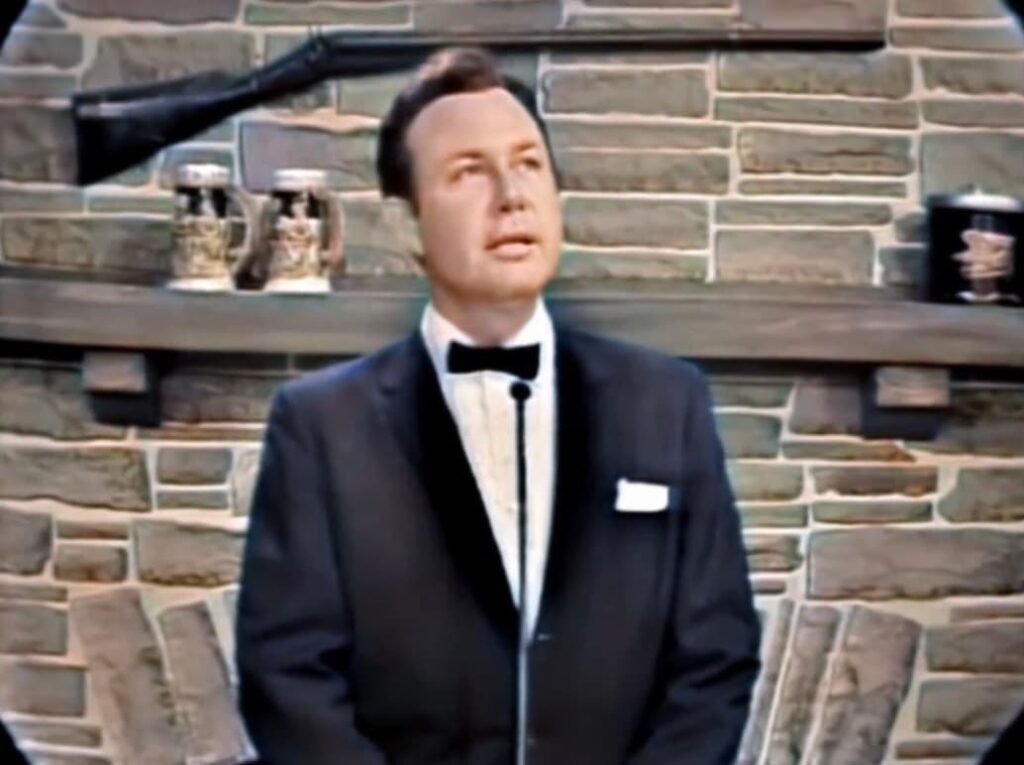
The live television performance from the mid-1950s carries a particular kind of intimacy. There is no elaborate staging, no dramatic lighting. Just a man, a microphone, and a song that seems to unfold as if it were being spoken rather than sung. In that setting, “Four Walls” becomes something more than a hit record. It becomes a moment of stillness.
The meaning of the song is deceptively simple. A man sits alone, surrounded by the same walls that once held comfort, now closing in with quiet persistence. There are no grand declarations, no elaborate metaphors. Instead, there is repetition—of thought, of memory, of feeling. The walls are not just physical boundaries; they are reflections of a mind unable to escape its own longing.
What sets Jim Reeves apart in this performance is his refusal to exaggerate the emotion. He does not raise his voice to emphasize the loneliness. He does not linger excessively on any single word. Instead, he allows the melody to carry the weight naturally, trusting that the listener will recognize the feeling without being told how to interpret it. That trust is what gives the performance its enduring power.
There is a quiet story behind the success of “Four Walls.” At the time, Reeves had already experienced moderate success, but nothing that hinted at the lasting influence he would soon achieve. This song changed that trajectory. It marked a turning point—not just in his career, but in the broader direction of country music. By embracing a smoother, more controlled vocal style, Reeves helped open the genre to new audiences, many of whom had never before felt drawn to its traditional sound.
In the years that followed, that style would become his signature. Songs like “He’ll Have to Go” would refine it further, but “Four Walls” remains one of the earliest and clearest expressions of what he would become.
Watching that early television performance now, there is a sense of something quietly unfolding. The audience at the time may not have fully realized it, but they were witnessing the emergence of a voice that would come to define an era. There is no sense of ambition in the performance, no visible effort to impress. And yet, that is precisely what makes it so compelling.
The arrangement, minimal and unobtrusive, allows every nuance of Reeves’ delivery to be heard. Each phrase is measured, each pause intentional. It is not a song that demands attention. It invites it.
As the final lines of “Four Walls” fade, there is no dramatic conclusion. The room does not suddenly open, the loneliness does not resolve. Instead, the song simply ends, leaving behind a quiet echo—a feeling that lingers not because it insists, but because it understands.
And in that understanding, Jim Reeves offers something rare. Not a solution, not even a release, but a recognition. That sometimes, the deepest emotions are not the ones that are spoken loudly, but the ones that remain within reach, moving softly between memory and silence, held gently within four unchanging walls.
 Oldies Songs