
A voice returning without announcement, carrying the quiet truth that some journeys never really end
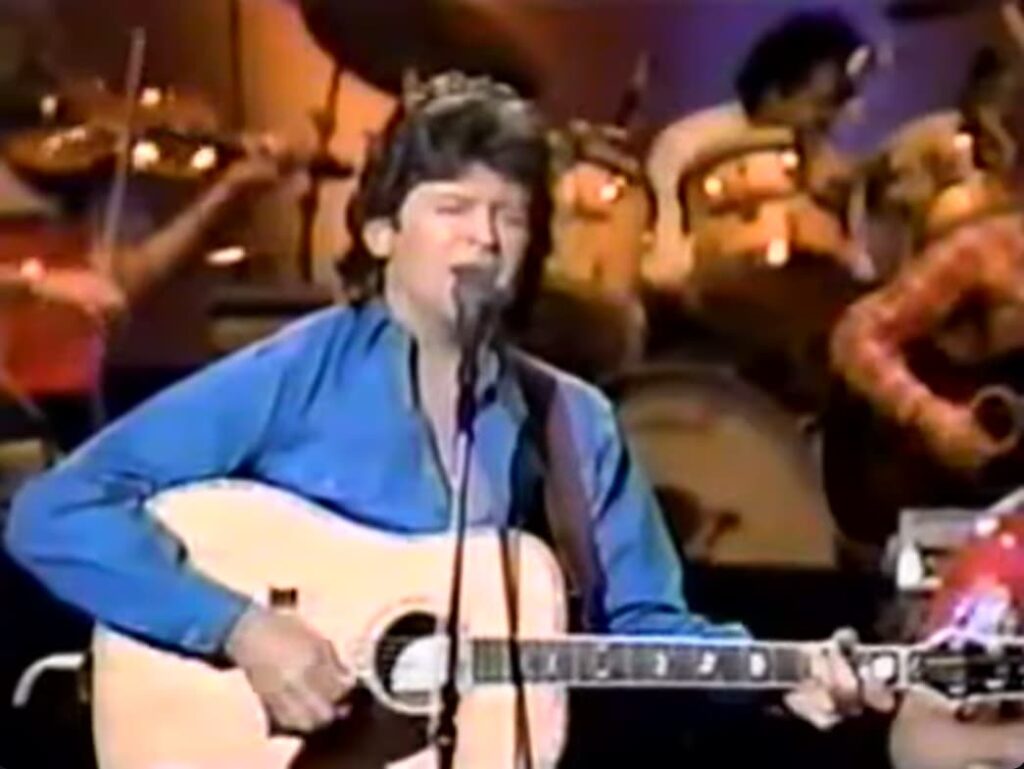
When Johnny Rodriguez appeared on Nashville Now in 1986 to perform “Here I Am Again,” the moment did not feel like a comeback in the dramatic sense. There were no grand declarations, no attempt to reclaim what had already passed. Instead, it felt like something more familiar—a return shaped by time, by distance, and by a voice that had never entirely left.
By 1986, Rodriguez’s place in country music history was already secure. His breakthrough in the early 1970s had been nothing short of remarkable, with a series of No. 1 hits on the Billboard Hot Country Singles chart, including “You Always Come Back (To Hurting Me)” (1973), “Ridin’ My Thumb to Mexico” (1973), and “That’s the Way Love Goes” (1973). These songs had defined an era in which his smooth phrasing and understated delivery brought a new kind of emotional clarity to country music.
Yet the mid-1980s found him in a different place. The industry had shifted, leaning toward a more polished and commercially driven sound, while many of the voices that had shaped the previous decade were navigating quieter paths. It was within this context that “Here I Am Again” takes on its meaning—not as a chart-driven single, but as a statement of presence. Unlike his earlier hits, the song did not register as a major chart success, and its performance on Nashville Now exists more as a recorded moment than a commercial milestone. But sometimes, those are the moments that reveal the most.
The song itself carries a theme that feels almost autobiographical. A man returns, not with explanations or apologies, but with a simple acknowledgment of being there once more. There is no attempt to rewrite the past, no insistence that things will be different. Instead, there is acceptance—of what has been, and of what remains.
What makes this performance particularly striking is the way Johnny Rodriguez delivers it. His voice, slightly deeper with age, carries a texture that cannot be manufactured. There is a softness in his approach, a willingness to let the song unfold at its own pace. Each phrase feels measured, as though he understands that the meaning lies not in what is said, but in how it is allowed to settle.
The setting of Nashville Now, hosted by Ralph Emery, adds another layer to the moment. The show itself was known for capturing artists in a more relaxed, conversational environment, where performances felt less like spectacle and more like reflection. In that space, Rodriguez does not perform at the audience—he shares something with them.
There is also a quiet continuity between this song and his earlier work. While the themes of love, longing, and return had always been present in his music, “Here I Am Again” approaches them with a different kind of perspective. It is less about the immediacy of emotion and more about its persistence. Time has passed, circumstances have changed, but the feeling remains—altered, perhaps, but not diminished.
Listening to this performance now, there is a sense of distance that cannot be ignored. The 1980s, once immediate, have become part of memory, and with that shift comes a different kind of understanding. What may have once seemed like a simple television appearance now feels like a document of something more enduring—a voice continuing to speak, even as the world around it changes.
For Johnny Rodriguez, this moment does not stand as a peak or a turning point. It exists somewhere in between, where much of life actually unfolds. And perhaps that is why it resonates. It does not try to define itself as important. It simply exists, quietly, honestly.
And as the final notes of “Here I Am Again” fade into the stillness of that studio, what remains is not a sense of conclusion, but of continuation. A reminder that some voices do not need to announce their return—they simply arrive, carrying with them everything that has come before.