
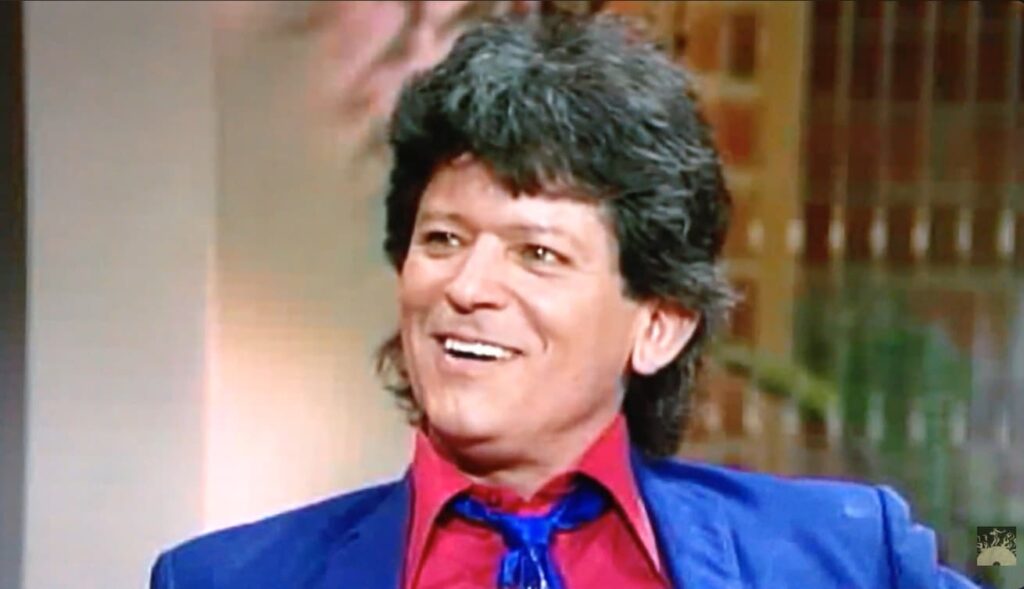
A quiet conversation in Nashville reveals how a gentle voice carried both pride and longing across generations
When Johnny Rodriguez appeared on Music City Tonight with Crook and Chase, the moment felt less like a formal interview and more like a return—back to a place, a sound, and a time that had shaped him. By then, Rodriguez was no longer the young man who had arrived in Nashville with little more than instinct and a remarkable voice. He had already become one of the defining figures of 1970s country music, a trailblazer whose success quietly shifted the boundaries of the genre.
His rise had been swift and, in many ways, unlikely. Born in Sabinal, Texas, Rodriguez brought with him a blend of influences that set him apart from his contemporaries. Traditional country was there, certainly, but so too were traces of Spanish language and Mexican American heritage—elements that would later become central to his identity as an artist. By the mid 1970s, he had achieved a string of No. 1 hits on the Billboard Hot Country Singles chart, including “You Always Come Back (To Hurting Me)” (1973), “Ridin’ My Thumb to Mexico” (1973), and “That’s the Way Love Goes” (1973). These were not just successful recordings; they were statements of presence.
Sitting across from Lorianne Crook and Charlie Chase, Rodriguez spoke with a calm, almost understated tone. There was no attempt to dramatize his past, no need to amplify what had already been lived. Instead, he reflected on his journey with a sense of quiet gratitude, as though the distance between then and now had softened the sharper edges of memory.
What made this interview particularly compelling was the way Rodriguez spoke about his relationship with music itself. For him, songs were never just material to be performed. They were reflections of something deeply personal—moments of longing, fragments of experience, echoes of places left behind. When he discussed recordings like “Pass Me By (If You’re Only Passing Through)” (No. 9, 1972) or “I Just Can’t Get Her Out of My Mind” (No. 1, 1975), there was a sense that these songs had not simply passed through his career, but had stayed with him, shaping the way he understood his own life.
There was also an unspoken awareness of the cultural ground he had broken. As one of the first Mexican American artists to achieve sustained success in mainstream country music, Johnny Rodriguez had navigated a path that few had walked before. Yet in conversation, he did not dwell on that distinction. He spoke instead about belonging—not as a concept, but as a feeling. Nashville, once distant and uncertain, had become a place where his voice found its audience.
The interview touched gently on the passage of time, a theme that seemed to linger beneath every answer. Rodriguez did not frame his career in terms of peaks and declines. Rather, he spoke of it as something continuous, shaped by change but never entirely defined by it. There was a recognition that the industry had evolved, that sounds had shifted, but also a quiet confidence that sincerity in music remains constant.
Perhaps most striking was the way he described the act of singing itself. There was no technical explanation, no attempt to dissect the mechanics of his voice. Instead, he spoke of feeling—of allowing a song to unfold naturally, without forcing it into something it was not. It is this approach that gave his recordings their enduring quality. Even decades later, they retain a sense of immediacy, as though they are being sung not from memory, but from the present moment.
In the setting of Music City Tonight, the conversation became more than an interview. It became a reflection—on music, on identity, on the quiet resilience required to sustain a life in art. Johnny Rodriguez did not present himself as a figure of legend, though his achievements would justify it. He spoke instead as someone who had lived through his songs, carrying them forward even as time moved on.
And as the exchange drew to a close, what remained was not a summary of accomplishments, but a feeling—subtle, enduring, and unmistakably human. A reminder that behind every familiar melody lies a story that continues long after the final note has faded.