
A fragile plea wrapped in quiet intensity—“Stay With Me Baby” reveals how love often lingers most in the moments when it is already slipping away
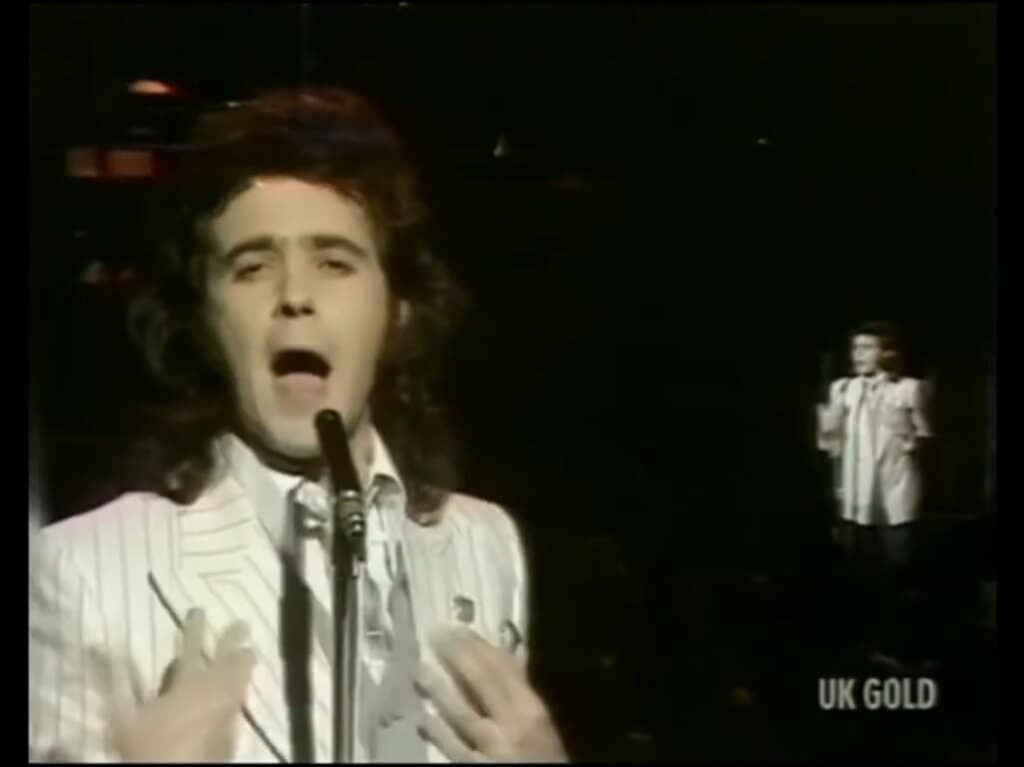
When David Essex stepped onto the stage of Top Of The Pops to perform “Stay With Me Baby,” it was not simply another television appearance. It felt closer to a confession set to music—restrained, intimate, and carried by a voice that had already known both the glare of fame and the quiet weight that follows it.
Originally recorded for his 1975 album “All the Fun of the Fair,” “Stay With Me Baby” did not arrive as a chart-topping single in the way some of his earlier hits had. Unlike “Gonna Make You a Star,” which soared to No. 1 on the UK Singles Chart in 1974, this song occupied a different space in his catalogue—less immediate, less commercial, yet far more revealing. It belonged to that category of songs that do not rely on chart positions to endure, because their strength lies in something quieter, something that unfolds slowly with time.
The song itself carries a history that reaches beyond David Essex. Written by George David Weiss, Jerry Ragovoy, and Bert Berns, it had been recorded by several artists before him, most notably Lorraine Ellison, whose 1966 version remains one of the most emotionally charged recordings of its era. But when David Essex approached the song, he did not attempt to replicate that intensity. Instead, he softened it—pulled it inward—and in doing so, created something more reflective than dramatic.
His Top Of The Pops performance captures that shift perfectly. There is no excess in the delivery. No grand gestures designed for the camera. He stands within the song rather than performing above it. The arrangement is measured, allowing space between the notes, as if the silence itself is part of the story.
And the story, at its core, is simple. A plea. Not loud, not desperate in the obvious sense, but quietly insistent. The kind of request that comes when someone already senses what is about to happen. “Stay with me, baby” is not framed as a demand—it is closer to an acceptance that the answer may already be no.
That emotional restraint is what gives the performance its lasting resonance. Because in many ways, David Essex was an artist navigating transition during this period. By the mid 1970s, he had already achieved significant success, both as a musician and as an actor, particularly with his role in That’ll Be the Day. But success, as it often does, brought with it a certain distance. The earlier energy, the immediacy of rising fame, had begun to settle into something more introspective.
“Stay With Me Baby” reflects that shift. It does not chase attention. It does not attempt to define an era. Instead, it lingers in a moment that feels personal, almost private. The phrasing of each line suggests careful control, but beneath it there is a quiet vulnerability—something that cannot be fully hidden, no matter how composed the delivery remains.
Watching the performance now, there is a sense of time moving through it. Not in a dramatic way, but in small details—the pacing, the stillness, the absence of urgency. It feels like a song that understands its own limitations. It knows it cannot change the outcome. And yet, it chooses to speak anyway.
That is perhaps why the song continues to resonate, even without the reinforcement of chart success. It belongs to that rare space in music where recognition is not measured in numbers, but in memory. The kind of song that returns unexpectedly, carrying with it a feeling that is difficult to explain but impossible to ignore.
In the end, “Stay With Me Baby” is not about whether the plea is answered. It is about the moment in which it is made—the brief, fragile space where hope and resignation exist side by side. And in that space, David Essex leaves behind something far more lasting than a hit record. He leaves behind a feeling that, once heard, is not easily forgotten.