
A sudden burst of chaos and glamour—“The Ballroom Blitz” captured a moment when pop became louder, bolder, and impossible to ignore
There are songs that arrive gently, and then there are songs like “The Ballroom Blitz”—records that seem to explode the moment the needle touches the vinyl. When Sweet released “The Ballroom Blitz” in September 1973, it did not simply enter the charts; it charged into them with a kind of theatrical urgency that perfectly defined the glam rock era. The single climbed to No. 2 on the UK Singles Chart, while in the United States it reached No. 5 on the Billboard Hot 100 in early 1975, marking one of the band’s most successful international breakthroughs.
Written by the prolific songwriting duo Nicky Chinn and Mike Chapman, the song was inspired by a real and rather unsettling incident. During a 1973 concert at the Grand Hall in Kilmarnock, Scotland, Sweet faced an unexpectedly hostile crowd. Bottles were thrown, the atmosphere turned volatile, and the band was forced to leave the stage abruptly. What could have remained a troubling memory was instead transformed into something electrifying. “The Ballroom Blitz” became a stylized retelling of that night—part chaos, part spectacle, and entirely unforgettable.
The famous opening roll call—“Are you ready, Steve? Andy? Mick?”—was not merely a gimmick. It served as a dramatic introduction, pulling listeners directly into the moment before the storm breaks. Each name belonged to a member of the band, grounding the theatricality in something real. And then, almost without warning, the song erupts. The pounding drums, the sharp guitar riffs, and the layered vocals create a sense of controlled disorder, as if the music itself is reenacting the confusion of that chaotic evening.
What makes “The Ballroom Blitz” endure is not just its energy, but its precision. Beneath the noise and flamboyance lies a tightly constructed pop song. Sweet, often associated with glitter, platform boots, and bold visuals, demonstrated here a remarkable discipline in arrangement. Every shift in tempo, every vocal harmony, feels deliberate. The chaos is carefully designed.
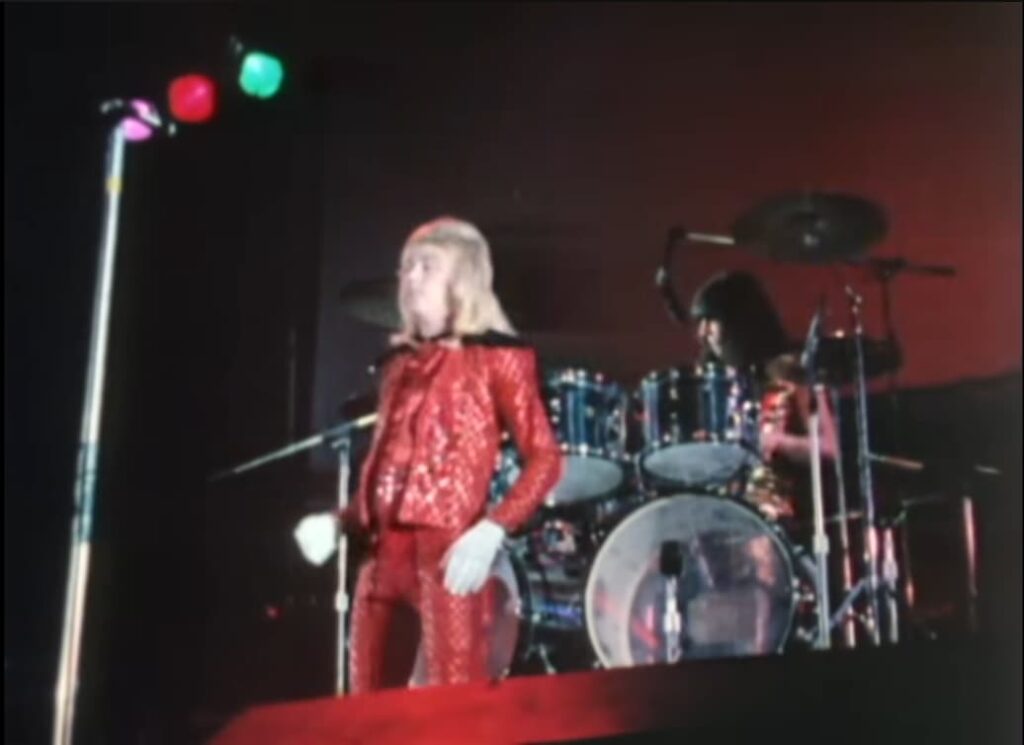
The Disco/Promo Clip from October 27, 1973, further amplifies this duality. Visually, it reflects the glam aesthetic—bright lights, exaggerated fashion, a sense of performance that borders on the surreal. Yet there is also a tension beneath it. The band does not simply play the song; they inhabit it. Lead vocalist Brian Connolly delivers his lines with a mix of confidence and urgency, while the rest of the group moves with a kind of synchronized intensity that mirrors the song’s restless energy.
In the broader context of the early 1970s, “The Ballroom Blitz” stands as a defining moment for glam rock. It arrived at a time when music was becoming increasingly visual, increasingly theatrical. Artists were no longer just performers—they were characters, storytellers, larger-than-life figures. And yet, even within that spectacle, the song retains something grounded. It is rooted in a real experience, a real confrontation between performer and audience.
There is also a certain irony in its legacy. What began as a reaction to hostility became one of the most celebrated party anthems of its time. The tension, the confusion, the sense of things spiraling out of control—all of it was reshaped into something people would dance to, sing along with, and remember with a sense of exhilaration rather than fear.
Listening to “The Ballroom Blitz” now, one can still feel that initial jolt. It does not fade into the background. It demands attention, just as it did upon its release. But beyond the surface excitement, there is a deeper resonance—a reminder of how quickly a moment can turn, how unpredictability can shape art in unexpected ways.
In the end, Sweet did more than capture an incident. They transformed it. They took a night that could have been forgotten for all the wrong reasons and turned it into something enduring. And in doing so, “The Ballroom Blitz” became more than just a hit record. It became a snapshot of an era when music dared to be loud, dramatic, and unapologetically alive.