
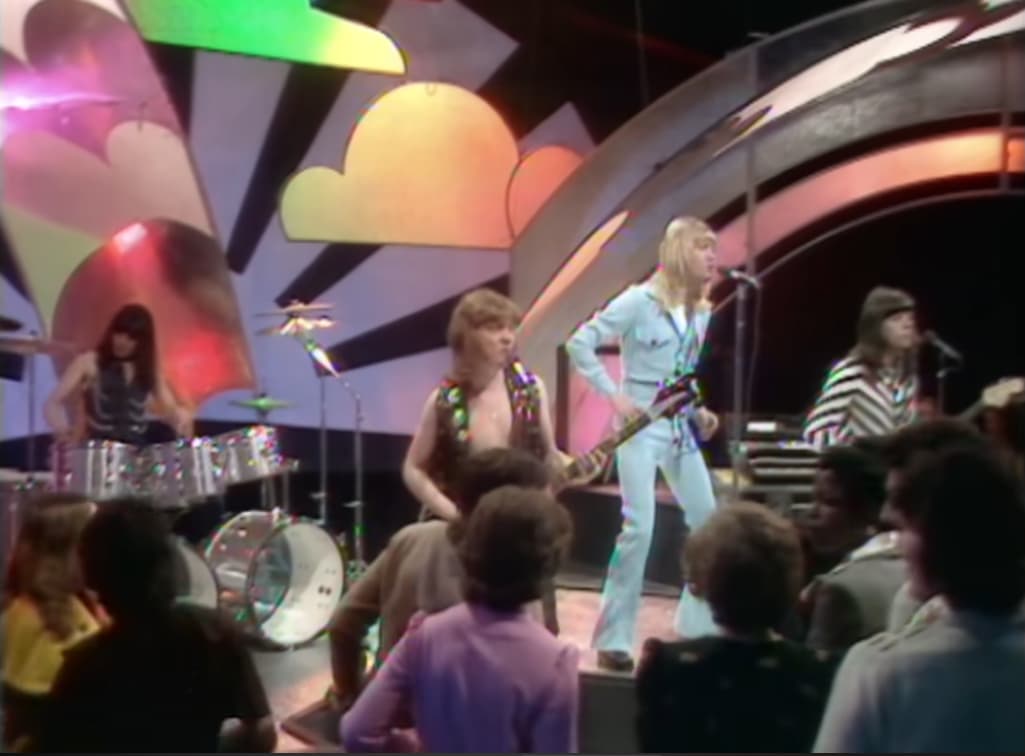
A glittering escape wrapped in rhythm—“Fox On The Run” captures the fleeting nature of fame, where beauty shines brightest just before it disappears
When Sweet stepped onto the stage of Top Of The Pops on December 23, 1975, to perform “Fox On The Run,” they were not merely presenting another hit single—they were quietly redefining themselves. Released earlier that year, the song became one of their most successful records, reaching No. 2 on the UK Singles Chart and climbing to No. 5 on the US Billboard Hot 100. It also topped charts in several countries, marking a moment when Sweet stood firmly on both sides of the Atlantic, their sound resonating far beyond the glam rock scene that had first embraced them.
What made “Fox On The Run” particularly significant was not just its success, but its origin. Unlike many of their earlier hits, this track was written and produced entirely by the band—Brian Connolly, Andy Scott, Steve Priest, and Mick Tucker—without the involvement of their long-time collaborators Nicky Chinn and Mike Chapman. This independence signaled a turning point. It was Sweet stepping out from behind a carefully crafted image and taking control of their artistic direction, shaping a sound that felt more personal, more deliberate, and perhaps more reflective of who they had become.
At first listen, “Fox On The Run” feels bright, immediate, almost effortless. The layered harmonies, the polished production, the unmistakable glam sheen—it all suggests a song built for radio and wide audiences. But beneath that surface lies something more nuanced. The lyrics tell the story of a woman constantly in motion, elusive and untouchable, moving from one place to another without ever truly settling. She is admired, desired, and yet ultimately unreachable.
It would be easy to hear this as a simple narrative, but in the context of Sweet’s career at the time, it begins to take on a different meaning. The “fox” becomes more than just a character—it becomes a symbol. Perhaps of fame itself. Perhaps of the fleeting nature of success, where attention shifts quickly, where what is celebrated today may be forgotten tomorrow. There is an undercurrent of distance in the song, a quiet acknowledgment that not everything worth chasing can be held onto.
The Top Of The Pops performance that December carries its own kind of atmosphere. Positioned just before the holiday, the broadcast had a sense of celebration, of looking back on the year that had passed. For Sweet, it was a moment of arrival—but also, in hindsight, a moment suspended in time. The energy on stage is confident, polished, and assured. Yet there is something in the performance that feels almost reflective, as if the band understood, even then, how quickly moments like these could pass.
Musically, the song stands as one of the clearest examples of Sweet’s ability to blend accessibility with craftsmanship. The guitar work is crisp, the rhythm steady and inviting, and the vocal arrangement layered with precision. It is a sound that feels both expansive and controlled, never overwhelming, always drawing the listener in. Unlike the heavier edge of some of their other tracks, “Fox On The Run” leans into melody and texture, creating something that lingers long after it ends.
Over time, the song has taken on a life beyond its original release. It has appeared in films, commercials, and countless compilations, each time introducing itself to new listeners while carrying the memory of its first moment. And yet, no matter how many times it returns, there remains something tied to that winter performance in 1975—a sense of presence, of immediacy, of a band fully aware of where they stood, even if they could not yet see what lay ahead.
There is a quiet honesty in that. Because songs like “Fox On The Run” do not simply endure because they are catchy or well-crafted. They endure because they capture something that cannot be easily explained—a feeling, a moment, a recognition that slips in quietly and stays.
And so, when the final notes fade, what remains is not just the echo of a melody, but the sense of having witnessed something just out of reach. Something bright, fleeting, and impossible to hold onto for long.