
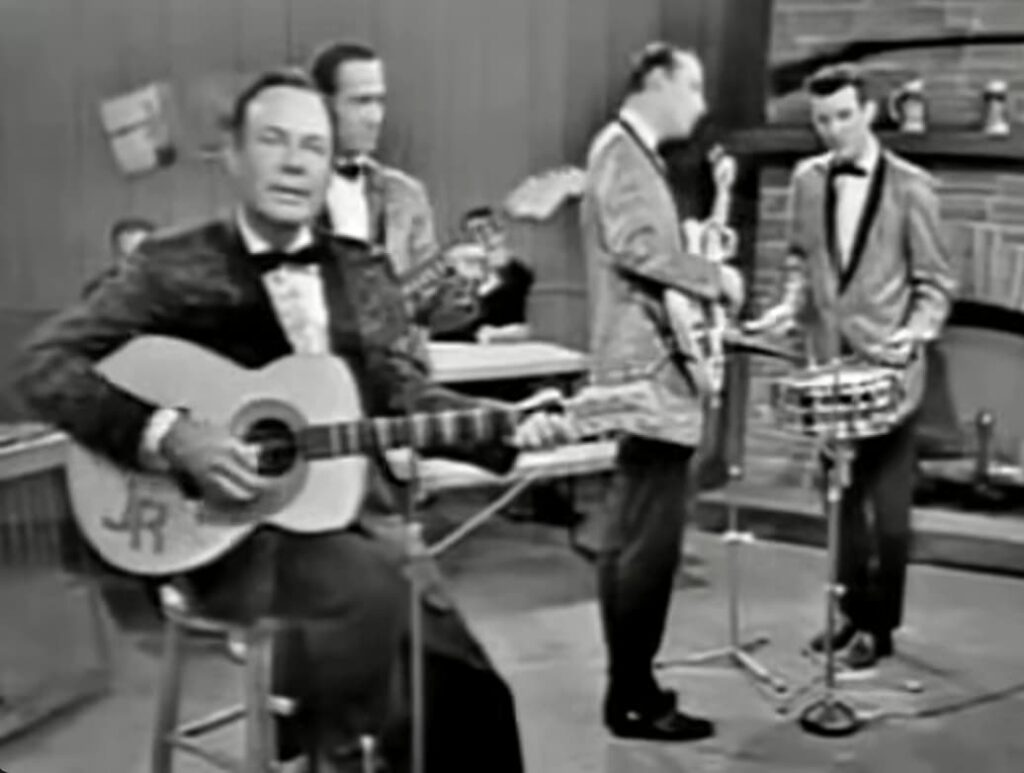
A voice that never needed to rise—Jim Reeves turned even the shortest lines into something lasting, where love, distance, and memory quietly endured
When Jim Reeves appeared on the Pet Milk Grand Ole Opry stage, offering shortened renditions of “Four Walls,” “Tennessee Waltz,” and “He’ll Have To Go,” the performance carried a kind of quiet authority that few artists ever truly achieve. These were not full-length interpretations, not elaborate reimaginings, but something more distilled—fragments of songs that somehow felt complete, as though each line already held everything that needed to be said.
By the time of this appearance, Jim Reeves had firmly established himself as one of the defining voices of the Nashville Sound, a smoother, more orchestrated approach to country music that emerged in the late 1950s. His breakthrough came with “Four Walls” in 1957, a recording that reached No. 1 on the Billboard Country & Western Best Sellers chart and crossed over to No. 11 on the Billboard Pop chart. It was a remarkable achievement for a country record at the time, signaling a shift in how the genre could reach beyond its traditional audience.
“He’ll Have To Go,” released in 1959, would go even further. The song spent 14 weeks at No. 1 on the Billboard Hot Country Singles chart and climbed to No. 2 on the Billboard Hot 100, becoming one of the most iconic crossover hits of its era. Meanwhile, “Tennessee Waltz,” though originally popularized by Patti Page in 1950, had long been absorbed into the shared memory of American music—a song that carried its own history wherever it was sung.
What makes this particular Opry performance so compelling is not the fame of the songs themselves, but the way Jim Reeves approaches them. There is no urgency in his delivery. No attempt to impress or overwhelm. Instead, there is a remarkable sense of control—an understanding that the emotional weight of a song does not depend on volume or length, but on timing, phrasing, and restraint.
In “Four Walls,” even in abbreviated form, one can still feel the isolation that defines the song. Written by Marvin Moore and George Campbell, it tells the story of a man confined not just by physical space, but by memory. Reeves does not dramatize that loneliness. He allows it to exist quietly, almost matter-of-factly, which somehow makes it more convincing.
With “He’ll Have To Go,” the mood shifts, but only slightly. The song, built around a late-night telephone conversation, is one of the most subtle portrayals of romantic uncertainty ever recorded. Reeves’s signature line—delivered in a near whisper—does not demand attention. It invites it. Even in a shortened version, that intimacy remains intact. The listener is drawn in, not by force, but by the sense that something deeply personal is being shared.
And then there is “Tennessee Waltz.” In Reeves’s hands, it becomes less about heartbreak and more about recollection. The melody moves gently, almost as if it is aware of its own history. There is no attempt to reinterpret or modernize it. Instead, he treats it with a kind of quiet respect, allowing the song to remain exactly what it has always been—a memory set to music.
What ties these performances together is not just the material, but the voice itself. Jim Reeves possessed what many have described as a “velvet baritone,” but that description only captures part of it. There is also a steadiness in his tone, a refusal to overstate emotion. He sings as though he trusts the listener to understand, without needing to be convinced.
Looking back, there is something almost timeless about this moment at the Grand Ole Opry. It reflects an era when music did not need to fill every space, when silence could carry as much meaning as sound. The shortened format of the songs only reinforces that idea. Nothing is wasted. Nothing is exaggerated.
In the end, these brief performances say more than many full-length recordings ever could. They remind us that a song, at its core, is not defined by its duration, but by its truth. And in the voice of Jim Reeves, that truth feels steady, unhurried, and quietly enduring—like something that does not need to be held onto, because it never really leaves.
 Oldies Songs