
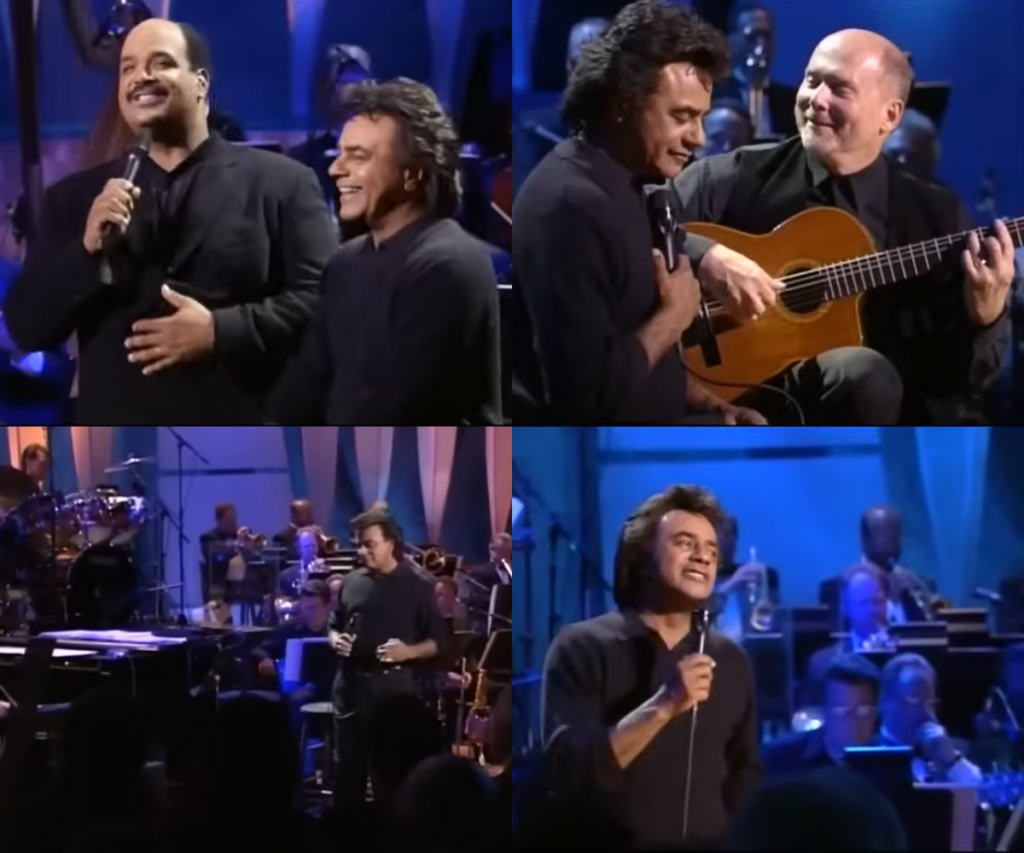
An evening shaped by memory and request—“Johnny Mathis Sings Live at the Audience’s Request” becomes less a concert, more a quiet conversation between a voice and those who have carried it through time
On May 28, 1998, inside the intimate setting of Sony Music Studios in New York, Johnny Mathis stepped onto the stage not to present a fixed program, but to respond—to listen, and then to sing. The result was “Johnny Mathis Sings Live at the Audience’s Request,” a live album that would go on to reach No. 1 on the Billboard Traditional Jazz Albums chart and No. 10 on the Top Jazz Albums chart, reaffirming Mathis’ enduring presence in a musical landscape that had long since changed around him.
What made that evening distinct was not merely the repertoire, but the spirit behind it. By 1998, Johnny Mathis was no longer simply a recording artist; he had become something closer to a custodian of memory. His voice, remarkably unchanged in its warmth and clarity, carried with it decades of listening—weddings, quiet evenings, long drives, and solitary reflections. And on that night in New York, the audience did not come to be introduced to new songs. They came to hear what had stayed with them.
The concept was simple, almost disarmingly so: the audience would request the songs, and Mathis would deliver them. Yet within that simplicity lay something deeply revealing. Each request was not just a title, but a story unspoken. And when Mathis responded—whether with “Misty,” “Chances Are,” or one of the many standards that had become inseparable from his name—he was not merely performing. He was returning something that had once been given.
There is a certain stillness that defines this recording. Unlike large concert halls filled with spectacle, the studio setting allowed for closeness. The arrangements are elegant but never overwhelming—strings that rise and fall with restraint, a rhythm section that understands when to step forward and when to recede. Everything is built around the voice, and the voice, in turn, never seeks to dominate.
Listening carefully, one begins to notice the subtle changes that time has brought. There is a slightly deeper texture now, a softness at the edges that was not present in the early recordings. But rather than diminishing the performance, these changes add something else—an honesty that cannot be replicated in youth. When Mathis holds a note, there is no urgency to impress. Only a quiet assurance that the song will find its way.
What is perhaps most striking is the absence of distance. Many performers, after decades in the spotlight, create a space between themselves and their audience—a necessary boundary shaped by time and experience. Johnny Mathis, on this night, does the opposite. He steps closer. He listens. He allows the direction of the evening to be guided not by structure, but by connection.
There is also a gentle sense of reflection that runs through the performance. Not in words, but in tone. Each song feels as though it is being revisited, not repeated. The melodies remain unchanged, yet something within them has shifted—subtly, almost imperceptibly. It is the difference between remembering and reliving.
The success of “Johnny Mathis Sings Live at the Audience’s Request” on the jazz charts speaks to more than commercial achievement. It reflects a continued desire to return to music that does not rush, that does not demand, but instead invites. In a time when the industry had begun to move faster, louder, and more transient, Mathis offered something steady. Something that could be held onto.
And perhaps that is what remains most enduring about that evening in New York. It was not a performance designed to be monumental. There were no dramatic reinventions, no attempts to reshape the past. Instead, it was an acknowledgment—that certain songs, once given, continue to live quietly in the lives of those who heard them.
In the end, Johnny Mathis did not need to reinvent his music to keep it alive. He simply returned to it, again and again, with the same care and attention. And in doing so, he reminded us that sometimes, the most meaningful music is not what is new, but what remains—unchanged, familiar, and still capable of reaching us, even after all these years.