
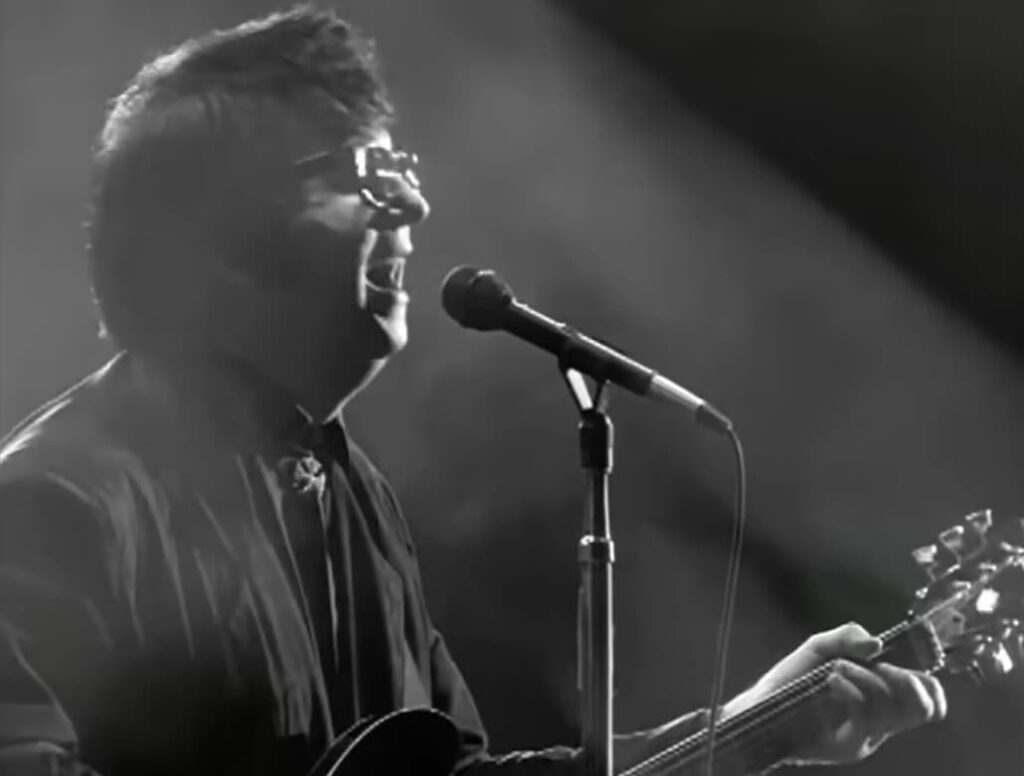
A timeless rhythm of longing and admiration—“Oh, Pretty Woman” endures as both a celebration of beauty and a quiet confession of loneliness
When Roy Orbison first released “Oh, Pretty Woman” in 1964, it did not simply climb the charts—it defined them. The single reached No. 1 on the Billboard Hot 100, holding its place for three consecutive weeks, while also topping charts in the United Kingdom, Canada, and Australia. It became one of the most recognizable songs of its era, later earning a place in the Grammy Hall of Fame, and standing as a cornerstone of Orbison’s remarkable catalog. Yet decades later, when he returned to perform the song in the 1988 television special A Black and White Night, something subtle but profound had changed. The song was no longer just a hit—it had become a reflection.
The origins of “Oh, Pretty Woman” are almost disarmingly simple. Co-written with Bill Dees, the idea came from a passing remark as Orbison’s wife, Claudette, left the house. What began as a casual observation—“A pretty woman never needs any money”—quickly evolved into a melody, then a rhythm, then a song that would carry far beyond its modest beginnings. Built around that instantly recognizable guitar riff, the track combined a driving beat with Orbison’s unique vocal phrasing—part rock and roll, part operatic yearning. It was bold, confident, and yet, beneath the surface, undeniably vulnerable.
That vulnerability becomes even more apparent in the Black and White Night performance. Surrounded by an extraordinary ensemble that included Bruce Springsteen, Elvis Costello, and T-Bone Burnett, Orbison stands almost completely still, dressed in black, his presence quiet yet commanding. There is no need for movement, no need for spectacle. The voice carries everything.
What makes this version of “Oh, Pretty Woman” so compelling is not its energy—though the rhythm remains as infectious as ever—but its sense of distance. Time has placed a gentle weight on the performance. The playful flirtation of the original recording is still there, but it is tempered by something deeper, something earned. When Orbison sings, there is a sense that he is not simply addressing a passing figure on the street, but revisiting a feeling he has known for a lifetime—the mixture of admiration, longing, and quiet uncertainty that lingers long after the moment itself has passed.
By 1988, Orbison had already lived through both immense success and profound personal loss. These experiences do not announce themselves directly in the performance, but they shape it in ways that are impossible to ignore. The phrasing is more measured, the delivery more deliberate. Even the pauses seem to carry meaning. It is as if the song has been given room to breathe, to reveal something it could not fully express in its earlier, more youthful form.
There is also a certain intimacy in the setting of A Black and White Night. The stripped-down visual style—no elaborate staging, no distractions—places the focus entirely on the music. And in that space, Roy Orbison does something remarkable: he allows the song to exist exactly as it is, without embellishment, without reinvention. He trusts it. And in doing so, he reminds us why it has endured.
Listening now, it becomes clear that “Oh, Pretty Woman” is not simply about beauty, nor even about desire. It is about recognition—the fleeting moment when someone passes by and leaves an impression that cannot quite be explained. It is about the distance between seeing and knowing, between wanting and understanding. And perhaps most of all, it is about the quiet hope that, just once, that distance might close.
In the end, the Black and White Night performance does not attempt to recapture the past. It does something far more meaningful. It acknowledges it. It honors it. And it lets the song speak with the full weight of everything that has come before.