
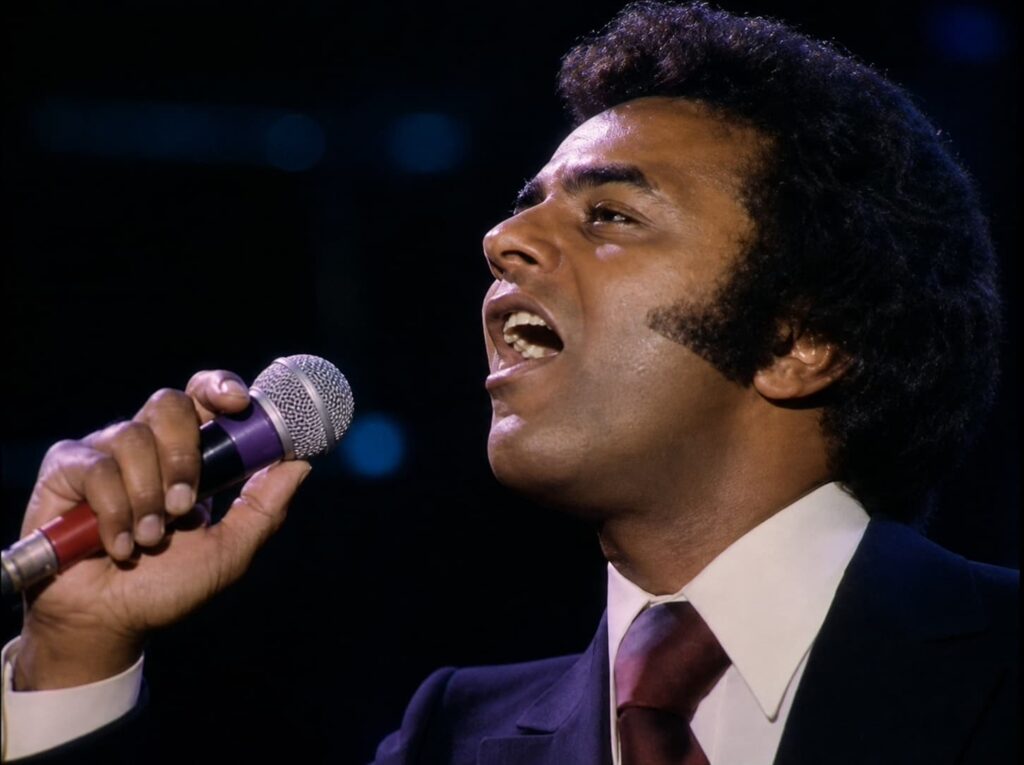
A song of impossible dreams carried through time—“Man of La Mancha Medley” becomes, in Johnny Mathis’ voice, a quiet testament to endurance and belief
When Johnny Mathis performed the “Man of La Mancha Medley” at the Royal Albert Hall in 1978, he was not introducing a new hit to the charts, nor revisiting one of his own signature singles. Instead, he was stepping into a broader musical tradition—one rooted in the enduring legacy of the stage musical Man of La Mancha, with music by Mitch Leigh and lyrics by Joe Darion. Songs such as “The Impossible Dream (The Quest)”, the centerpiece of the medley, had already achieved widespread recognition, reaching No. 35 on the Billboard Hot 100 in 1966 through the recording by Jack Jones, and later becoming a standard interpreted by countless vocalists. Yet in Mathis’ hands, especially on that London evening, the material takes on a different kind of life—less theatrical, more reflective.
By 1978, Johnny Mathis had already secured his place as one of the most enduring voices in popular music. His early successes in the late 1950s had established him as a chart force, but performances like this one reveal something beyond commercial achievement. They reveal an artist who had learned how to inhabit a song fully—without excess, without urgency, and without the need to prove anything further.
The Royal Albert Hall setting plays an essential role in shaping the atmosphere. There is a natural grandeur to the venue, a sense of history that quietly frames every note. And yet, despite the scale of the hall, the performance itself feels intimate. Mathis does not attempt to overpower the space. Instead, he allows his voice to move through it with measured grace, trusting in its clarity rather than its volume.
The medley format allows for a gentle progression of themes—hope, struggle, perseverance—woven together without abrupt transitions. At its core lies “The Impossible Dream,” a song that has, over the years, come to represent something larger than its original context. In Mathis’ interpretation, it is stripped of theatrical bravado. What remains is something more personal, more grounded. The dream is no longer a distant ideal—it feels closer, more human, shaped by experience rather than imagination alone.
There is a noticeable restraint in his delivery. Where other interpretations might lean into dramatic crescendos, Mathis chooses subtlety. He understands that the strength of the song lies not in how loudly it is sung, but in how sincerely it is felt. Each phrase is given careful attention, each word allowed to settle before the next begins. It is a performance built on patience—on the belief that meaning reveals itself gradually.
What makes this rendition particularly affecting is the sense of perspective it carries. By this stage in his career, Mathis was no longer singing about dreams from a place of anticipation, but from a place of reflection. The journey implied in the lyrics—the striving, the setbacks, the quiet determination—feels less like a narrative and more like a lived experience. There is no need to emphasize it. It is simply there, embedded in the tone of his voice.
The orchestration supports this approach beautifully. It remains present but never intrusive, allowing the vocal line to remain at the forefront. There is a balance here that is not easily achieved—a dialogue between voice and arrangement, rather than a competition.
Listening to the “Man of La Mancha Medley” from this 1978 performance, one is reminded that certain songs do not belong to any single moment in time. They evolve, gathering meaning as they are revisited by different voices, in different contexts. And in this instance, Johnny Mathis does not attempt to redefine the material. He simply reveals another layer of it—one shaped by time, by experience, and by a quiet, unwavering belief in the value of the song itself.
In the end, the performance does not seek applause through grandeur. It leaves something more lasting—a sense of calm conviction, of a dream that may never be fully realized, yet remains worth holding onto, precisely because of that.