
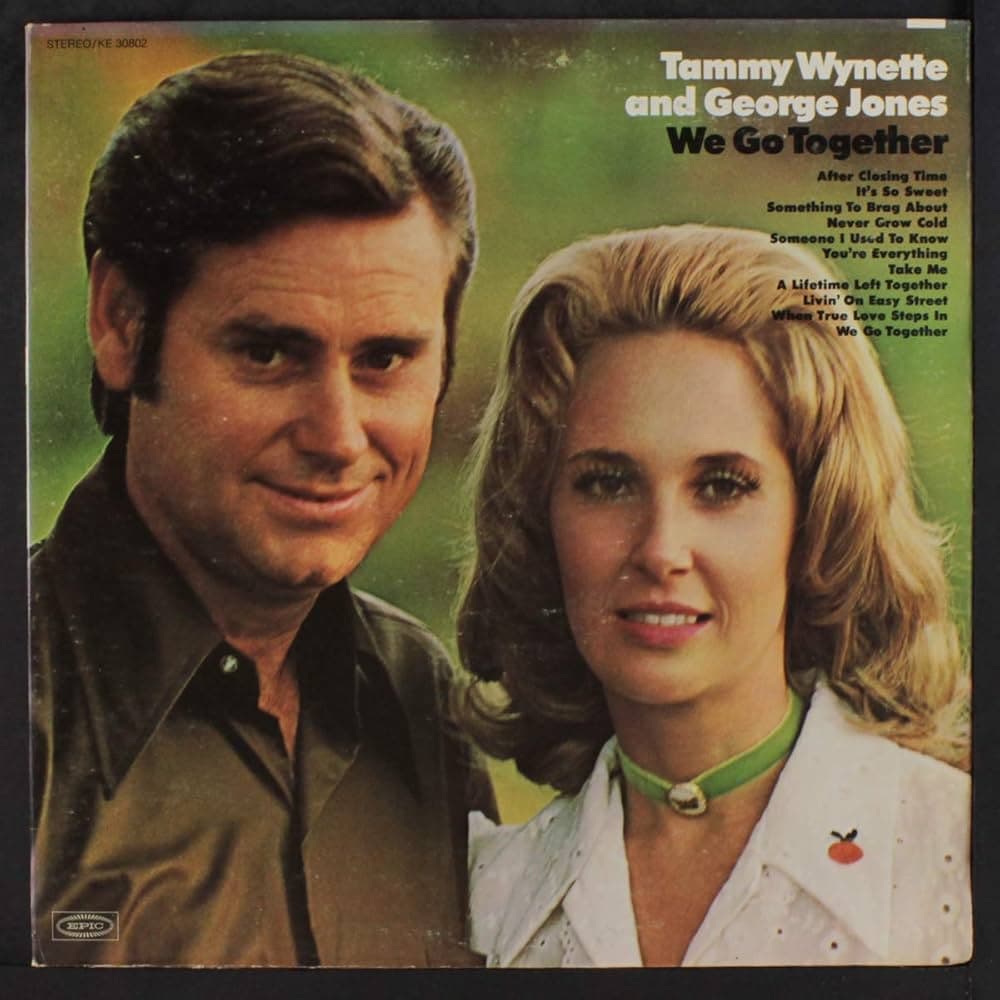
When two wounded voices learn to stand side by side—“We Go Together” becomes less a duet album and more a fragile promise set to music
By the time Tammy Wynette and George Jones released the album We Go Together in 1971, their names were already inseparable in the world of country music—both artistically and personally. The record arrived during a period when their relationship was still intact, still holding on, and perhaps still believing in its own title. On the charts, the album reached No. 3 on the Billboard Top Country Albums, while its standout single, “Take Me”, climbed to No. 9 on the Billboard Hot Country Singles chart. These were not just respectable numbers—they reflected a public that was deeply invested in the voices, and perhaps even more in the lives, behind them.
But statistics, as they often do, only tell part of the story. Because We Go Together was never just a collection of songs. It was a moment captured between two people who, at that time, were still trying to believe that harmony could exist both on stage and off.
The album itself is built on the delicate balance between two unmistakable voices. Tammy Wynette’s delivery carries a certain clarity—controlled, emotionally precise, almost fragile in its honesty. George Jones, on the other hand, brings a depth that feels weathered, as though every note has already lived through something before reaching the listener. When these two voices meet, they do not blend in the traditional sense. They lean against each other. Sometimes gently, sometimes with tension just beneath the surface.
Songs like “Take Me” embody this dynamic perfectly. There is longing in every line, but it is not a naive kind of longing. It is shaped by experience, by the quiet understanding that love is rarely simple, and even more rarely permanent. The lyrics speak of closeness, of needing someone, yet there is always an undercurrent—a sense that such closeness comes with a cost.
At the time of recording, Wynette and Jones were already navigating a relationship that would later become one of the most talked-about in country music history. They married in 1969, and by the early 1970s, the cracks had begun to show, even if they were not yet fully visible to the public. That is what gives We Go Together its lasting resonance. It captures them not at the end, not in the aftermath, but in that uncertain middle—where hope still exists, even as reality quietly begins to intrude.
There is a certain restraint in the production of the album, a decision not to overwhelm the listener with elaborate arrangements. Instead, the focus remains firmly on the voices, on the conversation between them. It feels intimate, almost unguarded at times, as though the songs were less about performance and more about expression.
Listening now, there is an unavoidable sense of hindsight. The title itself—“We Go Together”—carries a weight it may not have held in 1971. What once sounded like a declaration now feels closer to a question. Did they, truly? Or was it something they wanted to believe, something they tried to hold onto for as long as they could?
And yet, that uncertainty is precisely what makes the album endure. It does not offer resolution. It does not attempt to simplify what was, by all accounts, a complicated relationship. Instead, it allows the listener to sit within that complexity, to hear two voices reaching toward each other, even as something unspoken lingers between them.
In the years that followed, Tammy Wynette and George Jones would part ways, their personal story unfolding in ways that were as difficult as they were inevitable. But We Go Together remains—a snapshot of a time when the possibility of “together” still felt within reach.
There are albums that impress with their craftsmanship, and there are albums that endure because they reveal something deeper. This is one of the latter. Not because it tells a perfect story, but because it tells an honest one—where love is not idealized, but lived, with all its uncertainty, all its quiet contradictions, and all the moments that exist in between.