
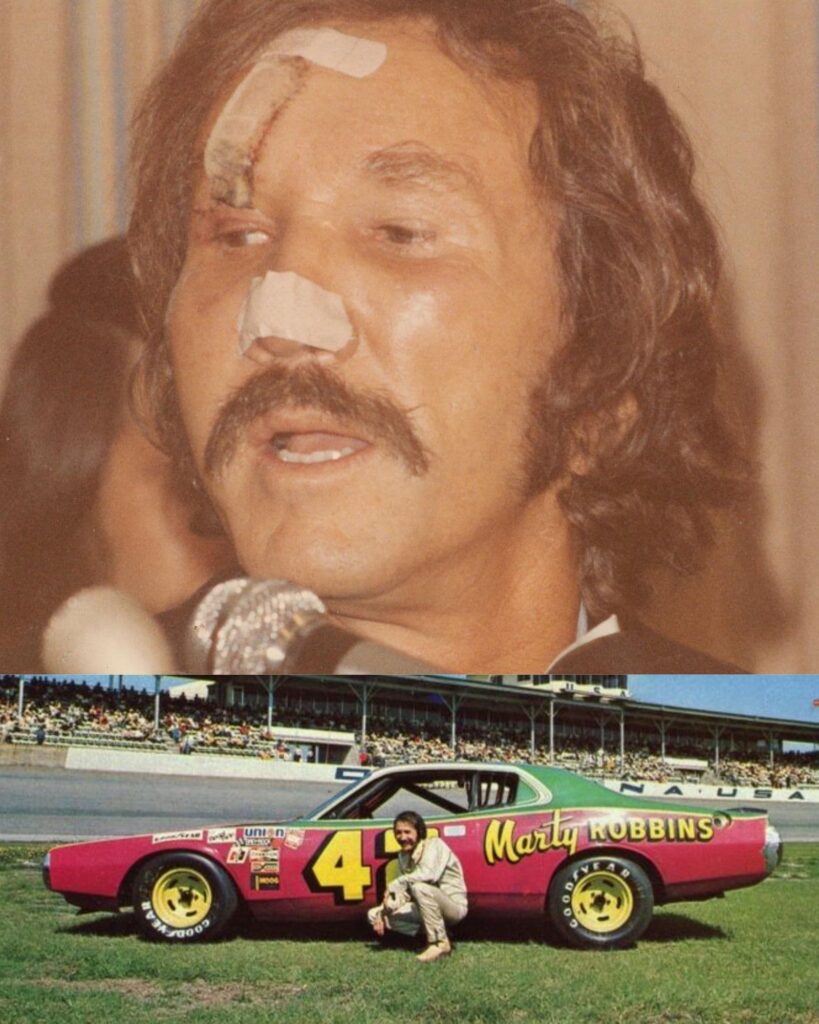
Where courage becomes instinct—“Big Iron” is not just a Western ballad, but a reflection of the quiet bravery Marty Robbins carried beyond the music
Long before the story of a split-second decision at Charlotte Motor Speedway in 1974 became part of his legend, Marty Robbins had already given voice to a certain kind of man—one who steps forward when others hesitate, who acts not for recognition, but because something inside him leaves no alternative. That voice found one of its most enduring expressions in “Big Iron”, released in 1959 as part of the landmark album Gunfighter Ballads and Trail Songs.
While “Big Iron” was not initially released as a major chart-topping single in the way some of Robbins’ other recordings were, it steadily gained recognition over time, eventually reaching No. 5 on the Billboard Country Chart and becoming one of the defining tracks of his career. The album itself performed strongly, solidifying Robbins’ place as a master storyteller within the country and western tradition. Decades later, the song would experience a remarkable revival, reintroduced to new audiences and reaffirmed as a cornerstone of narrative songwriting.
Written entirely by Robbins, “Big Iron” tells the story of an Arizona Ranger sent to bring down an outlaw known as Texas Red. On the surface, it is a simple Western tale—lawman versus fugitive, order confronting chaos. But as the song unfolds, it becomes something more measured, more deliberate. The Ranger does not rush. He does not boast. He arrives quietly, waits patiently, and when the moment comes, acts with a precision that feels almost inevitable.
There is no wasted motion in the narrative. No unnecessary drama. And that restraint is precisely what gives the song its weight. Robbins understood that true tension does not come from noise, but from stillness—the kind that settles just before something irreversible happens.
Years later, that same understanding would appear, not in a lyric, but in a real moment of consequence. During the 1974 Charlotte 500, fellow driver Richard Childress found himself in a vulnerable position, his car stalled across the track. At racing speed, there was no time for careful consideration—only instinct. Robbins, approaching at high velocity, made a decision that echoed the quiet certainty of the characters he once wrote about. He turned his car into the wall.
The cost was immediate and severe: broken ribs, a fractured tailbone, and more than thirty stitches. Yet what followed was not a declaration of sacrifice, not a moment of self-congratulation. Instead, Robbins expressed something far simpler—relief. Relief that Childress had walked away.
It is difficult not to hear “Big Iron” differently after knowing that. The song’s central figure—the Ranger who steps forward when no one else can—no longer feels like fiction alone. It feels like an extension of the man who wrote it. Not because Robbins sought to live out his own songs, but because both the music and the moment seem to arise from the same place: a quiet sense of responsibility, an understanding that action, when it matters most, does not announce itself.
Musically, “Big Iron” is built on a steady, unhurried rhythm. The arrangement is sparse, almost deceptively simple, allowing the story to remain at the forefront. Robbins’ voice carries the narrative with calm authority, never pushing, never overstating. He sings as though he is recalling something already decided, something that could not have happened any other way.
That sense of inevitability is what lingers. Not the gunfight itself, but the stillness that precedes it. Not the victory, but the certainty behind it.
And perhaps that is why the song endures. Because it speaks to a kind of courage that does not need to be named. A kind that exists in moments too brief for reflection, where instinct reveals character more clearly than intention ever could.
In the end, “Big Iron” is not just about a Ranger in the desert. It is about the quiet line between hesitation and action, and the rare individuals who cross it without looking back.