
A song of innocence remembered—“Toyland” becomes, in later years, a quiet meditation on time, memory, and the fragile beauty of youth
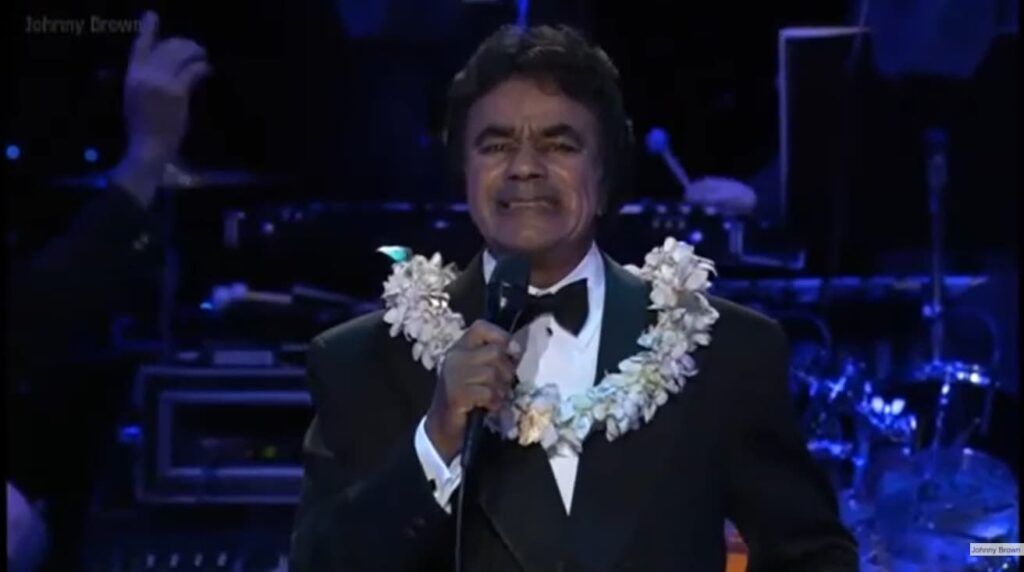
When Johnny Mathis stepped onto the stage in 2006 for his Gold: A 50th Anniversary Celebration, there was already a lifetime behind every note he would sing. Among the selections that evening, “Toyland” held a particularly delicate place. Originally written by Victor Herbert with lyrics by Glen MacDonough for the 1903 operetta Babes in Toyland, the song had long been associated with childhood wonder and gentle moral reflection. It was never a chart-topping single in the modern commercial sense, nor did Mathis’s rendition enter contemporary rankings. But to measure “Toyland” by chart positions alone would be to misunderstand its purpose entirely. Its true resonance lies elsewhere—in the quiet space between memory and time.
By the time Mathis revisited “Toyland” in this anniversary concert, his voice had already become something more than just an instrument of melody. It carried history. Known for his early successes in the late 1950s with hits like “Chances Are” and “It’s Not for Me to Say,” he had built a career defined by warmth, control, and an almost conversational intimacy. Yet in “Toyland,” especially in this 2006 live performance, there is an added layer—a sense of looking back, not with regret, but with a kind of careful understanding.
The arrangement itself remains faithful to the song’s traditional structure. There are no dramatic reinventions, no modern reinterpretations. Instead, it unfolds gently, almost reverently, allowing the melody to guide the listener. Mathis does not rush. Each phrase is given room to settle, as though he is aware that the meaning of the song lies not in its progression, but in its pauses.
Lyrically, “Toyland” has always carried a quiet lesson. “Once you pass its borders, you can never return again.” It is a line that, in younger years, may feel abstract—something to be understood later. But in the hands of a seasoned performer like Johnny Mathis, it becomes something else entirely. It is no longer a simple reflection on childhood. It becomes an acknowledgment of time’s steady movement, of the way certain places—whether real or emotional—exist only once, and then only in memory.
There is something particularly moving about the context of this performance. A 50th anniversary is not just a celebration of longevity—it is a moment of reckoning, of quiet inventory. What has endured, what has changed, what remains. In choosing to include “Toyland” in this program, Mathis seems to be offering more than nostalgia. He is offering perspective.
His delivery is restrained, almost understated. There are no grand vocal flourishes, no attempts to impress. Instead, there is a steadiness, a clarity that comes from knowing exactly what the song requires. The voice, still remarkably intact, carries a softness that feels intentional—as though anything more forceful would disturb the fragile atmosphere the song creates.
And perhaps that is what makes this performance linger. It does not ask for attention. It invites reflection. It reminds us that music, at its most enduring, is not always about innovation or reinvention. Sometimes, it is about returning to something familiar and seeing it differently.
In “Toyland,” as performed during Gold: A 50th Anniversary Celebration, there is a quiet understanding that time does not erase what has come before—it reshapes it. The song remains what it has always been, but the listener, and the singer, bring new meaning to it with each passing year.
By the final notes, there is no dramatic conclusion, no sense of finality. Just a gentle fading, as though the song itself is stepping back into the distance. And in that moment, it becomes clear that Johnny Mathis is not simply revisiting the past. He is acknowledging it, holding it briefly, and then letting it rest—exactly where it belongs.