
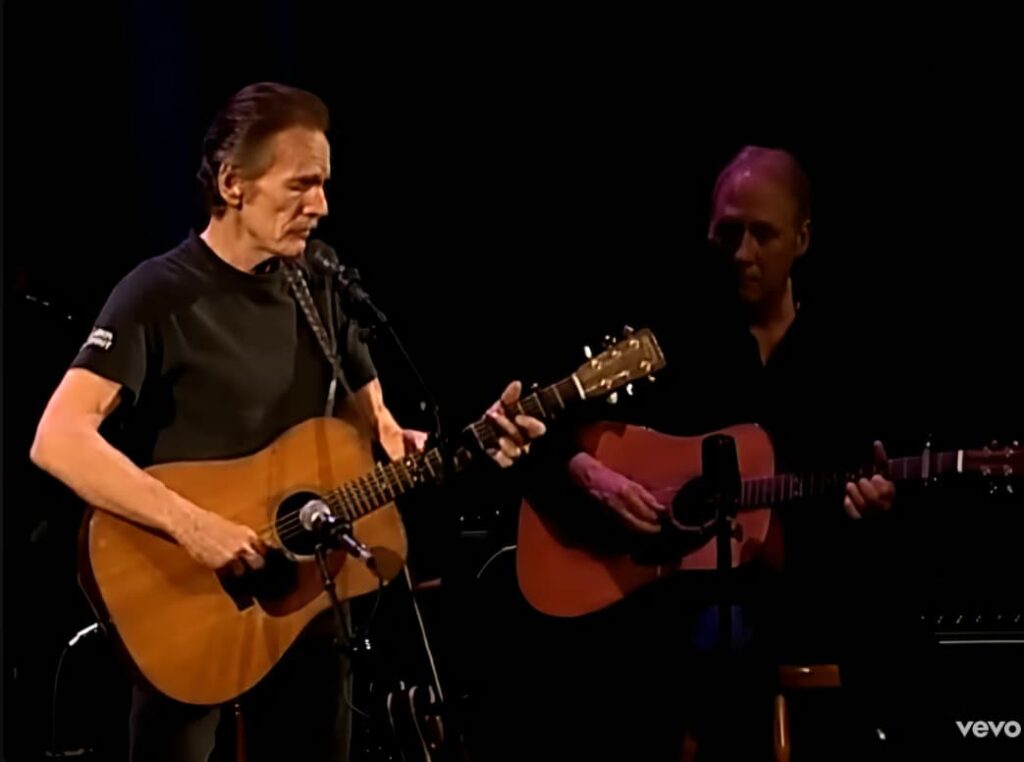
A confession set to melody—“If You Could Read My Mind” reveals how love, once broken, lingers quietly in memory rather than disappearing
When Gordon Lightfoot released “If You Could Read My Mind” in 1970, it did not arrive with the force of spectacle, but with the quiet certainty of truth. The song climbed to No. 5 on the Billboard Hot 100 and reached No. 1 on the Adult Contemporary chart, while also securing strong positions in Canada and the United Kingdom. It became Lightfoot’s most commercially successful single, yet its lasting significance cannot be measured by chart performance alone. It endures because it feels less like a composition and more like a private admission—one that was never meant to be overheard, yet somehow was.
Written during the emotional aftermath of his first marriage’s collapse, the song carries a deeply personal origin. Lightfoot himself would later acknowledge that it came from a place of quiet turmoil, written almost as a way of understanding what had already been lost. There is no attempt to dramatize the pain, no effort to assign blame. Instead, there is a steady, almost resigned clarity. The kind that comes not in the middle of heartbreak, but after it—when the noise has faded and only the truth remains.
In the “Live in Reno” performance, this sense of reflection becomes even more pronounced. Time has softened the edges of the original recording, but it has also deepened its meaning. Lightfoot’s voice, slightly weathered, carries an added weight—one that cannot be replicated in a studio. There is a noticeable stillness in the way he delivers each line, as though he understands that the song no longer belongs solely to the moment it was written. It has traveled, gathered meaning, and returned with something new.
Musically, “If You Could Read My Mind” is deceptively simple. The gentle acoustic guitar progression, the restrained arrangement, the absence of unnecessary embellishment—all of it serves a single purpose: to allow the words to breathe. And those words, filled with imagery of ghost stories, paperback novels, and fading characters, create a distance that feels intentional. It is easier, perhaps, to speak of love through metaphor than to confront it directly. Yet in doing so, Lightfoot achieves something more honest.
The central idea of the song—that understanding another person completely is both desired and impossible—remains as compelling now as it was at the time of its release. “If you could read my mind,” he suggests, everything would make sense. But the very existence of the song proves the opposite. Some things cannot be fully explained. Some feelings resist translation, no matter how carefully they are expressed.
What makes the Reno performance particularly affecting is its restraint. There is no attempt to revisit the past with nostalgia, no effort to recreate the original recording note for note. Instead, Lightfoot allows the song to exist in its current form—slightly slower, more deliberate, shaped by years of distance. The phrasing is more measured, the pauses more meaningful. It is as though he is no longer telling the story for the first time, but remembering it.
And memory, as the song gently suggests, is not always precise. It softens certain details, sharpens others, and leaves behind an impression rather than a complete picture. In this way, “If You Could Read My Mind” becomes less about a specific relationship and more about the nature of reflection itself. The way we revisit moments, not to relive them, but to understand them differently.
There is a quiet dignity in this performance. It does not seek resolution, nor does it offer one. The song ends much as it begins—open, unresolved, and honest. And perhaps that is why it continues to resonate. Not because it answers anything, but because it acknowledges the questions that remain.
In the end, Gordon Lightfoot does not ask to be understood completely. He simply offers a glimpse—enough to recognize the feeling, even if the full story remains just out of reach.