
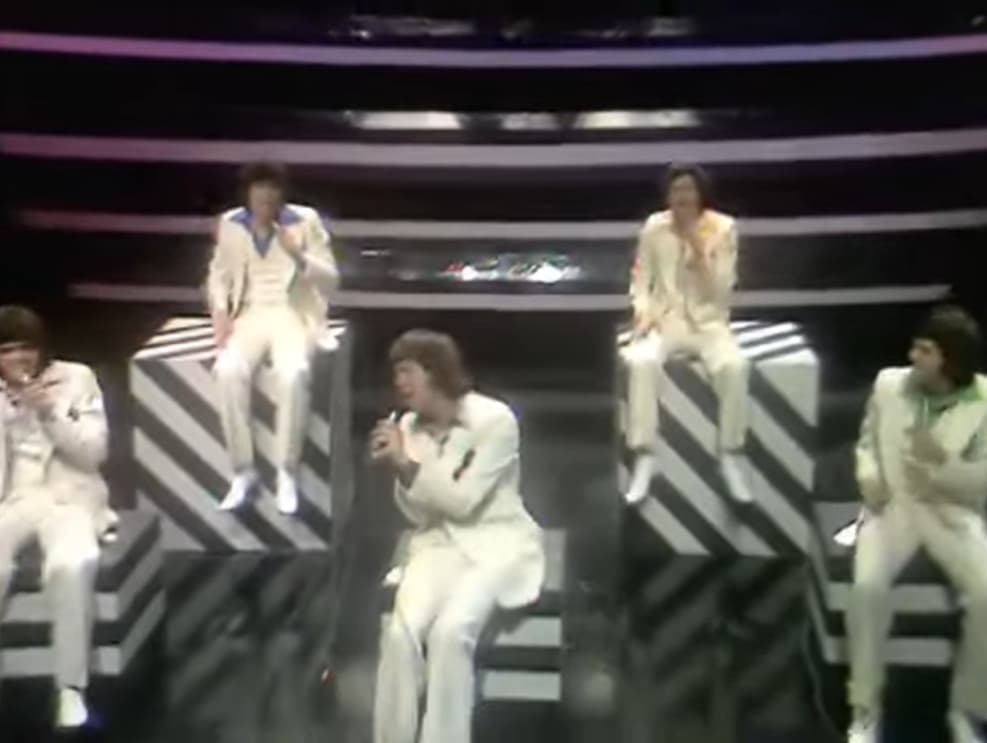
A declaration of loyalty and quiet devotion—“The Proud One” reflects a moment when sincerity in pop music still carried its own kind of strength
When The Osmonds brought “The Proud One” to British television audiences on Top of the Pops in 1975, they were presenting more than just another single—they were reaffirming their place within a rapidly shifting musical landscape. Originally released in 1973, the song reached No. 22 on the UK Singles Chart and climbed to No. 40 on the Billboard Hot 100 in the United States. While it did not achieve the explosive chart dominance of their earlier hit “Love Me for a Reason,” which reached No. 1 in the UK, “The Proud One” revealed something quieter, but perhaps more enduring: emotional steadiness in a time increasingly drawn to spectacle.
Written by Merrill Osmond and produced during a period when the group was transitioning from teen idols into more self-directed musicians, “The Proud One” carries the unmistakable imprint of personal investment. This was no longer a family act simply performing material handed to them. There was authorship here, intention, and a desire to be taken seriously beyond the expectations that had defined their early success.
The 1975 Top of the Pops performance is particularly revealing in this regard. British audiences, often more reserved in their reception, provided a setting where the group’s sincerity could either resonate or falter. And yet, The Osmonds approached the stage without exaggeration. There were no elaborate theatrics, no attempt to chase the harder-edged sounds that were beginning to dominate mid-1970s pop and rock. Instead, they leaned into what they understood best—tight harmonies, clear melodic lines, and a sense of unity that had always been their foundation.
Lyrically, “The Proud One” speaks in direct, uncomplicated terms. It is a song about standing by someone without hesitation, about carrying a quiet sense of pride in a relationship that does not require validation from the outside world. “I’m the proud one,” the chorus insists—not with arrogance, but with a kind of gentle certainty. It is not a boast. It is an acknowledgment.
What makes the song linger is precisely this lack of complexity. In an era when music was becoming more experimental, more layered, and at times more distant, The Osmonds offered something immediate and recognizable. The emotions are not obscured by metaphor or abstraction. They are presented plainly, almost earnestly. And in that honesty, the song finds its strength.
The arrangement supports this approach with careful restraint. The instrumentation is polished but never overwhelming, allowing the vocal harmonies to remain central. There is a balance here that reflects the group’s identity—each voice distinct, yet always working toward a collective sound. It is this sense of cohesion that defines the performance, both on record and in the televised appearance.
By 1975, the cultural tide had begun to shift. Glam rock, progressive influences, and the early stirrings of punk were beginning to reshape popular music. In that context, “The Proud One” might have seemed almost out of step. But listening now, that very quality gives it a certain resilience. It does not attempt to follow trends. It remains rooted in its own values—melody, harmony, and emotional clarity.
The Top of the Pops performance captures a group aware of these changes, yet unwilling to abandon what had brought them this far. There is a quiet confidence in the way they carry themselves, a sense that they understand their place even as the landscape evolves around them.
In the end, “The Proud One” is not a song that demands attention. It does not seek to overwhelm or impress through complexity. Instead, it offers something steadier—a reminder that music can still speak in simple, direct terms and be no less meaningful for it. And in that simplicity, The Osmonds leave behind a performance that continues to resonate, not because it follows the moment, but because it gently resists it.