
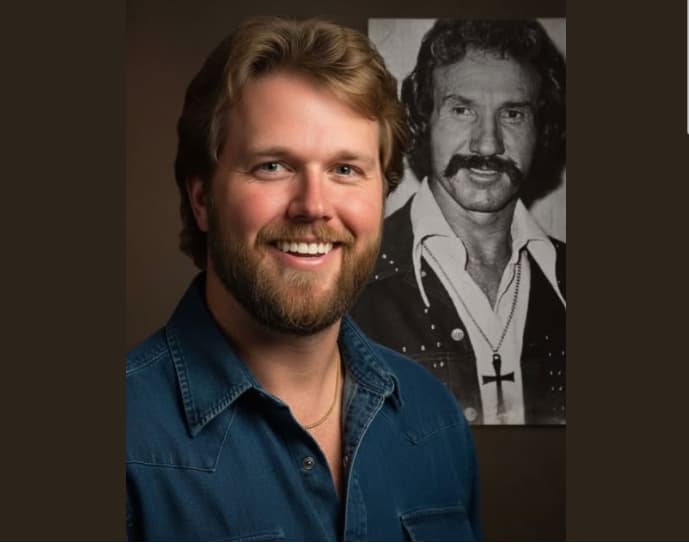
Blood and Ballads – “The Robbins Legacy”: A Saga of Poverty, Pain, and the Resilience of a Desert Dynasty
The story of the Robbins family is not merely a collection of hits on a Billboard chart; it is an epic narrative of “Blood and Ballads” that began in the sun-scorched, “working-class” dust of Glendale, Arizona. For Marty Robbins and his son Ronny, the journey was never a smooth ride through a painted Western backdrop. It was a gritty, cinematic struggle through the crushing weight of Great Depression poverty, the physical agony of a life-or-death health battle, and the complex “shadow of a legend” that required both father and son to find their own “foundation” in a world that often demanded too much.
The “backstory” of this dynasty is rooted in a resilience that modern audiences might find staggering. Marty Robbins—born Martin David Robinson—was forged in a home where resources were scarce and “scars” were often hidden behind a smile. His mother, Emma, provided the emotional architecture, but it was the poverty of his youth that fueled his “passion and danger” drive to succeed. When Ronny was born into his father’s burgeoning fame in the 1950s, he inherited a world of opportunity, yet he also inherited the heavy responsibility of carrying a “Titan’s” name. While Marty “ranked” among the elite with 94 hits, the real story was the private one: a father and son navigating the heights of Nashville success while never forgetting the “desert dust” from which they came.
The Architecture of Endurance: From Arizona Dust to Nashville Gold
For the sophisticated listener who has weathered their own life-seasons, the “Blood and Ballads” journey resonates as a “souvenir” of authentic American grit. Marty’s life was a series of narrow escapes. He faced the “danger” of a failing heart starting in 1969, undergoing pioneering bypass surgeries that left him with physical scars beneath his sharp Western coats. Yet, he refused to let the “pain” silence his “Velvet Voice.” Ronny, standing by his side, witnessed the cost of this greatness firsthand.
“It’s the foundation of the home that keeps the man standing when the world outside is shaking.”
This sentiment guided both men. Ronny’s decision to join his father’s band and later forge his own path at Columbia Records wasn’t an act of competition; it was an act of “blood” loyalty. He understood that to be the son of a “Gentle Giant” meant protecting the legacy while building his own “Happy Home.” Their collaborative journey through the 1970s was a cinematic masterclass in mutual respect, proving that even in the shadow of a monolith, a son can find his own light.
A Legacy Written in Grit and Grace
As we look back at the grand legacy of the Robbins family, we see a story that is as much about the “pain” of the journey as it is about the glory of the destination. They taught us that a “ballad” is only as strong as the “blood” that inspired it. Marty took the hardships of his childhood and turned them into the epic tales of “El Paso,” while Ronny took the lessons of his father’s endurance and turned them into a life of quiet, proud stewardship.
They remain titans because they understood the hierarchy of values: “Passion” for the art, “Danger” for the thrill, but “Family” for the soul. The Robbins saga is a reminder that the most enduring legends are built on the “working-class” virtues of persistence and love. Even after the final “farewell” in 1982, the echo of their shared journey remains as vibrant as an Arizona sunrise.
 Music Legend