
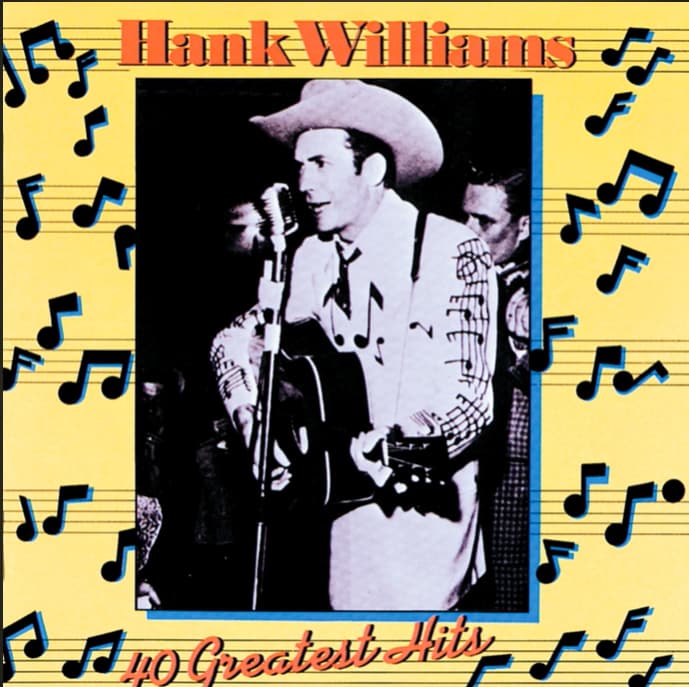
Hank Williams – “The Beacon for Lonely Souls”: A Voice Crying Out from the Wilderness of the Heart
In the grand architecture of American music, there are stars who shine for the crowd, and then there is Hank Williams—a man who burned like a solitary signal fire for the lost, the broken, and the late-night wanderers. Known as the “Hillbilly Shakespeare,” Hank didn’t just sing about loneliness; he gave it a physical form, a “Velvet Voice” that was ragged with the “scars” of a life lived at a breakneck pace. From the “desert dust” of his Alabama upbringing to the high-stakes stage of the Grand Ole Opry, he became a “Titan” for anyone who has ever felt the world was a little too quiet and the night a little too long.
The “backstory” of Hank Williams is a cinematic journey through “passion and danger.” Born in 1923 with a spinal condition (spina bifida occulta) that left him in chronic “pain,” Hank’s life was a constant life-or-death battle between his staggering genius and his physical fragility. While he “ranked” among the greatest with 35 Top 10 hits in just five years—including immortals like “Your Cheatin’ Heart” and “I’m So Lonesome I Could Cry”—his true legacy was his “working-class” honesty. He spoke for the “Lonesome Fugitive” in all of us, released under MGM Records, providing a “foundation” of truth for a generation that was often told to keep their sorrows hidden.
The Poet of the Midnight Hour and the Architecture of Grief
For the sophisticated listener who has navigated the “mountain climbs” and “valleys” of their own decades, Hank’s music is more than just a “souvenir” of the past; it is a mirror. He possessed the unique ability to take the most complex human emotions and distill them into a few simple chords. He understood that “loneliness” isn’t just being alone—it’s the feeling of a “Happy Home” that remains just out of reach.
“The silence of a falling star lights up a purple sky… and as I wonder where you are, I’m so lonesome I could cry.”
With these words, Williams utilized imagery that felt both epic and intimate, a cinematic masterclass in lyrical economy. For our generation, he remains the ultimate “beacon” because he refused to mask his vulnerability. He taught us that there is a certain dignity in the “scars” we carry, and that singing through the “pain” is the only way to find the light. His “farewell” on New Year’s Day in 1953 was a tragic end to a short life, but it was the beginning of an immortality that still resonates in every honky-tonk and heart in 2026.
An Eternal Echo for the Working Man
As we look back at the grand legacy of Hank Williams, we see a man who was the “Gentle Giant” of sorrow. He proved that you don’t need a “White Sport Coat” or a flashy production to move a soul; you only need the truth. He took the “desert dust” of his origins and turned it into the gold of the American songbook. He was a pioneer who cleared the trail for legends like Marty Robbins and Merle Haggard, proving that the “storyteller” is the most vital role an artist can play.
He remains a monolith of authenticity because he never stopped being the boy from Mount Olive who just wanted to be heard. Today, his voice remains a sanctuary for the “lonely souls” of the world—a reminder that as long as his records are spinning, none of us are truly walking after midnight alone.
 Music Legend