
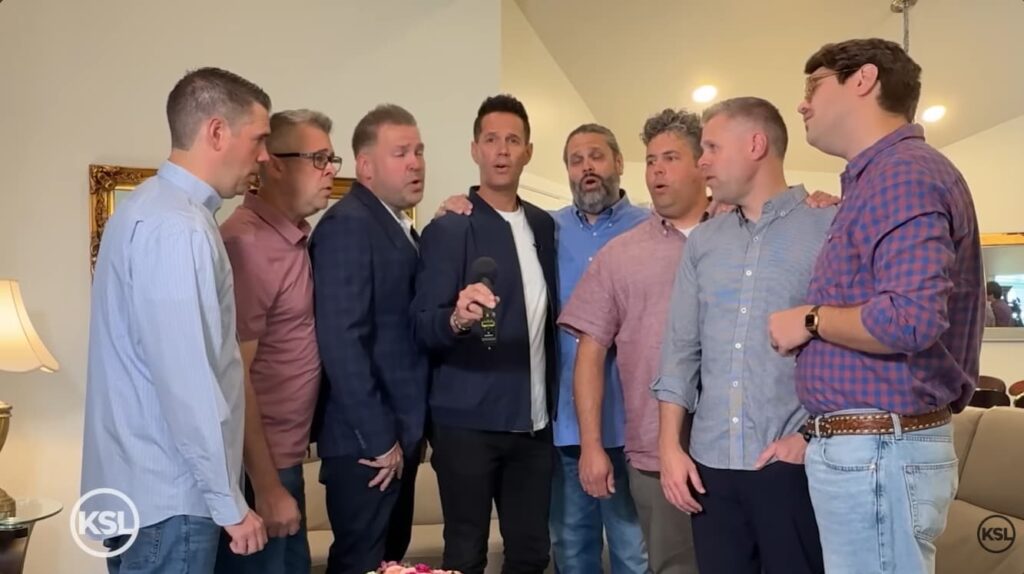
A farewell wrapped in harmony—“I May Never Pass This Way Again” becomes, in this tribute, a quiet reckoning with time, family, and the things left unspoken
When the sons of Alan Osmond came together to perform “I May Never Pass This Way Again,” the moment carried a meaning far beyond the song itself. Originally written by Ronnie Hinson and first recorded by The Imperials in 1975, the song reached No. 1 on the Billboard Hot Gospel Songs chart and went on to become one of the most enduring pieces in contemporary Christian music. Its message—simple, direct, and deeply reflective—has long been associated with the passage of time and the quiet awareness that life offers no guarantees of return.
But in this particular performance, the song takes on a different dimension. It is no longer just a meditation on life’s fleeting nature. It becomes a personal tribute, shaped by family ties and the presence of a man whose influence extended far beyond the stage. Alan Osmond, known as the steady foundation of The Osmonds, was never the most visible member of the group, but he was often its guiding force—the one who held things together, who believed in discipline, in faith, and in the quiet strength of unity.
The choice of “I May Never Pass This Way Again” feels almost inevitable in this context. The lyrics speak not of regret, but of awareness—the understanding that every moment carries weight because it may not come again. Lines that once resonated in a broader spiritual sense now feel intimate, almost conversational. They do not reach outward; they turn inward, toward memory, toward gratitude, and toward the unspoken acknowledgment of influence passed from one generation to the next.
What makes this rendition especially affecting is its restraint. There is no attempt to transform the song into something grander than it already is. The arrangement remains gentle, allowing the harmonies—so deeply rooted in the Osmond family tradition—to carry the emotional core. Voices blend not in perfection, but in sincerity. And in that sincerity, something more powerful emerges.
There is a noticeable sense of continuity in the performance. The sons do not simply sing the song; they inherit it, in a way. The harmonies echo the sound that once defined The Osmonds, yet they also carry subtle differences—small shifts in tone, in phrasing—that reflect time’s passage. It is a reminder that legacy is not about exact replication. It is about carrying something forward while allowing it to change.
The emotional weight of the tribute lies in what is left unsaid. There are no elaborate speeches, no attempts to explain the significance of the moment. The song itself becomes the language. And perhaps that is fitting, because “I May Never Pass This Way Again” has always been a song about what cannot be fully expressed in words. It acknowledges the limits of language, the way certain feelings resist explanation and can only be felt in passing moments—moments that linger long after they have ended.
In revisiting the song in this way, the performance also invites reflection on the nature of time itself. Not as something dramatic or overwhelming, but as something steady and persistent. It moves quietly, often unnoticed, until a moment like this brings it into focus. And when it does, it reveals not only what has been lost, but also what remains.
The legacy of Alan Osmond is present here, not in overt gestures, but in the very structure of the performance—the unity, the discipline, the emphasis on harmony over individual display. These are qualities that cannot be taught in a single moment. They are built over years, carried forward almost unconsciously, until they reveal themselves in a setting like this.
In the end, this version of “I May Never Pass This Way Again” does not seek to redefine the song. It simply allows it to become what it was always capable of being—a quiet acknowledgment of life’s passing moments, and a gentle reminder to recognize their value while they are still here.