
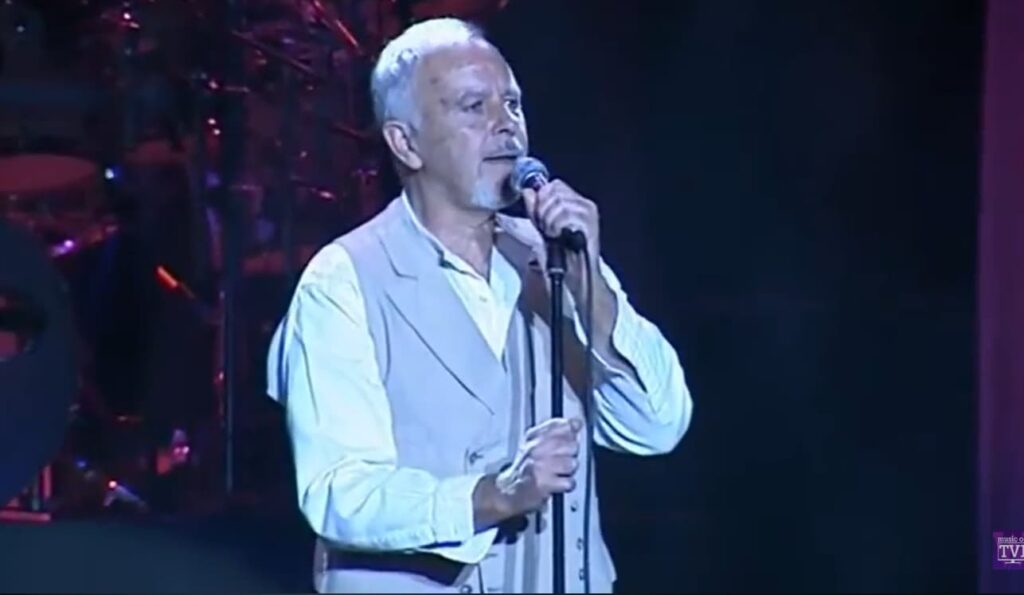
A voice revisiting its own echo—“Pretty Thing” in later years becomes less about desire, and more about the quiet passage of time and memory
When David Essex performed “Pretty Thing” during The Secret Tour Live (2009), the moment carried with it a sense of return, though not in the way one might expect. This was not a revival aimed at reclaiming chart success, nor a recreation of youthful energy for its own sake. Instead, it felt like a conversation between past and present—an artist standing within his own history, revisiting a song that once belonged to a very different time.
Originally emerging during the height of his 1970s popularity, David Essex had already established himself as a prominent figure in British pop and rock. His earlier successes, including “Rock On”—which reached No. 3 on the UK Singles Chart and later climbed to No. 5 on the Billboard Hot 100—and “Gonna Make You a Star,” a UK No. 1 hit in 1974, positioned him firmly within the musical landscape of that era. Albums like Rock On further solidified his presence, blending a distinctive vocal style with a sense of theatrical flair that set him apart from many of his contemporaries.
By contrast, the 2009 live performance of “Pretty Thing” belongs to a later chapter—one defined not by ascent, but by reflection. The song itself, while not among his most chart-dominant releases, carries the essence of Essex’s songwriting approach: a blend of melody and mood, shaped as much by feeling as by structure. In its original form, it spoke with a certain immediacy, a sense of closeness that felt almost urgent. But decades later, that urgency softens, giving way to something more measured, more contemplative.
On stage during The Secret Tour, there is a noticeable shift in tone. The performance does not attempt to recreate the past note for note. Instead, it allows the song to evolve. The arrangement feels more spacious, the tempo slightly more deliberate, as though each phrase is given time to settle before moving forward. Essex’s voice, now touched by years of experience, carries a different kind of weight. It is less about projection, and more about presence.
There is something quietly compelling in the way he delivers the song. The lines that once might have suggested longing or admiration now seem to carry traces of memory. The title—“Pretty Thing”—no longer feels like a simple address. It becomes something more distant, almost reflective, as though recalling someone or something that belongs to another time.
This transformation is not unusual, yet it is rarely as clear as it is here. Songs, like the people who sing them, do not remain unchanged. They gather meaning over time, shaped by experience, by distance, by the simple act of being revisited. In the case of David Essex, that process is evident in every note of this performance.
What makes The Secret Tour Live (2009) particularly significant is its intimacy. Unlike large-scale productions designed to impress, this setting feels closer, more immediate. It allows the audience to engage with the music in a different way—not as spectacle, but as shared reflection. The connection is quieter, but perhaps more lasting.
There is also a sense of continuity running through the performance. While the years have altered the delivery, they have not diminished the essence of the song. If anything, they have clarified it. The simplicity of the arrangement, the restraint in the vocal, the absence of excess—all of these elements point toward a deeper understanding of what the song represents.
In the end, “Pretty Thing” in this 2009 performance is no longer tied to a specific moment in the charts or a particular phase of popularity. It exists beyond those measures. It becomes a reflection on time itself—on how meaning shifts, how memories settle, and how certain songs remain, not because they are unchanged, but because they are willing to change along with us.
And as David Essex stands within that moment, there is no attempt to hold onto what once was. Only a quiet acknowledgment of it—and an understanding that sometimes, the most enduring performances are the ones that allow the past to speak softly, without needing to be repeated exactly as it was.