
A quiet road measured not in distance but in memory—“99 Miles (From L.A.)” becomes a reflection on longing, distance, and the places we never quite leave behind
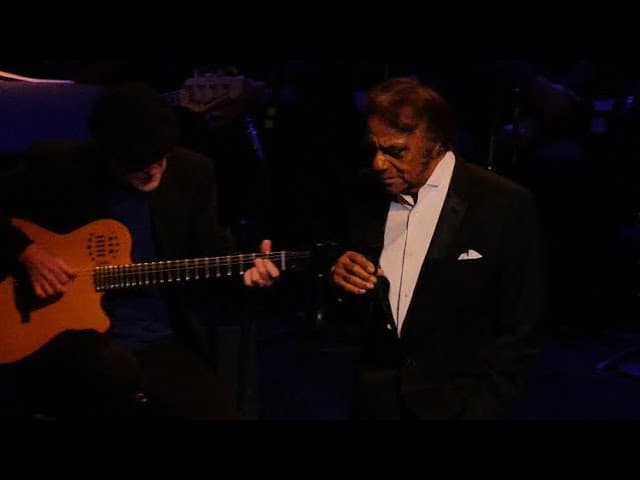
When Johnny Mathis performed “99 Miles (From L.A.)” in Coral Springs on March 23, 2023, the moment carried a sense of stillness that only time can bring. This was not a debut, nor a song seeking validation through charts. In fact, “99 Miles (From L.A.)”—originally written by Albert Hammond and Hal David—first appeared on Mathis’s 1975 album The Way We Were, a record that reached No. 8 on the Billboard 200 and reaffirmed his place in a changing musical landscape. The song itself was never released as a major charting single, yet it endured quietly, carried not by numbers but by feeling.
Nearly five decades later, standing on stage in Coral Springs, Johnny Mathis returned to it with a voice shaped by years rather than ambition. The performance did not attempt to recreate 1975. Instead, it acknowledged the distance—both literal and emotional—that had accumulated over time. And in doing so, it revealed something deeper about the song itself.
At its core, “99 Miles (From L.A.)” is deceptively simple. It speaks of physical distance—of being close, yet not quite there. But beneath that surface lies a more complex idea: the emotional space between where one is and where one longs to be. The “99 miles” become symbolic, not just of geography, but of hesitation, memory, and the quiet weight of what remains unresolved.
In his earlier recordings, Mathis approached the song with the clarity and control that defined his prime years. The phrasing was precise, the tone smooth, the emotion carefully measured. But in the 2023 performance, something shifts. The voice, while still unmistakably his, carries a different texture—softer, more reflective, touched by time in a way that feels honest rather than diminished.
There is a noticeable patience in how he delivers each line. He allows the words to settle, to find their place within the melody before moving forward. This slower, more deliberate approach changes the song’s meaning. What once felt like a moment of longing now feels like a recollection of it—something remembered rather than experienced in the present.
The arrangement remains understated, as it always has. Gentle instrumentation supports the vocal without drawing attention away from it. This simplicity becomes essential, allowing the listener to focus not on the structure of the song, but on its atmosphere. It feels less like a performance and more like a conversation—quiet, unforced, and deeply personal.
What makes this rendition particularly compelling is its sense of perspective. Johnny Mathis, having spent decades interpreting songs about love, distance, and time, no longer needs to emphasize their meaning. He understands it instinctively, and that understanding shapes every note. There is no urgency to impress, no need to prove. Only a steady presence, grounded in experience.
The Coral Springs setting adds another layer to the moment. Far removed from the studios and stages of the 1970s, it represents a different kind of connection—one that values intimacy over scale. The audience is not witnessing a recreation of the past, but a continuation of it.
In many ways, “99 Miles (From L.A.)” feels more complete in this later performance than it did at its origin. Time has filled in the spaces between its lines, giving weight to its simplicity. The distance it describes no longer feels temporary. It feels lived in, understood.
And as the final notes fade, there is no sense of conclusion—only a quiet acknowledgment of the journey. Not just the 99 miles, but all the distance that has come before and after. In that moment, Johnny Mathis does not close the song. He leaves it open, allowing it to continue, somewhere just beyond reach, where memory and music quietly meet.