
A quiet current beneath familiar waters—“The River” flows not with urgency, but with reflection, carrying time, memory, and what remains unspoken
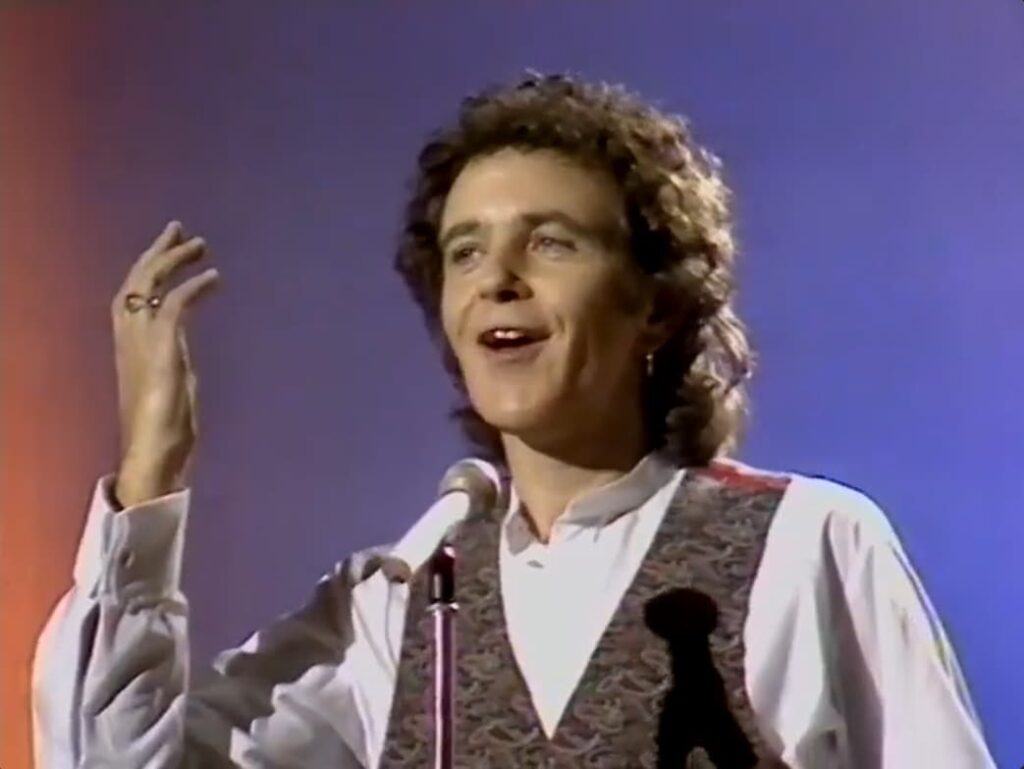
When David Essex performed “The River” on Wogan in 1988, it arrived at a point in his career that felt markedly different from the bright surge of his early success. By then, Essex was no longer the young figure racing up the charts with immediate, radio-driven hits. Instead, he had entered a more contemplative phase, where songs seemed less concerned with impact and more with meaning.
Unlike “Rock On”—his breakthrough single that reached No. 3 on the UK Singles Chart in 1973 and later climbed to No. 5 on the Billboard Hot 100—or “Gonna Make You a Star,” which held the No. 1 position in the UK in 1974, “The River” was not built around chart ambition. It did not emerge as a major commercial single, nor did it seek the kind of widespread attention that defined his earlier work. And yet, in many ways, it reveals something deeper about Essex as an artist—something that could only surface after the initial wave of fame had passed.
Appearing on Wogan, a program known for its conversational tone and intimate performances, Essex delivered the song with a restraint that felt almost deliberate. There was no attempt to amplify the moment beyond what the song required. Instead, he allowed it to unfold naturally, guided by a steady, unhurried rhythm that mirrored the very image suggested by its title.
“The River” is not a song that announces itself loudly. It moves quietly, almost imperceptibly at times, drawing the listener in not through force, but through patience. The lyrics suggest movement, passage, and continuity—ideas that resonate more strongly when viewed through the lens of time. A river does not rush for the sake of arrival. It carries what it must, at its own pace, shaping and reshaping the landscape as it goes.
In this 1988 performance, that metaphor feels especially fitting. By this stage, David Essex had already lived through the intensity of early stardom, the expectations that followed, and the gradual shift toward a more enduring, less visible form of artistry. His voice reflects that journey. It is steadier now, less urgent, shaped by experience rather than momentum. There is a subtle gravity in his delivery, as though each line has been considered rather than simply sung.
The arrangement remains understated—gentle instrumentation, no excess, nothing that distracts from the core of the song. This simplicity allows the meaning to surface gradually. It is not presented all at once, but revealed over time, much like memory itself.
There is also a sense, difficult to define yet unmistakable, that the performance exists slightly apart from the present moment. It feels reflective, almost inward-looking, as though Essex is not only addressing the audience, but also tracing something within himself. The song becomes less about a specific narrative and more about a state of mind—one shaped by reflection, by the awareness of time’s passage, and by the quiet acceptance that comes with it.
What makes “The River” endure is precisely this lack of urgency. It does not demand attention. It invites it. And in doing so, it creates space—for thought, for memory, for recognition. It allows the listener to meet it halfway, bringing their own experiences into the flow of the song.
Looking back, the performance on Wogan stands as a reminder that not every meaningful moment in music is defined by charts or headlines. Some exist in quieter forms—in songs that do not seek to dominate the moment, but to accompany it.
In the end, David Essex does not attempt to control the direction of “The River.” He allows it to move as it will, trusting in its course. And perhaps that is where its true strength lies—not in its destination, but in the steady, unbroken movement that carries it forward, long after the performance itself has come to an end.