
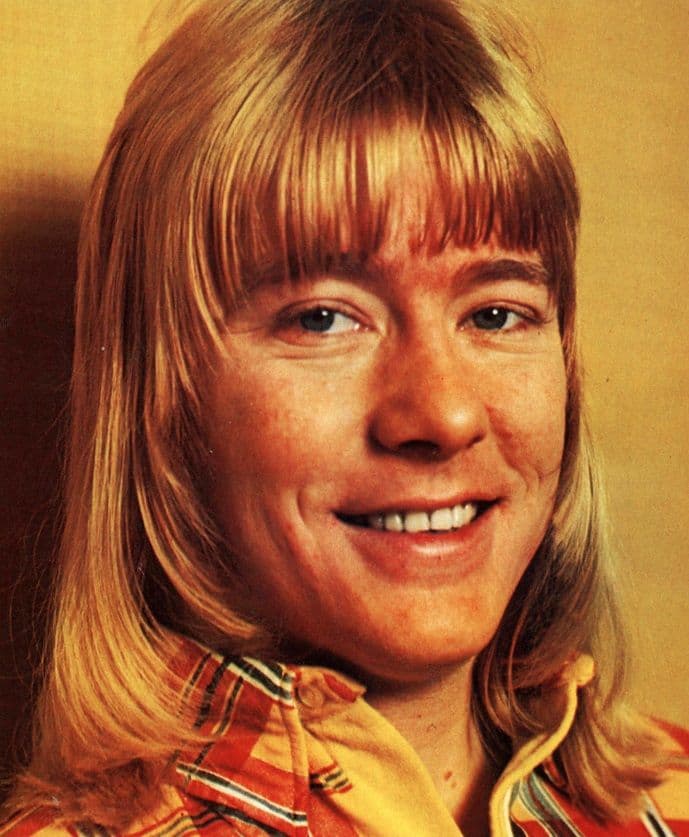
A voice that carried both glitter and gravity—Brian Connolly gave Sweet not only its sound, but its emotional pulse beneath the spectacle
In the story of Sweet, it is easy to remember the bright lights, the sharp hooks, and the theatrical energy that defined glam rock in the early 1970s. Yet behind that surface stood Brian Connolly, a voice that did far more than lead—it anchored, shaped, and ultimately humanized the band’s identity.
From the very beginning, Connolly’s vocal presence was unmistakable. On “Ballroom Blitz,” released in 1973 and reaching No. 1 on the UK Singles Chart while climbing to No. 5 on the Billboard Hot 100, his delivery carried both urgency and control. It was not simply loud or energetic—it was precise, almost theatrical in its timing. Each line felt deliberate, as though he understood instinctively how to balance chaos with structure. That same instinct followed into “Teenage Rampage,” another UK No. 2 hit in 1974, where his voice became a rallying call, capturing the restless energy of youth without losing clarity.
Then came “Fox on the Run,” released in 1975, a song that marked a turning point for Sweet. Reaching No. 2 in the UK and breaking into the Top 5 in the United States, it showcased a band beginning to take greater control over its own sound. Connolly’s vocal here is different—still confident, still commanding, but more measured. There is a sense of distance in his tone, as though the excitement is now tempered by awareness. The performance does not push forward recklessly; it holds back just enough to let the melody breathe.
What made Brian Connolly particularly compelling was this ability to shift between extremes without losing coherence. He could deliver a line with playful swagger, almost teasing in its rhythm, and then, without warning, move into something sharper, more direct. It was not a change for effect—it felt natural, as though both sides existed simultaneously within his voice. This duality became one of the defining characteristics of Sweet’s sound.
As the band moved further into the mid-1970s, their music began to evolve beyond the straightforward glam formula. The production grew more layered, the themes more reflective. On “Love Is Like Oxygen,” released in 1978 and reaching No. 8 on the Billboard Hot 100 and No. 9 in the UK, Connolly revealed a different dimension of his vocal ability. The intensity remained, but it was softened by a sense of restraint. The phrasing became more fluid, the emotion less immediate but more sustained.
In this later period, his voice carried a subtle wear—something that could not be manufactured or rehearsed. It suggested experience, perhaps even vulnerability, without ever becoming fragile. The power was still there, but it no longer needed to dominate. Instead, it settled into the song, allowing the melody and lyrics to share the space.
There is a tendency to associate glam rock with image, with performance, with the outward expression of energy. But in the case of Brian Connolly, the lasting impression comes from something quieter. It is found in the way he held a note just long enough, in the slight shift of tone between lines, in the sense that beneath the surface of each performance was a deeper understanding of what the song required.
Looking back, it becomes clear that Connolly was not simply the frontman of Sweet. He was the element that gave their music continuity as it changed. The band could evolve in style, in production, in direction—but his voice remained the thread that connected those shifts, making them feel like part of a single, ongoing story.
And perhaps that is why his presence still lingers in those recordings. Not because of volume or spectacle, but because of balance—the rare ability to bring together energy and control, brightness and depth, without forcing either. In that balance, Brian Connolly did more than perform. He defined a sound that continues to resonate, long after the stage lights have dimmed.