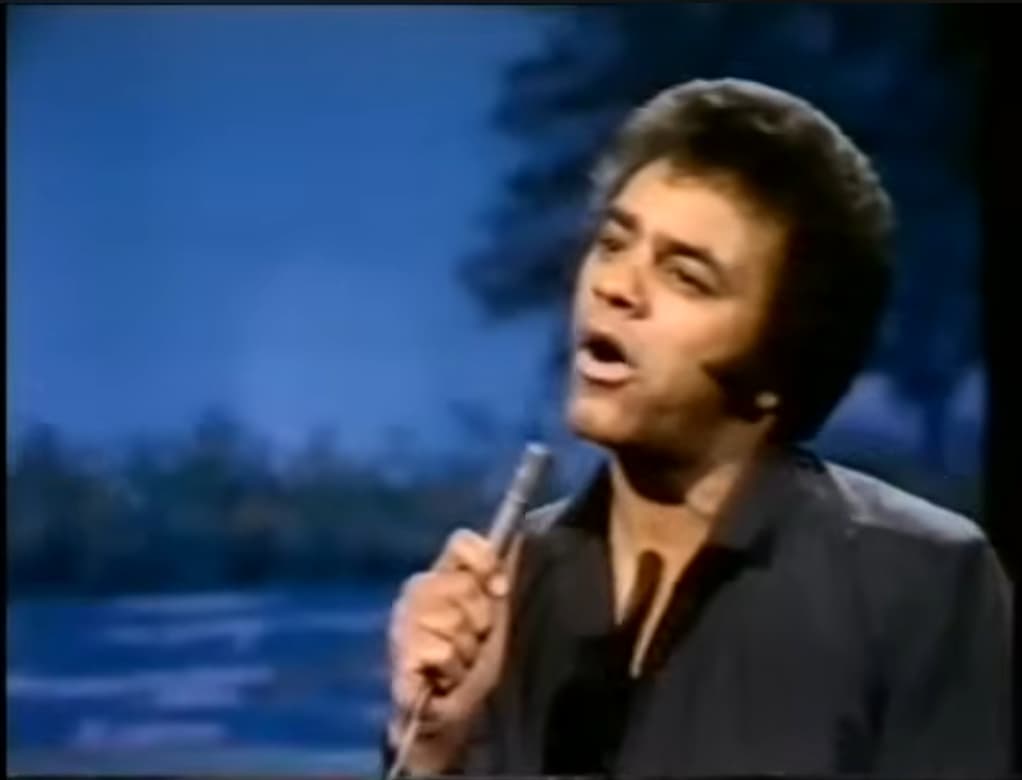
A song about quiet illumination—“You Light Up My Life” becomes less a declaration of love, and more a reflection on the gentle ways one soul steadies another
When Johnny Mathis brings “You Light Up My Life” to the stage in a live setting, he is stepping into a song already deeply embedded in popular memory. Originally written by Joseph Brooks for the 1977 film of the same name, the song became a phenomenon through the version by Debby Boone, which spent an extraordinary 10 consecutive weeks at No. 1 on the Billboard Hot 100, a record at the time. It also earned the Academy Award for Best Original Song and the Grammy Award for Song of the Year, firmly establishing it as one of the defining ballads of its era.
By the time Johnny Mathis approached “You Light Up My Life”, the challenge was not to surpass its success, but to reinterpret its meaning. Mathis, whose career had already spanned decades with signature recordings like “Chances Are” and “Misty,” was never an artist who relied on reinvention for its own sake. Instead, he brought continuity—an ability to carry a song into a different emotional space without altering its essence.
In his live performances, “You Light Up My Life” becomes something quieter, more inward. Where the original version leans toward clarity and uplift, Mathis introduces a sense of reflection. His phrasing slows ever so slightly, allowing each line to settle before moving forward. This subtle shift changes the song’s emotional center. It is no longer simply about the presence of love, but about the recognition of it over time.
The strength of Johnny Mathis has always been his control—his ability to maintain a smooth, almost effortless tone while conveying something deeply personal. In this performance, that control is accompanied by a softness that feels earned. His voice, shaped by years rather than diminished by them, carries a warmth that cannot be replicated in a studio setting. It is not about perfection. It is about understanding.
The arrangement in the live setting remains respectful to the original composition. Gentle instrumentation supports the vocal without overwhelming it, creating a space where the melody can unfold naturally. There is no need for dramatic reinterpretation. The song’s structure remains intact, but its atmosphere shifts. It feels less like a performance intended for an audience, and more like a moment shared quietly within it.
What gives this rendition its lasting resonance is the perspective it carries. “You Light Up My Life” was once a song of immediate emotion—bright, direct, and certain. In Mathis’s hands, it becomes something more layered. The “light” described in the song is no longer just a sudden illumination. It feels steady, enduring, something that has remained through change and uncertainty.
There is also a sense of distance in the performance—not emotional detachment, but reflection. The lyrics are not delivered as though they are being experienced for the first time. They are remembered, revisited, understood in a way that only time allows. This perspective gives the song a different kind of depth. It acknowledges that love is not always defined by intensity alone, but by its ability to remain.
For an artist like Johnny Mathis, whose career has been built on interpreting the emotional nuances of song, “You Light Up My Life” becomes an opportunity not to impress, but to connect. He does not alter the melody or the structure. Instead, he adjusts the weight of each moment within it. A pause here, a softer note there—these small choices reshape the song without drawing attention to the act itself.
Listening to this live rendition, one is reminded that songs do not remain fixed. They evolve with the voices that carry them, and with the lives of those who hear them. What was once a declaration becomes a reflection. What was once immediate becomes enduring.
And as the final note lingers, there is a quiet realization that the song’s meaning has not changed—it has simply deepened. In that space, Johnny Mathis does not just perform “You Light Up My Life.” He allows it to breathe again, gently, as though it had been waiting all along to be understood this way.
Video: