
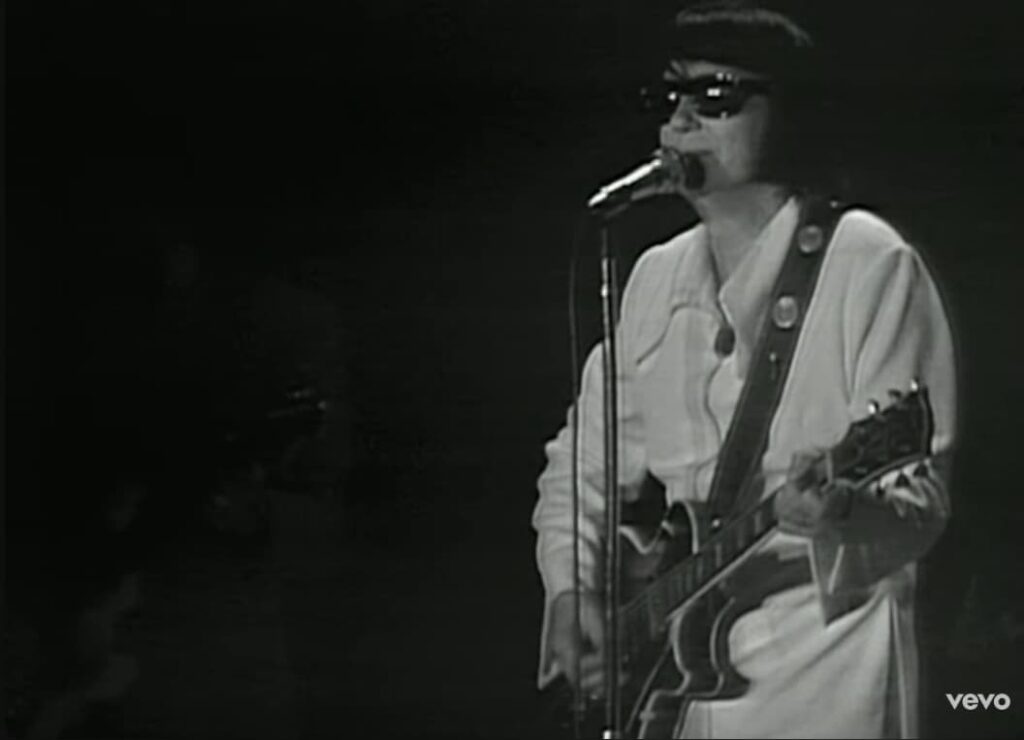
A song about love arriving before the heart is ready—“Too Soon To Know” lingers in that fragile moment where feeling comes first and understanding follows slowly
When Roy Orbison performed “Too Soon To Know” live in Australia in 1972, he was revisiting a song that traced back to the very beginnings of his recording career. First released in 1956 on the Sun Records label, the track did not achieve major chart success at the time, but it carried something far more enduring—the early outline of a voice that would later become one of the most distinctive in popular music. Long before “Only the Lonely” or “Crying” defined his legacy, “Too Soon To Know” quietly introduced the emotional language that would shape everything that followed.
Written by Don Gibson, a songwriter deeply attuned to the complexities of love and longing, the song revolves around uncertainty. It does not declare love with confidence, nor does it reject it outright. Instead, it lingers in hesitation—in that space where the heart recognizes something significant, yet the mind is not ready to accept it. This tension, understated in its original form, becomes something more profound when interpreted by Roy Orbison.
By 1972, Orbison was no longer the young artist navigating the edges of the industry. He had already experienced both immense success and deep personal loss. His voice, always remarkable for its range and clarity, had taken on a new dimension—one shaped by experience rather than ambition alone. In the Australian performance, this transformation is unmistakable.
The arrangement remains restrained, allowing the focus to remain on the vocal. There is no need for elaborate production or dramatic instrumentation. Orbison’s voice carries the weight of the song entirely on its own. Each phrase is delivered with care, as though the meaning is being discovered in the moment rather than simply repeated.
What distinguishes this live rendition is its sense of reflection. In 1956, “Too Soon To Know” might have felt like a question—something unresolved, something waiting for clarity. In 1972, it feels more like recognition. The uncertainty is still there, but it is no longer unfamiliar. It is understood, perhaps even accepted.
Orbison’s vocal control in this performance is extraordinary, not because of its power, but because of its restraint. He does not push the song toward a dramatic peak. Instead, he allows it to unfold gradually, trusting the natural progression of the melody. This approach gives the performance a quiet intensity. It draws the listener inward, rather than overwhelming them.
There is also a sense of distance in the way the song is delivered—not emotional detachment, but perspective. The lyrics are no longer experienced as immediate confusion. They are remembered, revisited through the lens of time. This shift changes the emotional impact of the song. It becomes less about the uncertainty of love, and more about the recognition that such uncertainty is inevitable.
For Roy Orbison, whose career would later be defined by songs that explore longing, heartbreak, and devotion, “Too Soon To Know” stands as an early chapter—one that gains new meaning when revisited years later. It reveals that even at the beginning, the essential elements were already present: the vulnerability, the restraint, the ability to convey deep emotion without excess.
Listening to this 1972 performance, there is a sense that the song has grown alongside the artist. It has not changed in structure or lyric, but its meaning has deepened. What was once tentative now feels reflective. What was once uncertain now feels quietly acknowledged.
And as the final notes fade, there is no resolution offered—no clear answer to the question the song poses. Instead, there is acceptance. The understanding that some emotions are not meant to be resolved quickly, that some truths reveal themselves only over time.
In that space, Roy Orbison does not attempt to define love or explain it. He simply gives voice to its uncertainty, allowing it to exist as it is—unresolved, complex, and deeply human.