
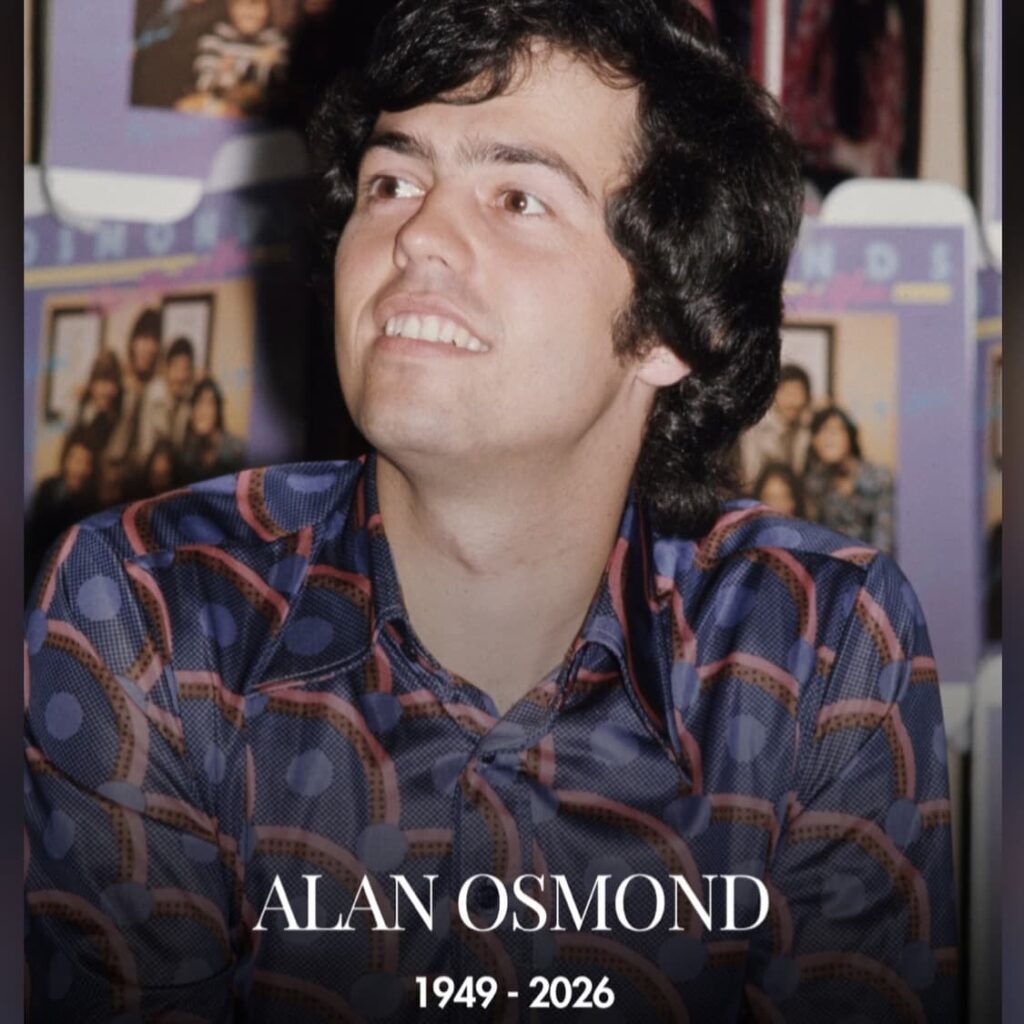
The quiet songs that outlive the charts—Alan Osmond reminds us that the truest legacy is not recorded, but remembered
A week has passed since the world grew noticeably quieter without Alan Osmond. For many, his name is forever tied to the bright, polished harmonies of The Osmonds, a group that once stood at the center of popular music in the early 1970s. Their success was undeniable—“One Bad Apple” reached No. 1 on the Billboard Hot 100 in 1971, while albums like Osmonds and Homemade carried their sound across radio waves and into homes around the world. These were achievements that could be measured, certified, and celebrated.
But time has a way of softening what once seemed most important. The records remain, the chart positions unchanged, yet they begin to feel like only part of the story. Because for those who stood closest to Alan Osmond, the music that mattered most was never pressed onto vinyl. It was lived quietly, in moments that never sought an audience.
There is something deeply revealing in that distinction. Public success, no matter how extraordinary, exists within a defined space—it rises, peaks, and eventually settles into memory. But the quieter gestures, the ones that unfold away from the stage, do not follow that pattern. They do not fade in the same way. They linger, repeating themselves in small, almost imperceptible ways—through habits, through values, through the way one life shapes another.
Alan Osmond was often described as the guiding force behind The Osmonds, not only musically but spiritually. While the group’s image was built on energy and harmony, there was always an underlying discipline that held it together. That discipline did not come from ambition alone. It came from belief—from a steady, unwavering sense of purpose that extended beyond performance.
In later years, when illness gradually took him away from the stage, that purpose did not diminish. If anything, it became more visible. The absence of public appearances revealed something that had always been there—a quiet resilience, a strength that did not depend on recognition. It is in these years that the idea of “legacy” begins to shift. It is no longer about what was achieved, but about what was sustained.
There is a line often attributed to Claude Debussy: “Music is the space between the notes.” It is a thought that feels particularly fitting here. Because what remains after a life like Alan Osmond’s is not only the sound of the songs, but the spaces around them—the pauses, the silences, the moments where meaning quietly settles.
Those spaces are filled with things that cannot be easily described: a sense of presence, a way of listening, a kind of patience that reveals itself over time. They are not dramatic or immediate. They do not demand attention. But they endure.
To speak of loss in this context is to recognize that absence does not erase what was given. It changes its form. The voice that once carried melodies may no longer be heard in the same way, but its influence continues, woven into the lives it touched. The lessons remain, not as instructions, but as instincts—guiding quietly, without announcement.
There is also, within that recognition, a certain kind of gratitude. Not the kind that seeks to balance sorrow, but the kind that exists alongside it. A quiet awareness that to have shared in such a life, even briefly, is something that cannot be measured against the weight of loss. It does not lessen the silence, but it gives it meaning.
And so, when we speak of the “greatest hits” of Alan Osmond, it becomes clear that they are not confined to a discography. They are found in the way he lived, in the consistency of his values, in the quiet strength he carried into every room. These are the songs that do not fade, the melodies that do not depend on time or audience.
They continue, softly, in the background—unrecorded, perhaps, but no less real. And in that quiet continuation, there is a kind of warmth that remains, steady and enduring, long after the final note has passed.