
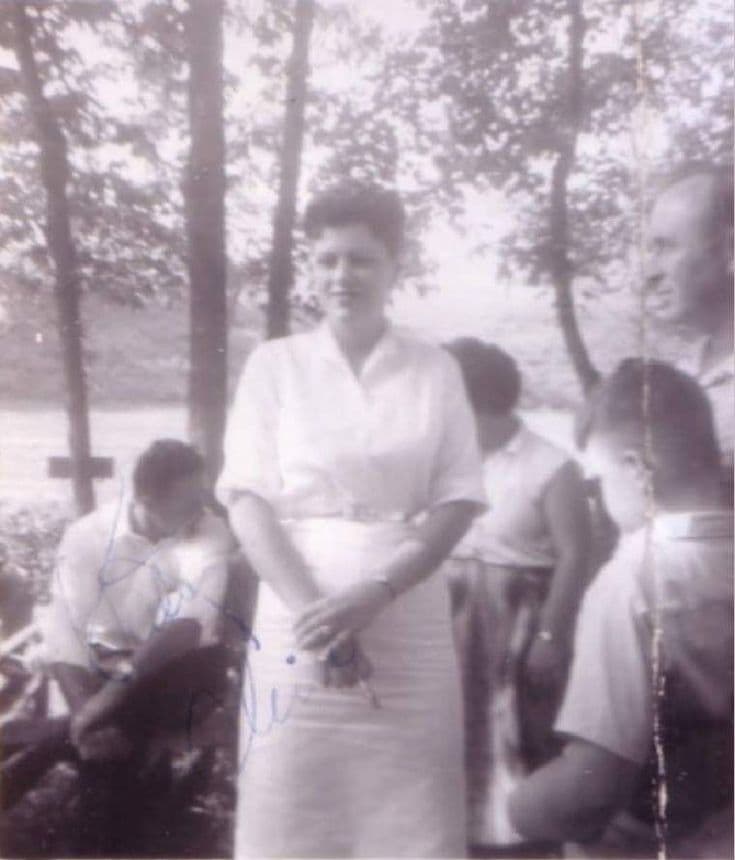
A voice rising between sorrow and strength—Patsy Cline at the Dixie Jubilee captures a moment where country music found both its heart and its courage
On December 2, 1961, Patsy Cline appeared on the Dixie Jubilee, delivering a full show performance that now feels less like a routine television appearance and more like a fragile, powerful document of resilience. This moment came just months after the devastating car accident in June 1961 that nearly ended her life. What unfolded on that stage was not simply a performance—it was a return.
By that time, Patsy Cline had already secured her place in country music history. Her breakthrough hit “Walkin’ After Midnight” reached No. 2 on the Billboard Country chart and crossed over to No. 12 on the Billboard Pop chart in 1957, marking her as a rare voice capable of bridging genres. Later, “I Fall to Pieces” would become her first No. 1 hit on the Billboard Country chart in 1961, solidifying her presence at the very top of the industry.
It is within this context that the Dixie Jubilee performance must be understood. She was not an emerging artist trying to prove herself—she was already established. And yet, everything had changed. The accident had left visible and invisible scars, and her return to the stage carried a weight that no chart position could measure.
Watching Patsy Cline in this performance, there is an immediate sense of composure. She does not present herself as fragile, nor does she draw attention to what she has endured. Instead, she stands with a quiet determination, allowing the music to speak in ways that words cannot fully express.
Her voice, remarkably, remains intact—perhaps even deepened. There is a richness, a slight gravity that seems to have settled into her tone. It is not diminished; it is transformed. Each note carries not only technical precision, but a lived understanding of hardship and recovery.
The Dixie Jubilee itself was a regional television program, not a national spectacle. And perhaps that is what gives this performance its particular intimacy. There is no overwhelming production, no attempt to elevate the moment beyond its natural scale. The setting is modest, the atmosphere direct. This allows Patsy Cline to connect without distraction, to deliver her songs as they are meant to be heard—clearly, honestly, without excess.
Songs performed during this period, including “Crazy”—which would go on to reach No. 2 on the Billboard Country chart in late 1961—carry an emotional depth that feels inseparable from her personal experience. Written by Willie Nelson, “Crazy” became one of her defining recordings, not because of its structure, but because of the way she inhabited it.
In the Dixie Jubilee performance, that same interpretive strength is evident. Whether delivering a ballad or a more rhythmic piece, she maintains a sense of control that never feels forced. There is no need to overreach. The emotion is already present, embedded within the phrasing, the timing, the subtle inflections that define her style.
There is also a sense of immediacy. This is not a performance polished through repetition or filtered through time. It exists in the moment, shaped by circumstances that cannot be replicated. That immediacy gives it a certain fragility—an awareness that what is being witnessed is both temporary and significant.
Looking back, this appearance takes on an added poignancy. It stands as part of a brief period between recovery and tragedy, before her life would be cut short in 1963. Yet the performance itself does not carry that knowledge. It remains focused, present, grounded in the act of singing.
And perhaps that is what makes it so enduring. It is not defined by what came before or what would follow. It exists on its own terms, as a moment where Patsy Cline stood before an audience and did what she had always done—sing with clarity, with feeling, and with an honesty that required no explanation.
In that space, there is no past, no future—only the voice, steady and unwavering.
And for a brief time, that is enough.
 Oldies Songs