
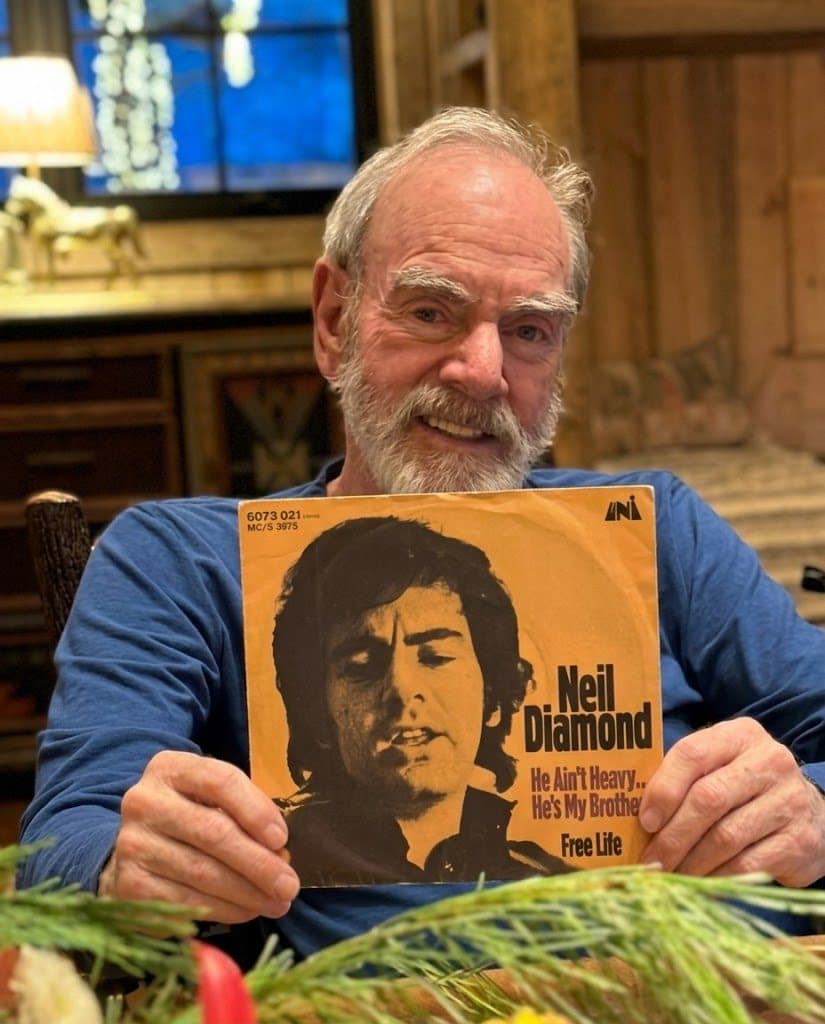
A burden shared becomes lighter—“He Ain’t Heavy, He’s My Brother” in Neil Diamond’s voice turns compassion into something deeply personal and enduring
When Neil Diamond chose to interpret “He Ain’t Heavy, He’s My Brother,” he stepped into a song already rich with history and emotional weight. Originally recorded by The Hollies in 1969, the song reached No. 3 on the UK Singles Chart and later climbed to No. 7 on the Billboard Hot 100 during its 1970 U.S. release. Written by Bobby Scott and Bob Russell, it quickly became one of the most enduring ballads of its time—a quiet anthem of compassion, responsibility, and human connection.
By the time Neil Diamond brought his own interpretation to audiences, he was already a songwriter and performer of remarkable depth, known for transforming material into something unmistakably his own. His version of “He Ain’t Heavy, He’s My Brother” did not seek to replace the original—it sought to understand it. And in doing so, it revealed something new.
Where the original carried a choral, almost collective sense of unity, Diamond’s approach feels more introspective. The song becomes less about a universal message and more about an individual realization. The burden described in the lyrics is no longer symbolic—it feels lived, specific, and deeply personal.
This shift is subtle, but it changes the emotional landscape of the song. In Diamond’s voice, there is a certain gravity, a deliberate pacing that allows each line to settle before moving forward. He does not rush the message. He allows it to unfold gradually, as though arriving at its meaning in real time.
The lyrics themselves remain among the most direct ever written: “The road is long, with many a winding turn…” There is no elaborate metaphor, no attempt to obscure the message. And yet, within that simplicity lies a profound truth—that carrying another person is not a burden when it is done with love.
In Neil Diamond’s interpretation, that truth feels earned rather than stated. His vocal delivery carries a weight that suggests experience—moments where the road has indeed been long, where the act of carrying has required more than intention. There is a quiet acknowledgment that such compassion is not always easy, but it remains necessary.
Musically, his arrangement tends to lean into warmth rather than grandeur. The instrumentation supports the vocal without overwhelming it, often allowing piano and soft orchestration to create a steady foundation. This restraint keeps the focus where it belongs—on the voice, and on the meaning behind it.
It is also worth considering the broader context of Neil Diamond’s career. Known for songs that often explore identity, belonging, and emotional resilience, he was uniquely positioned to interpret a piece like “He Ain’t Heavy, He’s My Brother.” His own songwriting frequently navigated similar themes, making this performance feel less like a departure and more like a continuation of an ongoing conversation.
Over time, the song has taken on a life beyond any single artist. It has been used in moments of public reflection, in times of collective difficulty, and in personal spaces where its message resonates quietly. Yet each interpretation adds something different, shaped by the voice that carries it.
In Neil Diamond’s hands, the song becomes less declarative and more reflective. It does not tell the listener what to believe—it invites them to consider what it means to stand beside someone else, to share in their weight without hesitation.
Listening now, there is a sense of stillness within the performance. It does not seek attention; it holds it gently. The message is not delivered with urgency, but with patience, as though trusting that its meaning will find its way to those who need it.
And perhaps that is why “He Ain’t Heavy, He’s My Brother” continues to endure. Not because it offers something new, but because it reminds us of something essential—something easily forgotten, yet always present beneath the surface.
In the end, Neil Diamond does not attempt to redefine the song. He simply lives within it, allowing its message to pass through him with quiet clarity.
And in doing so, he leaves behind not just a performance, but a moment of understanding—one that lingers, long after the final note has faded.
 Oldies Songs