
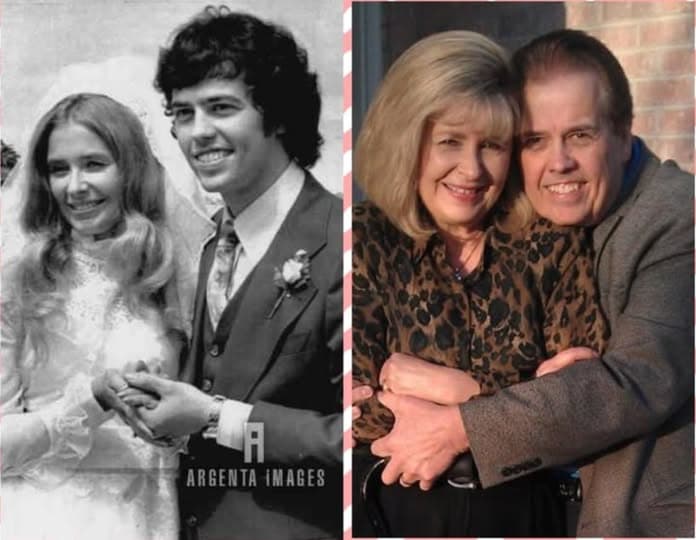
A quiet testament to faith, family, and endurance—“Pillars Of The Valley” stands as a deeply personal reflection from two voices shaped by legacy and time
Released in 2021, “Pillars Of The Valley” by Alan Osmond and Suzanne Osmond is not a chart-driven hit, nor was it intended to compete in the commercial landscape that once defined the Osmond name. Unlike the explosive success of The Osmonds in the early 1970s—when songs like “One Bad Apple” reached No. 1 on the Billboard Hot 100 in 1971—this composition exists in a far more intimate space. It is a work of reflection rather than ambition, a piece shaped not by the demands of the industry, but by the weight of lived experience.
To understand “Pillars Of The Valley,” one must first look beyond the melody and into the life of Alan Osmond himself—the eldest of the Osmond brothers, once the steady anchor of a family that seemed perpetually under the spotlight. Alan’s journey, particularly his long battle with multiple sclerosis, has profoundly influenced the tone and message of this song. By the time this piece emerged in 2021, it carried with it decades of perseverance, quiet struggle, and an unwavering commitment to faith and family.
The title itself—“Pillars Of The Valley”—is rich with symbolism. It evokes images of strength rooted in place, of figures who stand firm against the erosion of time and hardship. In many ways, the “pillars” are not just individuals, but ideals: resilience, devotion, and the quiet dignity of enduring life’s trials without spectacle.
Musically, the song leans toward a gentle, almost hymn-like arrangement. There is no urgency in its pacing, no attempt to dazzle with complexity. Instead, it invites the listener to slow down—to sit with the words, to absorb the sentiment. Suzanne Osmond’s voice adds a softness that complements Alan’s more weathered tone, creating a dialogue rather than a performance. Their voices do not compete; they support one another, much like the life they have built together.
There is something profoundly moving about hearing Alan Osmond sing at this stage of his life. Gone is the youthful brightness of the Osmonds’ early hits, replaced by a voice that carries the texture of time. It is not about perfection—it is about truth. Every note feels earned, every phrase shaped by memory.
The song’s meaning unfolds gradually, almost like a conversation remembered rather than performed. It speaks to the idea of legacy—not the kind measured in fame or chart positions, but the quieter legacy of influence, of values passed down through generations. In this sense, “Pillars Of The Valley” becomes more than just a song; it becomes a reflection on what truly remains when the applause fades.
For those who remember the Osmonds at their peak—those years of television appearances, sold-out concerts, and polished harmonies—this piece offers a different kind of connection. It does not seek to recreate the past, nor does it rely on nostalgia as a crutch. Instead, it acknowledges that time has passed, that life has changed, and that there is beauty in that transformation.
There is also a spiritual undercurrent that runs through the song, subtle but unmistakable. It does not preach, nor does it impose. Rather, it offers a sense of peace—a quiet reassurance that even in the face of uncertainty, there is something steady to hold onto. This is perhaps where the song resonates most deeply: not in its melody alone, but in the stillness it creates.
In a world where music often chases immediacy, “Pillars Of The Valley” stands apart. It does not demand attention; it earns it slowly, gently, with sincerity. It reminds us that not all songs are meant to climb charts or dominate airwaves. Some are meant simply to exist—to bear witness, to tell a story, to leave behind something honest.
And in that honesty, Alan and Suzanne Osmond offer something rare: a moment of quiet reflection, shaped by a lifetime, and shared without pretense.