
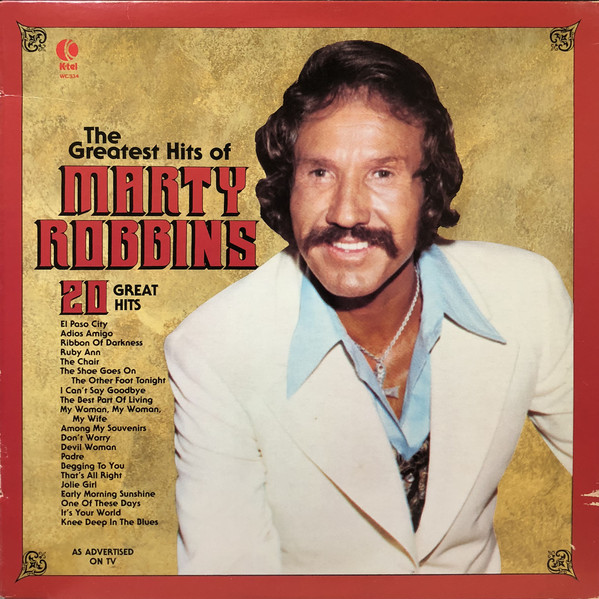
Marty Robbins – “Born from the Desert Dust”: The Arid Soil and Storied Winds That Shaped a Western Legend
To truly understand the velvet texture of Marty Robbins’s voice, one must first look to the parched, unforgiving landscape of Glendale, Arizona, in the mid-1920s. Born Martin David Robinson on September 26, 1925, he was not merely a product of his time, but a soul forged by the isolation and the rugged beauty of the high desert. Before he was a Grammy winner or a Country Music Hall of Fame inductee, he was a child of the dust, living in a household where music was not a luxury, but a vital means of survival against the silence of the plains. His origins provide the essential context for the cinematic scope of his later masterpieces, most notably the 1959 landmark album Gunfighter Ballads and Trail Songs, which remains the definitive blueprint for Western storytelling.
The “ranking” of Marty Robbins’s life began in the harsh reality of the Great Depression. Growing up in a large, impoverished family, the young Martin found his first escape not in a record player, but in the vivid, rambling tales of his maternal grandfather, “Texas” Bob Heckle. A former medicine show performer and a man who claimed to have seen the last of the true Old West, Heckle planted the seeds of the “Gunfighter” mythos in the boy’s mind. These weren’t just stories; they were a cultural inheritance. When you listen to the rhythmic galloping of “El Paso” or the haunting narrative of “Big Iron,” you aren’t just hearing a song—you are hearing the echoes of an old man’s voice carrying across a campfire in the Arizona night.
The Cultural Crucible and the Birth of a Stylist
What set Marty Robbins apart from his Nashville contemporaries was the unique cultural crucible of his upbringing. Living so close to the Mexican border, his ears were attuned to a different frequency—the soulful, trumpeting sounds of Mariachi and the intricate, Spanish-influenced guitar picking that would eventually define his signature sound. This wasn’t a style he learned in a studio; it was the ambient noise of his youth. The desert wasn’t just a place he lived; it was a character in his life, teaching him the value of space, timing, and the evocative power of a well-placed pause in a melody.
For those of us who remember the first time we heard that distinct “Tejano” flair in a country song, it felt like a door opening to a wider world. Robbins brought the grit of the desert and the elegance of the Spanish ballad into the mainstream. His early struggles—from dropping out of school to serve in the U.S. Navy during World War II, where he famously learned to play guitar to pass the time in the Pacific—only served to deepen the emotional well from which he drew.
Looking back, his origins remind us that the most enduring art often comes from the most difficult ground. Marty Robbins didn’t just sing about the West; he breathed it. He took the “desert dust” of his childhood and turned it into gold, creating a legacy that feels as vast and timeless as the Arizona horizon. It is a story of a boy who looked at a barren landscape and saw a stage, transforming the loneliness of the frontier into a universal language of longing and adventure.
To revisit the very beginning of his recording journey, one can look to his early Columbia Records sessions from the early 1950s, where the raw, honky-tonk influence of his youth first began to merge with his natural pop sensibilities.
 Music Legend