
When Love Withers Indoors While the Garden Still Blooms
In the long and dignified history of country music, few songs capture emotional quiet devastation as precisely as Good Year for the Roses. First recorded in 1970 by George Jones, and revisited nearly a quarter century later as a duet with Alan Jackson, the song stands as a masterclass in restraint, symbolism, and emotional honesty. It is not a song that raises its voice. Instead, it lowers it, trusting the listener to lean in and recognize the truth hidden in everyday details.
Written by Jerry Chesnut, Good Year for the Roses was originally released on George Jones’ 1970 album George Jones with Love. Upon its debut, the song climbed to No. 2 on the Billboard Hot Country Singles chart, narrowly missing the top spot but quickly earning something more enduring than chart dominance: reverence. At a time when country music was beginning to flirt more openly with pop crossover, Jones delivered a performance rooted firmly in traditional storytelling, proving that subtlety could still cut deeper than spectacle.
The song’s narrative is deceptively simple. A man wakes up to find his wife packing her things. There is no shouting, no confrontation, no dramatic explanation. Instead, the listener is guided through the house, room by room, object by object. Dirty dishes in the sink. Shirts left hanging. And outside, in the garden, roses blooming better than ever. The contrast is devastating. While the marriage collapses beyond repair, nature remains indifferent, even generous. That emotional irony lies at the heart of the song’s meaning. Life continues to offer beauty even when personal worlds fall apart.
What elevates George Jones’ original recording is his uncanny ability to sound emotionally exhausted without ever sounding melodramatic. By 1970, Jones was already known as “the greatest living country singer,” a title earned through his mastery of phrasing and his lived understanding of heartbreak. His voice on this track is weary but controlled, as if the character has cried all his tears before the song even begins. That restraint allows the listener to feel the weight of loss without being instructed how to feel.
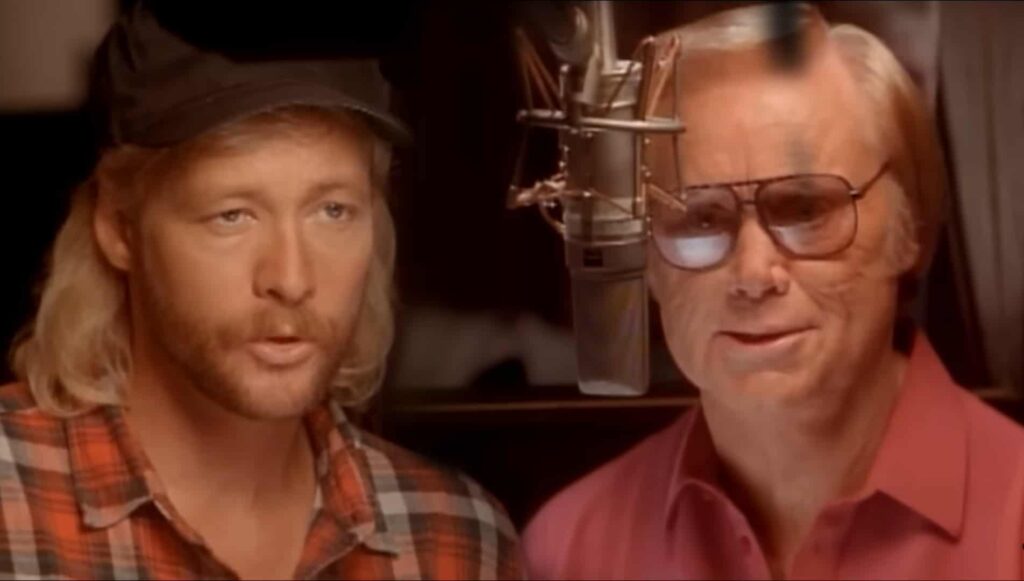
In November 1994, George Jones returned to the song, this time alongside Alan Jackson, for a new recording released on Jones’ album of that period. The collaboration was more than a duet. It was a symbolic passing of the torch. Alan Jackson, a devoted traditionalist in an era increasingly shaped by commercial polish, had often cited Jones as a primary influence. Bringing their voices together on Good Year for the Roses felt less like a remake and more like a conversation across generations.
This 1994 version reached No. 57 on the Billboard Hot Country Singles & Tracks chart, a modest showing by commercial standards. Yet its true impact was felt elsewhere. In 1995, the song earned the Music City News Country Award for Vocal Collaboration of the Year, recognizing not its sales power, but its artistic and emotional significance. Jackson’s smoother, reflective tone complements Jones’ seasoned ache, creating a layered performance that honors the past while acknowledging the present.
The enduring power of Good Year for the Roses lies in its universal truth. Heartbreak rarely announces itself with thunder. More often, it arrives quietly, while coffee cools on the table and flowers bloom outside the window. The song does not assign blame. It does not offer redemption or resolution. It simply observes. And in that observation, it finds honesty.
In a genre built on storytelling, this song remains a benchmark. Not because it shouts its pain, but because it trusts silence, imagery, and emotional intelligence. Whether heard in its original 1970 form or the reflective 1994 duet by George Jones and Alan Jackson, Good Year for the Roses endures as one of country music’s most eloquent meditations on love, loss, and the quiet cruelty of time moving forward.
 Music Legend