
A Quiet Continuation of Legacy: When Music Becomes Memory, and Family Becomes Its Voice
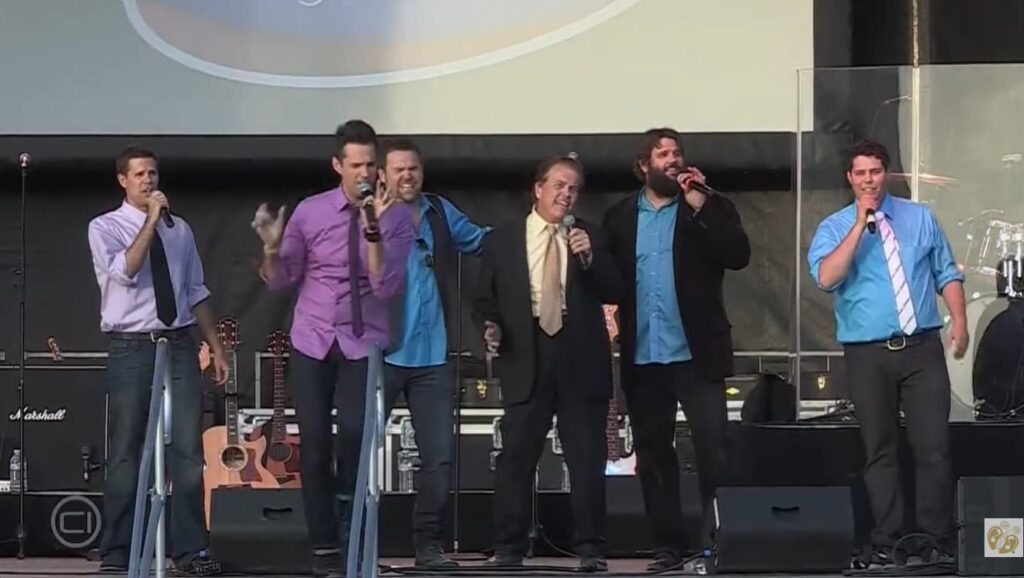
On June 16, 2012, in West Jordan, Utah, something deeply rooted in American musical heritage unfolded in a way that felt less like a concert and more like a gentle passing of a torch. The second generation of The Osmonds, often referred to as Osmonds 2nd G, took the stage alongside their father, not for chart positions or commercial acclaim, but for something far more enduring: a benefit performance for the Olive Osmond Hearing Fund. It was an evening shaped not by spectacle, but by memory, gratitude, and a quiet sense of continuity.
Unlike the original rise of The Osmonds in the late 1960s and early 1970s, which brought them chart success with hits like One Bad Apple reaching No. 1 on the Billboard Hot 100 in 1971, this 2012 performance carried no intention of climbing charts. And yet, in a way that only time can allow, it held a different kind of significance. The absence of chart ambition did not diminish its weight; rather, it amplified the sincerity behind every note sung that evening.
The story behind this performance begins long before 2012, rooted in the life of Olive Osmond, the matriarch whose hearing challenges shaped the family’s early awareness of music in a profoundly unique way. Her condition became both a hardship and an inspiration. It is no coincidence that the Osmond children developed such a strong sense of harmony, timing, and emotional connection to music. They learned to feel it, to understand it beyond sound. The Olive Osmond Hearing Fund was established to help others facing similar struggles, turning a personal family story into a broader mission of compassion.
By 2012, the original members of The Osmonds had long since moved beyond their peak commercial years. Their fame, once marked by screaming audiences and television appearances, had settled into something quieter. But music, as it often does, found a way to remain. It lived on not just in recordings, but in their children. The second generation did not merely inherit songs; they inherited a sensibility, a way of approaching music as something deeply tied to family and identity.
That night in West Jordan, the presence of both generations on stage created a layered emotional experience. For those familiar with the Osmond legacy, it was impossible not to reflect on the distance between past and present. The bright, polished pop of the early 70s had softened into something more reflective. Voices carried not just melody, but years of lived experience. And when the younger Osmonds sang, there was a subtle echo of what came before, not as imitation, but as continuation.
There is something particularly moving about performances that are not driven by the demands of the industry. Without the pressure of charts or sales, the music breathes differently. It becomes more personal, more deliberate. In this case, every song performed that evening seemed to carry an unspoken acknowledgment of where it all began. The benefit itself was not just about raising funds, but about honoring a legacy that had always been about more than music alone.
The meaning behind this event, then, is not found in statistics or rankings, but in its quiet symbolism. It speaks to the endurance of family bonds, the way music can serve as both memory and inheritance. It reminds us that the true measure of a musical legacy is not how long it stays on the charts, but how deeply it resonates across generations.
Looking back, the June 16, 2012 performance stands as a gentle reminder of what remains when the spotlight fades. The harmonies may be softer, the audience smaller, but the essence is unchanged. Music, in its purest form, continues to connect, to heal, and to carry stories forward. And in that small corner of Utah, on that particular evening, the legacy of The Osmonds was not just remembered. It was quietly, beautifully lived again.