
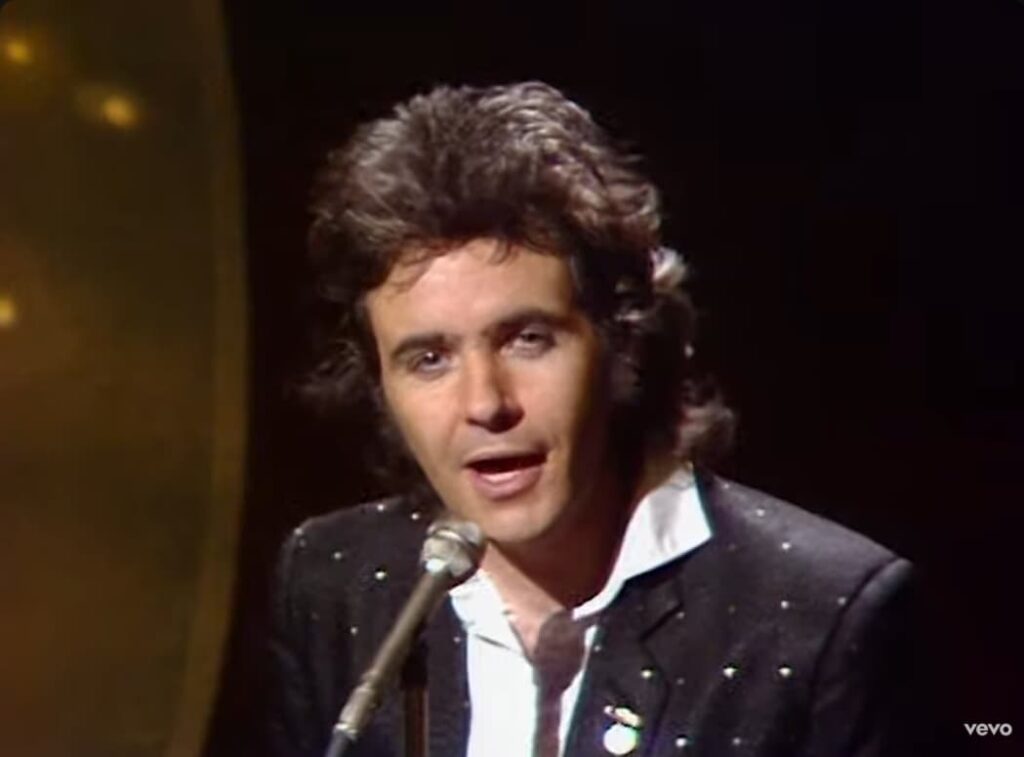
A fleeting rush of youth and longing, where love feels larger than time itself
Released in 1979, “O What A Feeling” by David Essex arrived at a moment when Essex was no longer the fresh-faced idol of the early 1970s, but something more complex a performer shaped by experience, by distance from the initial blaze of fame, and by a growing awareness of how quickly moments pass. The single did not achieve the towering chart dominance of his earlier hits like Gonna Make You a Star (UK No. 1 in 1974), yet it still found its place within the UK Singles Chart, reaching a modest but respectable position around the Top 40. And perhaps that is precisely where its meaning settles not as a triumphant return, but as a quiet continuation.
By the time David Essex recorded “O What A Feeling,” the musical landscape had shifted. Punk had already disrupted the polished pop world he once thrived in, and disco was beginning to dominate dance floors. Yet Essex did not chase those trends directly. Instead, he leaned into something more personal, crafting a song that feels suspended between eras, carrying traces of glam pop warmth while hinting at a more reflective, almost wistful sensibility.
There is, from the very first line, a sense that the song is not simply about joy, but about the awareness of joy. That distinction matters. Many songs celebrate feeling; “O What A Feeling” quietly questions it, holds it up to the light, as if asking how long it will last. The arrangement supports this emotional duality bright, melodic, almost deceptively light on the surface, yet beneath it runs a current of hesitation, as though the singer already knows that what he is describing cannot be held forever.
The story behind the song is less about a single dramatic event and more about a phase in Essex’s life. After years of intense public attention following his success in film (That’ll Be the Day, Stardust) and music, there came an inevitable slowing down. Fame, once immediate and overwhelming, became something more distant, more manageable. And in that quieter space, songs like “O What A Feeling” began to emerge not declarations, but reflections.
It is worth remembering that Essex was always more than a pop singer. He was an observer, someone who understood performance not just as entertainment, but as storytelling. In this track, he does not overreach. He does not attempt to reclaim the past. Instead, he allows the song to exist in a smaller, more intimate frame. That restraint gives it its power.
Listening now, decades removed from its release, the song carries an added layer of meaning. What once may have sounded like a simple expression of love or excitement begins to feel like a memory already fading even as it is being lived. The phrase “what a feeling” becomes almost bittersweet, as if it is spoken from a place that already knows the ending.
There is also something deeply human in the way the song resists grandiosity. It does not build toward a dramatic climax. It does not try to overwhelm. Instead, it lingers. It stays close to the ground, close to ordinary emotion the kind that does not announce itself loudly, but stays with you long after louder songs have faded.
In the broader context of David Essex’s career, “O What A Feeling” may not stand as a defining hit in terms of chart performance, but it reveals something equally important. It shows an artist learning to step away from the urgency of youth, beginning to understand that music does not always need to chase the moment. Sometimes, it simply needs to capture it, gently, before it slips away.
And perhaps that is why the song continues to resonate in its own quiet way. Not because it dominated the airwaves, but because it speaks to something more enduring the fragile, fleeting nature of feeling itself. A reminder that even at its brightest, emotion carries a shadow of impermanence. And in that awareness, there is a kind of beauty that no chart position could ever fully measure.