
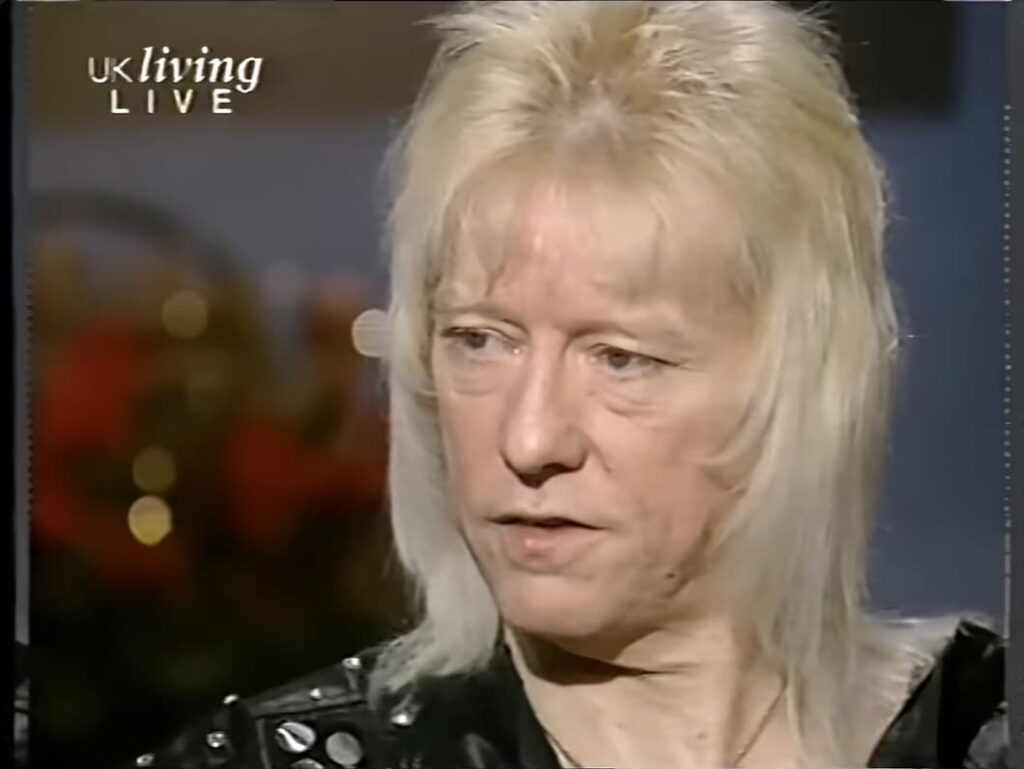
A reflective glimpse into the fragile brilliance and quiet struggles behind Brian Connolly’s voice with The Sweet
When speaking of Brian Connolly, the unmistakable frontman of The Sweet, one does not merely recall a singer, but rather a voice that defined an era of glitter, rebellion, and melodic craftsmanship in the early 1970s. The 1995 UK Living interview stands today not as a chart-topping milestone—unlike the band’s towering hits such as “Block Buster!” (UK No.1, 1973) or “Ballroom Blitz” (UK Top 5, 1973)—but as something far more enduring: a deeply human document. It is a rare, unguarded conversation that offers insight into the man behind the flamboyant image, long after the spotlight had dimmed.
By the time this interview aired, The Sweet had long since passed their commercial peak, and Connolly himself had endured years of personal and professional hardship. Yet, listening closely to his words, one senses not bitterness, but a quiet resignation—an acceptance shaped by time. His voice, once soaring over stomping glam rock anthems, now carried a different kind of weight: reflective, measured, and tinged with the wisdom of experience.
The story behind The Sweet’s meteoric rise is well known. Formed in the late 1960s, the band found explosive success in the early ’70s under the songwriting powerhouse of Nicky Chinn and Mike Chapman. Their sound—equal parts hard rock aggression and pop sensibility—captured a generation hungry for spectacle and escapism. And at the center of it all stood Brian Connolly, whose distinctive vocal tone gave emotional depth to songs that might otherwise have been dismissed as mere glam theatrics.
But fame, as Connolly candidly reflects in the interview, came at a cost. The relentless touring, the pressures of maintaining success, and the internal tensions within the band gradually took their toll. Perhaps most tragic was the physical assault Connolly suffered in 1974, which permanently damaged his vocal cords. It was a turning point—one that not only altered his career trajectory but also reshaped his identity as an artist.
What makes the 1995 interview so compelling is its honesty. There is no attempt to rewrite history or embellish past glories. Instead, Connolly speaks with a quiet sincerity about the highs and lows—the exhilaration of performing to thousands, and the loneliness that often followed when the lights went down. He acknowledges the fractures within The Sweet, the struggles with health, and the gradual fading from mainstream relevance.
And yet, beneath it all, there remains a profound sense of gratitude. Connolly reflects on the joy of creating music that resonated with so many, on the enduring connection between artist and audience. In a way, the interview itself becomes a kind of coda—a final verse that brings closure to a life lived in rhythm and rhyme.
There is also something deeply universal in his story. It speaks to the passage of time, to the inevitable shift from youthful ambition to reflective maturity. The glitter and platform boots of glam rock may belong to another era, but the emotions—hope, regret, pride—remain timeless.
In revisiting this interview today, one cannot help but feel a sense of quiet reverence. Brian Connolly is no longer just the charismatic frontman of The Sweet; he becomes a symbol of an era’s fleeting brilliance and the resilience required to endure beyond it. His voice, though changed, still echoes—not through chart positions or radio play, but through memory, through feeling, through the enduring legacy of songs that once defined a generation.
And perhaps that is the true meaning behind it all: that music, like life, is not measured solely by its peak moments, but by the stories it leaves behind.