
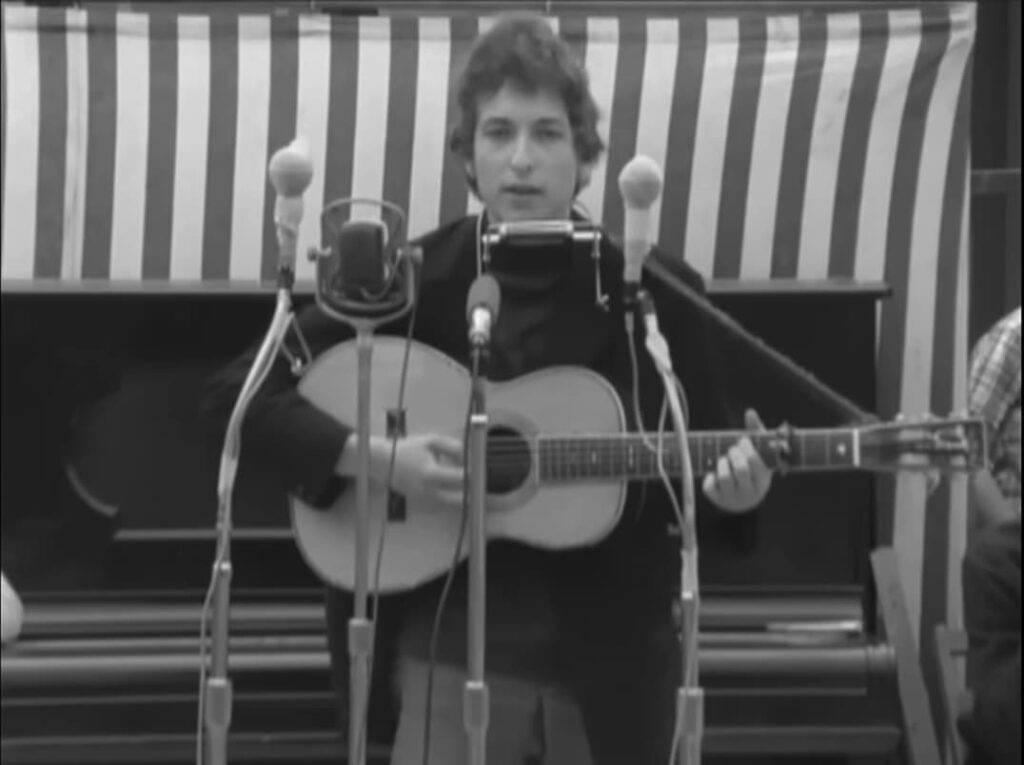
A poetic awakening that redefined folk music, “Mr. Tambourine Man” stands as a timeless bridge between innocence and restless searching in the voice of Bob Dylan.
There are moments in music history when a single performance feels less like entertainment and more like a quiet turning point. “Mr. Tambourine Man”, performed live by Bob Dylan at the Newport Folk Festival in 1964, is one such moment—an intimate yet profound expression of an artist standing on the threshold of transformation. Long before the electric controversy of Newport 1965, this earlier appearance captured Dylan in a phase of poetic clarity, where his songwriting began to transcend the boundaries of traditional folk music.
Written in early 1964 and later released on the album Bringing It All Back Home in 1965, “Mr. Tambourine Man” did not initially chart as a single for Dylan himself. However, its cultural impact was immense. It was The Byrds’ electrified cover in 1965 that soared to No. 1 on the Billboard Hot 100 and the UK Singles Chart, introducing the song to a wider audience and effectively helping to birth the folk-rock movement. Yet, to understand the song’s soul, one must return to Dylan’s own performances—especially those early, stripped-down renditions like Newport 1964.
On that stage, with little more than his guitar and harmonica, Bob Dylan delivered the song not as a polished product, but as a living, breathing piece of poetry. His voice—nasal, unrefined, yet unmistakably sincere—carried lines that seemed to drift between dream and reality: “Take me on a trip upon your magic swirling ship…” It was not merely a request, but an invitation—to escape, to imagine, to surrender to something beyond the ordinary.
The origins of “Mr. Tambourine Man” have long been the subject of interpretation and quiet speculation. Some have suggested that the “Tambourine Man” was inspired by musician Bruce Langhorne, who played a large Turkish frame drum during sessions with Dylan. Others have read the song as a veiled reflection on fatigue, artistic longing, or even altered states of consciousness. Dylan himself, characteristically elusive, never confined the song to a single meaning. And perhaps that ambiguity is precisely its strength.
What is undeniable, however, is the song’s lyrical sophistication. At a time when popular music often relied on simple themes of love and heartbreak, Dylan offered something altogether different: a stream of consciousness that felt literary, almost surreal. The imagery—“the haunted, frightened trees,” “the smoke rings of my mind”—evokes a landscape that is as internal as it is external. Listening to it, one senses a young artist grappling with the weight of awareness, seeking refuge not in answers, but in the act of wandering itself.
The Newport Folk Festival 1964 performance carries a particular kind of quiet intimacy. There is no urgency, no need to impress. Instead, there is a sense of stillness, as though both performer and audience are suspended in a shared moment of contemplation. It is a far cry from the tension that would define Dylan’s Newport appearance the following year. Here, he is still very much within the folk tradition—yet already reaching beyond it. In retrospect, “Mr. Tambourine Man” can be seen as a gentle farewell to one chapter and a subtle prelude to another. It retains the acoustic purity of folk music, but its spirit is unmistakably forward-looking. It suggests that music could be more than storytelling—it could be introspection, abstraction, even a form of quiet rebellion against convention.
For those who return to this performance today, there is an almost meditative quality to it. It does not demand attention; it invites reflection. The years may have softened its edges, but they have also deepened its resonance. One listens not just to the notes, but to the spaces between them—the pauses, the breaths, the unspoken thoughts. And in those spaces, Bob Dylan’s “Mr. Tambourine Man” continues to live—not as a relic of the past, but as a timeless companion for anyone who has ever felt the pull of something just beyond reach, something that cannot quite be named, but is always worth following.
 Oldies Songs