
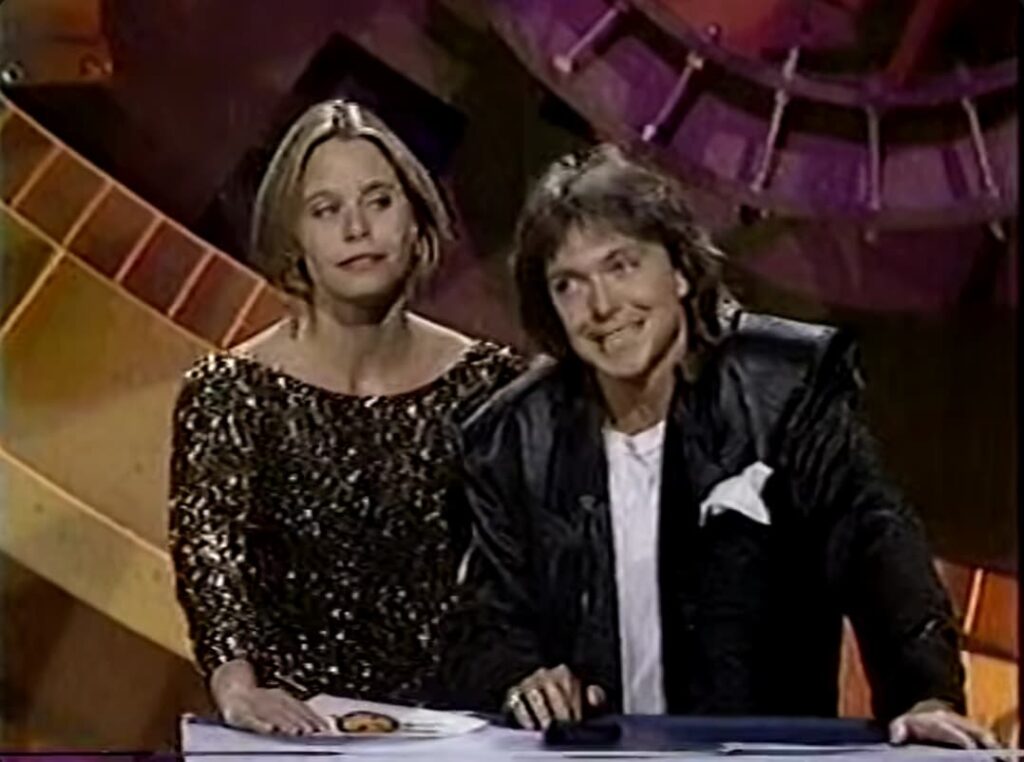
A fleeting reunion on a modern stage, where yesterday’s innocence meets a new era and quietly reminds us what time never truly erases
On September 6, 1990, during the broadcast of the MTV Video Music Awards, a brief yet deeply symbolic moment unfolded when David Cassidy and Susan Dey reunited to present the MTV Viewer’s Choice Award. There was no chart position attached to this appearance, no Billboard ranking to quantify its importance. And yet, for those who remembered the early 1970s, this moment carried a resonance that no chart statistic could ever fully capture. It was not about competition or commercial success. It was about memory, recognition, and the quiet passage of time.
To understand why this reunion mattered, one must return to the phenomenon that first brought these two names together. As central figures in The Partridge Family, David Cassidy and Susan Dey became part of a cultural fabric that extended far beyond television. The music from the show, particularly “I Think I Love You”, reached No. 1 on the Billboard Hot 100 in 1970, transforming a fictional band into a real musical force. That success was not accidental. It reflected a moment when pop music carried a certain warmth, a kind of innocence that felt both immediate and enduring.
By 1990, however, the world surrounding music had changed dramatically. The MTV Video Music Awards, established in 1984, represented a new visual era where image, style, and rapid cultural shifts defined success. Against this backdrop, the appearance of Cassidy and Dey felt almost like a bridge between two different understandings of fame. On one side stood the carefully crafted, television born stardom of the early 1970s. On the other, the fast moving, image driven landscape of MTV.
What made this moment particularly affecting was its restraint. There was no attempt to recreate the past, no overt nostalgia presented for applause. Instead, there was a quiet acknowledgment. Two individuals who had once shared a cultural peak stood together again, not as the characters they once portrayed, but as people shaped by the years that followed. In that brief exchange, one could sense both familiarity and distance, as if time itself had become an unspoken third presence on stage.
For David Cassidy, this period marked a complex phase in his life and career. He had long stepped away from the overwhelming intensity of teen idol fame, seeking instead to redefine himself as a musician and performer on his own terms. Yet, moments like this reunion inevitably drew attention back to the image that had first made him known. There is a certain tension in that return, a delicate balance between honoring the past and not being confined by it.
Susan Dey, meanwhile, had moved in a different direction, building a respected acting career that gradually distanced her from the musical identity of her earlier years. Her presence at the MTV Video Music Awards alongside Cassidy did not feel like a step backward. Rather, it felt like a brief pause, a moment of recognition for something that had once been shared, without any need to relive it fully.
The significance of this appearance is further deepened when viewed through the lens of preservation. The recording of this event, along with many other rare television moments, has been carefully maintained and shared by archival efforts such as the BetaGems collection, drawn from hundreds of Sony Super Beta recordings made between the early 1980s and the 1990s. These recordings, often captured from regional broadcasts in places like San Diego, now serve as fragile windows into a time when music television was still evolving, and when such appearances could easily have been lost to history. In that sense, this reunion is more than a nostalgic curiosity. It is a preserved fragment of cultural memory, one that reminds us how easily moments can fade if they are not cared for. The fact that it survives today allows us to see not just what happened, but how it felt. The slight pause before a line is spoken, the subtle exchange of glances, the understated way in which two familiar figures acknowledge each other once more.
There is no grand conclusion to draw from this moment, no dramatic lesson to impose upon it. Its meaning lies precisely in its simplicity. It reminds us that music, and the lives connected to it, do not exist only in the height of success or the clarity of charts. They exist in the spaces between, in the brief reunions, in the quiet acknowledgments, in the understanding that time changes everything, yet never fully erases what once was. And perhaps that is why this small, easily overlooked segment from the 1990 MTV Video Music Awards continues to linger. Not because it was meant to be historic, but because it became so in the most unassuming way possible. A moment remembered not for what it achieved, but for what it gently brought back into view.