
A quiet confession of fear and dignity, where a man senses he is being pushed aside yet refuses to disappear without a voice
There are songs that arrive like a storm, and there are songs that settle slowly, like a truth you were not ready to hear. “Somebody Wants Me Out Of The Way” by George Jones belongs firmly to the latter. Released in 1986 as part of the album “Wine Colored Roses”, the song climbed to No. 3 on the Billboard Hot Country Singles chart, a strong showing in a decade that was not always kind to traditional country voices. Yet chart positions only tell part of the story. What mattered more was how deeply the song resonated with those who understood what it meant to feel quietly replaced, gently erased from a life that once felt secure.
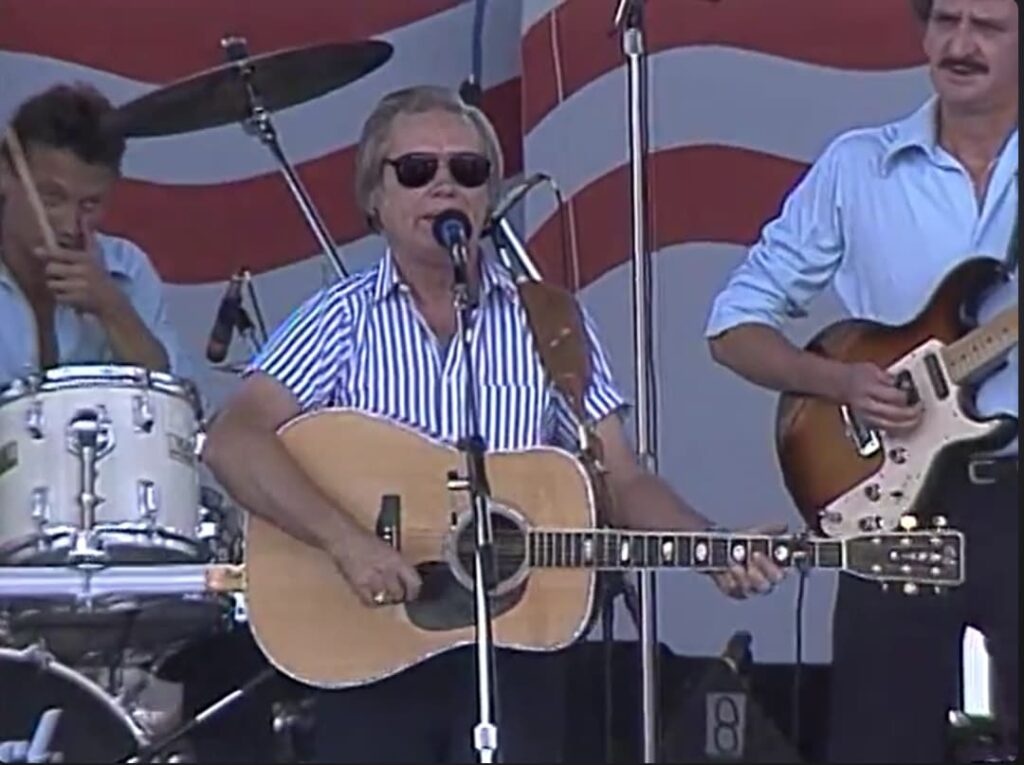
By the mid 1980s, George Jones was no longer just a singer. He was a survivor, carrying with him the weight of personal battles, public scrutiny, and a voice that had aged into something even more fragile and honest. When he stepped onto the stage at Farm Aid 1986 to perform this song, it was not merely a live rendition. It felt like a man standing still for a moment, looking back at everything he had endured, and choosing to tell the truth one more time.
The song itself was written by Jim McBride and Stewart Harris, two craftsmen who understood how to wrap complex emotions in simple, conversational language. At first glance, the lyrics seem straightforward: a man suspects that someone close to him is trying to push him out of the picture. But beneath that surface lies something far more unsettling. It is not anger that defines the song. It is not even heartbreak in the traditional sense. It is the slow realization of being unwanted, paired with the quiet dignity of acknowledging it without raising your voice.
George Jones delivers each line with a restraint that becomes the song’s greatest strength. There is no need for dramatic flourishes. His voice carries a slight weariness, a kind of emotional fatigue that cannot be imitated. You hear a man who has seen relationships fade, who understands that sometimes love does not end with a confrontation, but with silence, distance, and small, unspoken shifts. That emotional nuance is what allowed the song to stand out in 1986, a time when country music was balancing between polished production and its more traditional roots.
What makes the Farm Aid 1986 performance particularly memorable is the context surrounding it. Farm Aid was built on themes of struggle, survival, and the quiet resilience of ordinary people. In that setting, “Somebody Wants Me Out Of The Way” took on an added layer of meaning. It no longer felt like just a personal story. It echoed a broader sense of displacement, of people feeling pushed aside by forces they could not control. Jones did not need to explain any of this. He simply stood there and sang, and somehow, that was enough.
There is also a subtle irony in the song’s success. At a time when newer voices were beginning to dominate the charts, George Jones delivered a song about being pushed aside, and it became one of his biggest hits of the decade. It was as if the audience itself refused to let him fade quietly into the background. They heard the truth in his voice, and they responded.
Listening to this song now, decades later, one is struck not by its age, but by its timelessness. The fear of being replaced, the quiet suspicion that one’s place in someone’s life is slipping away, these are emotions that do not belong to any single era. They remain, unchanged, waiting in the background of human experience.
And perhaps that is why “Somebody Wants Me Out Of The Way” endures. Not because it reached No. 3, not because it was performed at a historic concert, but because it speaks in a voice that feels real. A voice that does not demand attention, yet lingers long after the song has ended. A voice that understands something difficult, and chooses to share it anyway.