
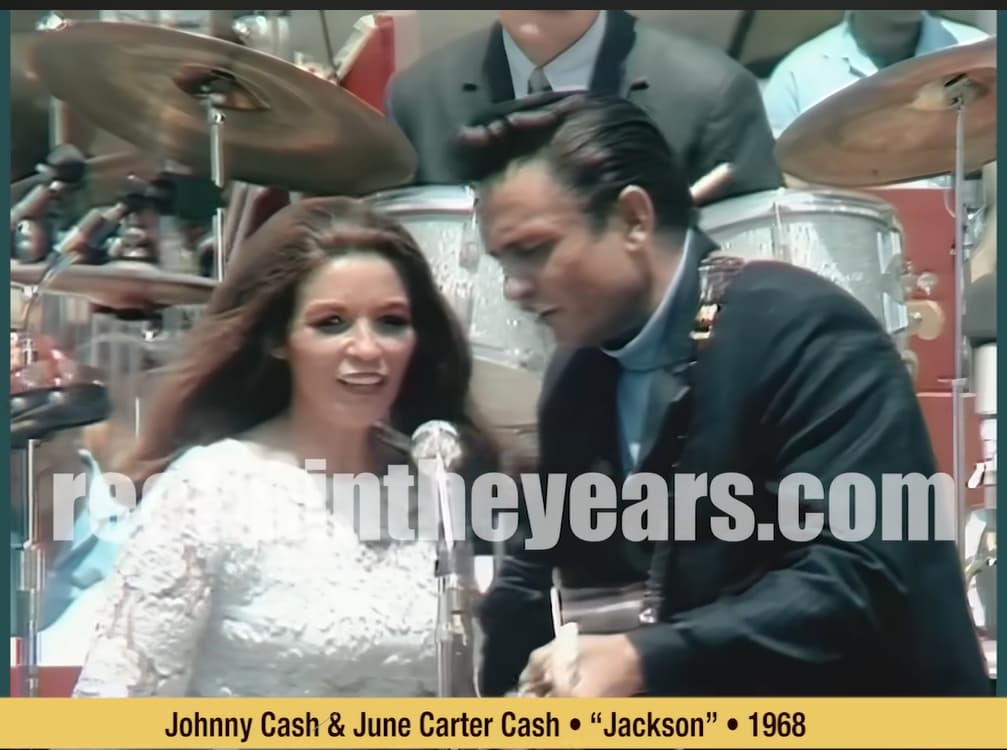
A Playful Duel of Love and Pride—Where Romance Turns into Rhythm and Wit on the Road to “Jackson”
Few duets in country music history carry the spirited charm and emotional undercurrent quite like “Jackson”, immortalized in 1968 by Johnny Cash and June Carter Cash. Released at a time when both artists were already deeply intertwined—both musically and personally—the song quickly climbed to No. 2 on the Billboard Hot Country Singles chart and reached No. 14 on the Billboard Hot 100, while also earning the Grammy Award for Best Country & Western Performance by a Duo or Group in 1968. These numbers, while impressive, only begin to hint at the song’s enduring cultural resonance.
Originally written by Billy Edd Wheeler and Jerry Leiber, “Jackson” had been recorded by other artists before, but it was the electrifying chemistry between Cash and Carter that transformed it into something unforgettable. By the time they recorded it for the album “Carryin’ On with Johnny Cash and June Carter”, their relationship was already evolving into one of the most iconic partnerships in music. That tension—equal parts affection, defiance, and playful rivalry—became the very heartbeat of the song.
At its surface, “Jackson” tells a simple story: a couple, worn down by routine and disappointment, threatens to escape to the city of Jackson in search of excitement and validation. Yet beneath that lively back-and-forth lies a deeper narrative about love tested by time. The lyrics are sharp, almost teasing, as each voice challenges the other—Cash’s steady, grounded baritone countered by Carter’s spirited, knowing replies. It is not a breakup song, nor is it a reconciliation. Instead, it exists in that fragile space where love persists, even when pride and frustration take center stage.
Musically, the track is driven by a brisk, almost marching rhythm—buoyant, confident, and impossible to ignore. The arrangement is deceptively simple, allowing the vocal interplay to shine. Every line feels like a conversation overheard, every pause filled with unspoken history. This is where the genius of the performance lies: it feels lived-in, authentic, as though the story being told is not merely fictional, but drawn from real emotion.
Listening to “Jackson” now, decades removed from its release, one cannot help but feel a sense of nostalgia—not just for the era, but for the kind of storytelling that defined it. There is a rawness here, an honesty that resists polish. The imperfections, the laughter tucked between lines, the subtle shifts in tone—all of it contributes to a sense of intimacy that is increasingly rare. It reminds us of a time when songs were not just performed, but inhabited.
The success of “Jackson” also marked a pivotal moment in the careers of both artists. For Johnny Cash, it reinforced his ability to bridge traditional country with broader audiences, while for June Carter Cash, it solidified her presence not just as a collaborator, but as an equal partner in both music and life. Their eventual marriage later in 1968 only deepened the connection that listeners had already sensed in the song.
But perhaps the most lasting legacy of “Jackson” lies in its spirit. It is a song that refuses to settle into a single emotion. It is playful yet pointed, humorous yet revealing. It captures the complexities of a relationship not in grand gestures, but in small, telling exchanges. And in doing so, it becomes something more than a hit record—it becomes a snapshot of human connection, with all its contradictions and enduring warmth.
As the final notes fade, one is left not with a sense of resolution, but with a lingering echo—a reminder that love, like music, is rarely simple. It is a dance of voices, sometimes in harmony, sometimes in opposition, but always moving forward. And in “Jackson,” that dance is captured with a vitality that continues to resonate, long after the last chord has been played.