
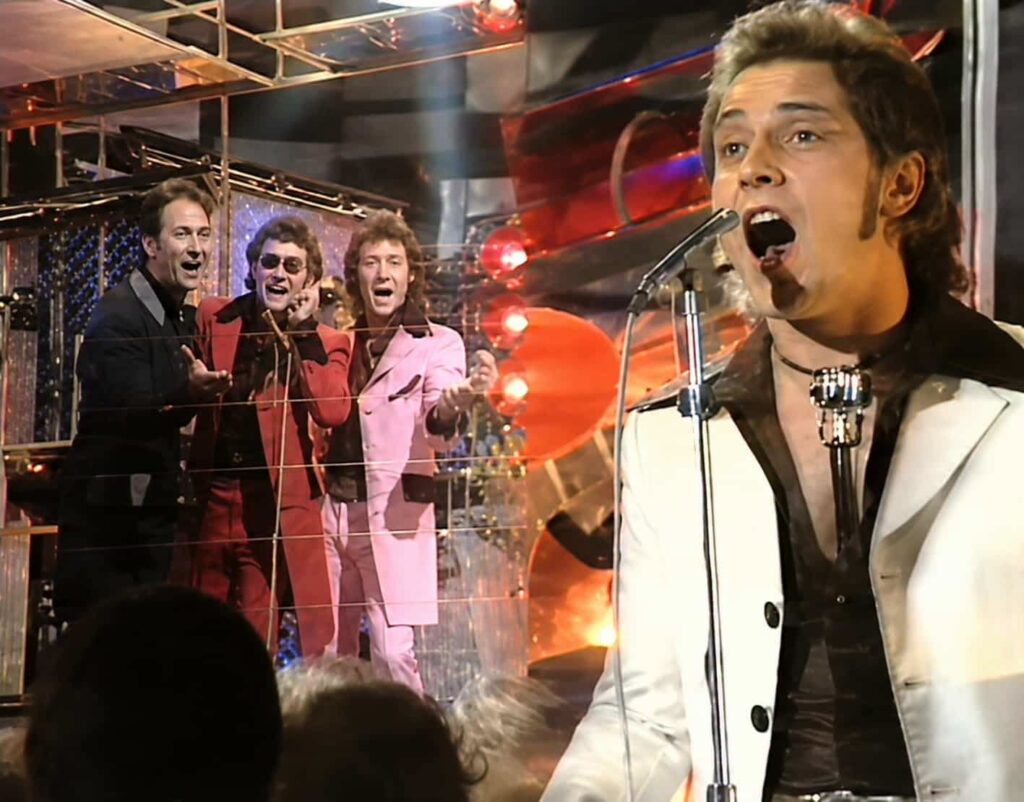
A bittersweet glance through the window of young love—where innocence meets longing in a fleeting, sunlit memory
When Showaddywaddy released “Windows” in 1977, they were already firmly established as one of Britain’s most recognizable revivalist rock & roll groups, carrying the spirit of the 1950s into a decade otherwise dominated by glam rock, disco, and the early stirrings of punk. Known for their polished harmonies and nostalgic flair, the band had built a strong chart presence with hits like “Under the Moon of Love” (UK No. 1, 1976) and “Three Steps to Heaven” (UK No. 2, 1975). Yet “Windows”, which reached No. 7 on the UK Singles Chart, revealed a softer, more reflective side of the group—one that often went overlooked beneath their upbeat exterior.
Included on the album Showaddywaddy (1976 UK release cycle, with subsequent compilations featuring the track), “Windows” stands apart not through grand musical ambition, but through its quiet emotional resonance. At its core, the song is deceptively simple: a young man watching the girl he loves from a distance, separated not by miles, but by something far more intangible—hesitation, circumstance, or perhaps the quiet fear of stepping beyond the safety of dreams.
What gives “Windows” its enduring charm is the way it captures a very specific emotional moment: that delicate space between longing and action. The image of a window becomes both literal and symbolic—a frame through which love is observed, but not yet lived. There is something deeply human in that restraint. Not every love story unfolds boldly; some remain suspended in glances, in imagined conversations, in the silent hope that tomorrow might offer courage that today cannot.
Musically, Showaddywaddy approached the song with characteristic elegance. The arrangement leans on gentle guitar lines, warm backing vocals, and a rhythm that never rushes. It allows the listener to settle into the mood, to feel the passage of time as the protagonist lingers in his quiet vigil. Unlike their more energetic hits, “Windows” does not seek to entertain in the conventional sense—it invites reflection.
The vocal delivery is particularly striking. There is a softness, an almost conversational tone, that gives the impression of someone speaking more to themselves than to an audience. This intimacy is crucial. It transforms the song from a simple narrative into something more personal, more introspective. One can almost picture the scene unfolding in real time: a quiet street, evening light fading, and a figure standing just out of reach of what he desires most.
Behind the song lies the broader context of Showaddywaddy’s artistic identity. At a time when musical trends were shifting rapidly, they chose instead to look backward—not out of resistance, but out of reverence. Their music was never about innovation for its own sake; it was about preserving a feeling, a sense of romance and melody that might otherwise have been lost. “Windows” exemplifies this mission perfectly. It feels timeless, not because it avoids its era, but because it embraces emotions that transcend it.
Listening to “Windows” now, there is an undeniable sense of nostalgia—but not merely for a specific time or place. It is nostalgia for a way of feeling, for a kind of emotional patience that seems increasingly rare. The song reminds us of moments when love was not immediately declared, when distance—however small—could feel vast, and when the simplest gesture carried profound meaning.
There is also a quiet poignancy in its unresolved nature. The song does not offer closure. We are left with the image of that window, still standing between the observer and the observed. And perhaps that is precisely the point. Not all stories are meant to conclude; some are meant to linger, to remain suspended in memory as gentle reminders of who we once were. In the end, “Windows” is not just a song—it is a mood, a moment, a reflection caught in glass. And like all such reflections, it is fleeting, fragile, and all the more beautiful because of it.