
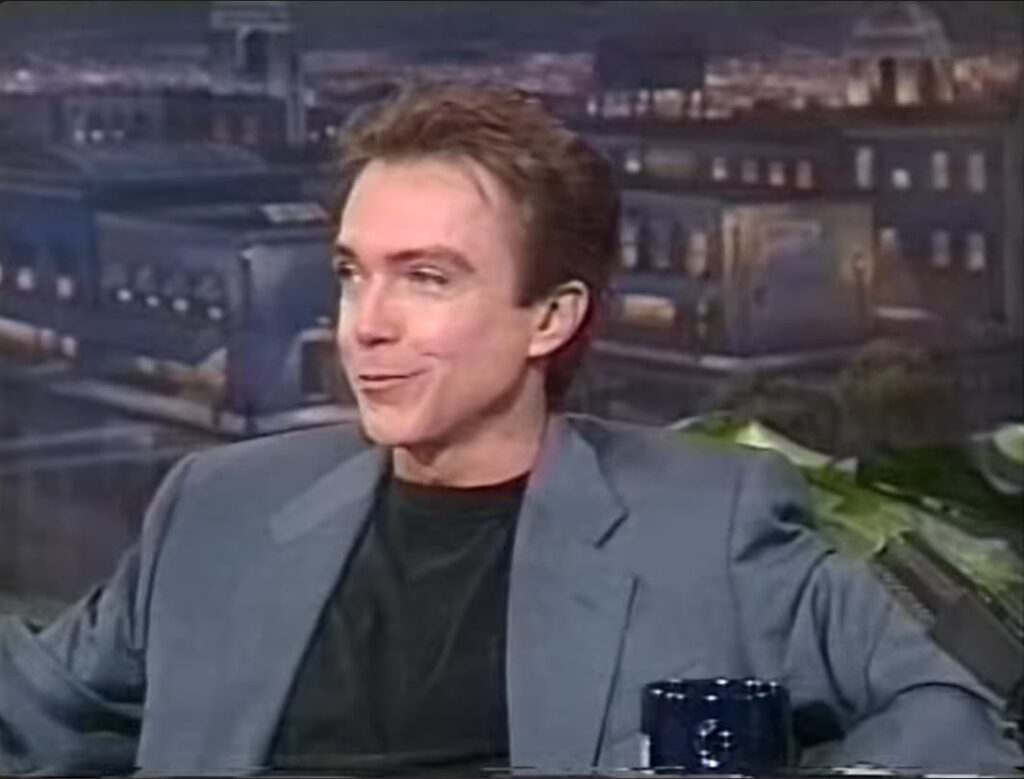
A fleeting return to the spotlight, where David Cassidy revisits memory, youth, and the quiet passage of time under the warm lights of late-night television
There are moments in music and television where time seems to fold in on itself, where the distance between past and present narrows just enough for us to feel something we thought we had long outgrown. David Cassidy’s appearance on The Tonight Show with Jay Leno was not tied to a chart-topping single or a newly released hit climbing the Billboard rankings, but it carried a weight that no number beside a title could ever fully capture. Still, to understand the significance of that moment, one must return briefly to the era when Cassidy’s voice did dominate the charts, when songs like “I Think I Love You” reached No. 1 on the Billboard Hot 100 in 1970, and when his presence as both a television star and recording artist shaped a generation’s idea of youthful longing.
By the time he sat across from Jay Leno, the frenzy had long settled. The screaming crowds, the magazine covers, the dizzying pace of early fame had softened into something quieter, more reflective. Cassidy was no longer the teen idol chasing chart positions, but a man looking back at a life lived in full view of the public, with all its triumphs and fractures. His appearance on the show became, in many ways, an unspoken continuation of his musical narrative, a place where the meaning behind the songs could finally breathe without the pressure of commercial success.
There is something deeply human in that transition. The songs that once soared to the top of the charts often carried a simplicity that belied their emotional truth. They spoke of first love, uncertainty, and hope, themes that seemed almost weightless at the time but have since grown heavier with memory. When Cassidy revisited these ideas in conversation and occasional performance on The Tonight Show, they no longer felt like declarations from a young man discovering the world, but reflections from someone who had already seen where those roads can lead.
Unlike a traditional song release, there is no official chart position attached to this particular moment in his career. Yet, if one were to measure its impact in terms of emotional resonance, it would stand alongside his most successful recordings. The audience, both in the studio and at home, was not simply watching a former star revisit his past. They were witnessing the quiet reconciliation between who he had been and who he had become.
The story behind Cassidy’s later appearances in such settings is inseparable from the broader arc of his life. Fame arrived early and intensely, often leaving little room for personal grounding. The pressures of maintaining that image, of continuing to meet expectations shaped by youthful success, eventually took their toll. Over the years, Cassidy spoke candidly about these struggles, and it is precisely this honesty that gave his later performances and interviews their depth. There was no longer a need to uphold the illusion of perfection. What remained was something far more compelling: authenticity.
In that sense, the “meaning” of his appearance on The Tonight Show is not confined to a single song or performance. It is about endurance, about the way music can follow a person through every stage of life, changing its shape while holding onto its core truth. The melodies may remain the same, but the voice behind them carries new weight, shaped by experience, regret, and understanding.
Watching David Cassidy in that setting, one cannot help but feel the quiet echo of those earlier days, when his voice first found its way into people’s lives. But there is also a recognition that time has added something invaluable to that voice. It is no longer just about youthful emotion. It is about reflection, about the stories that linger long after the charts have moved on, and about the enduring connection between an artist and those who have listened, remembered, and perhaps grown older alongside him.